Behavioral interview answers are scored on the follow-ups, not the story.
On this page
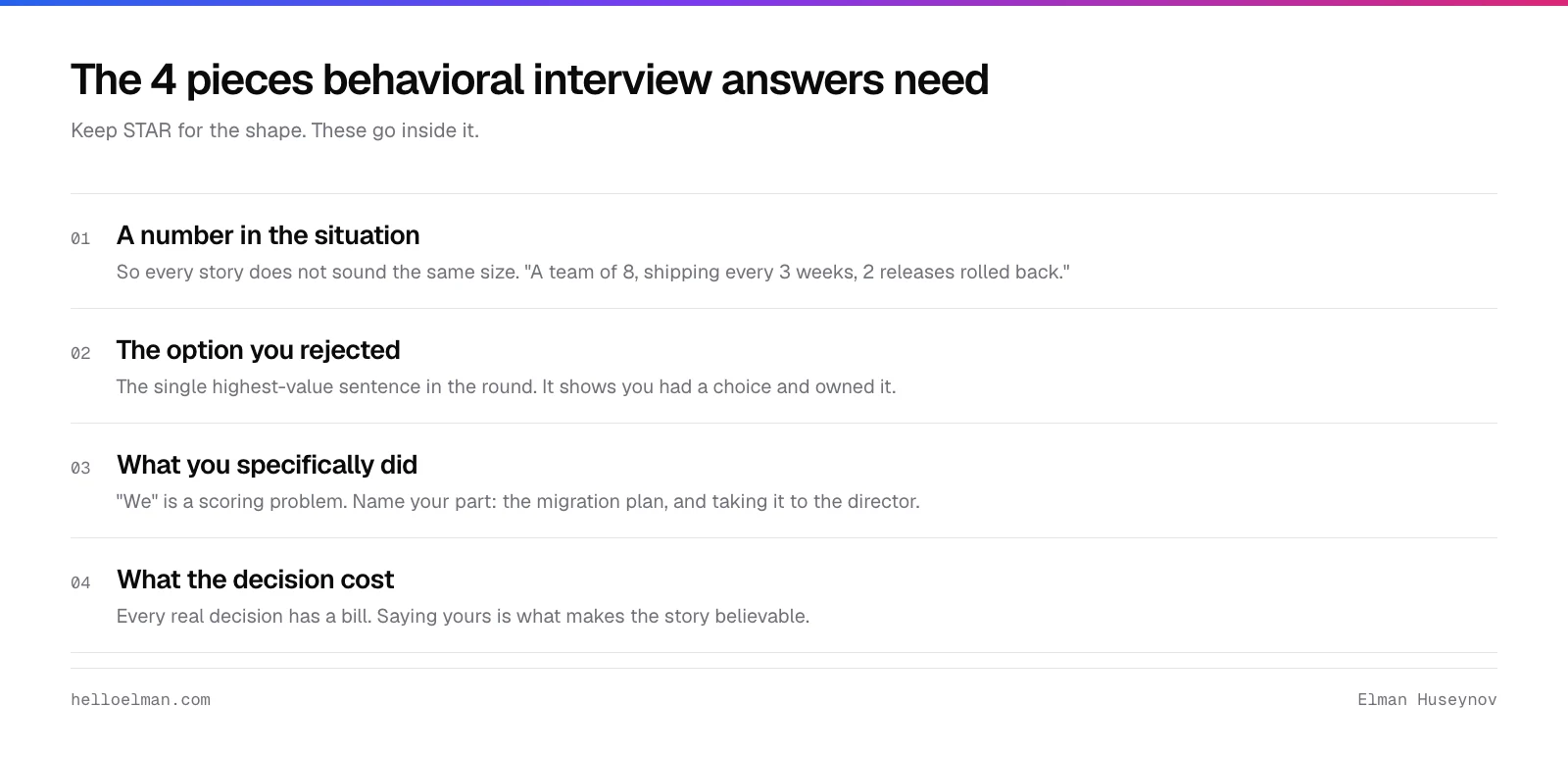
Keep STAR for the shape. Put 4 things inside it.
A number in the situation. The option you rejected. What you specifically did. What the decision cost.
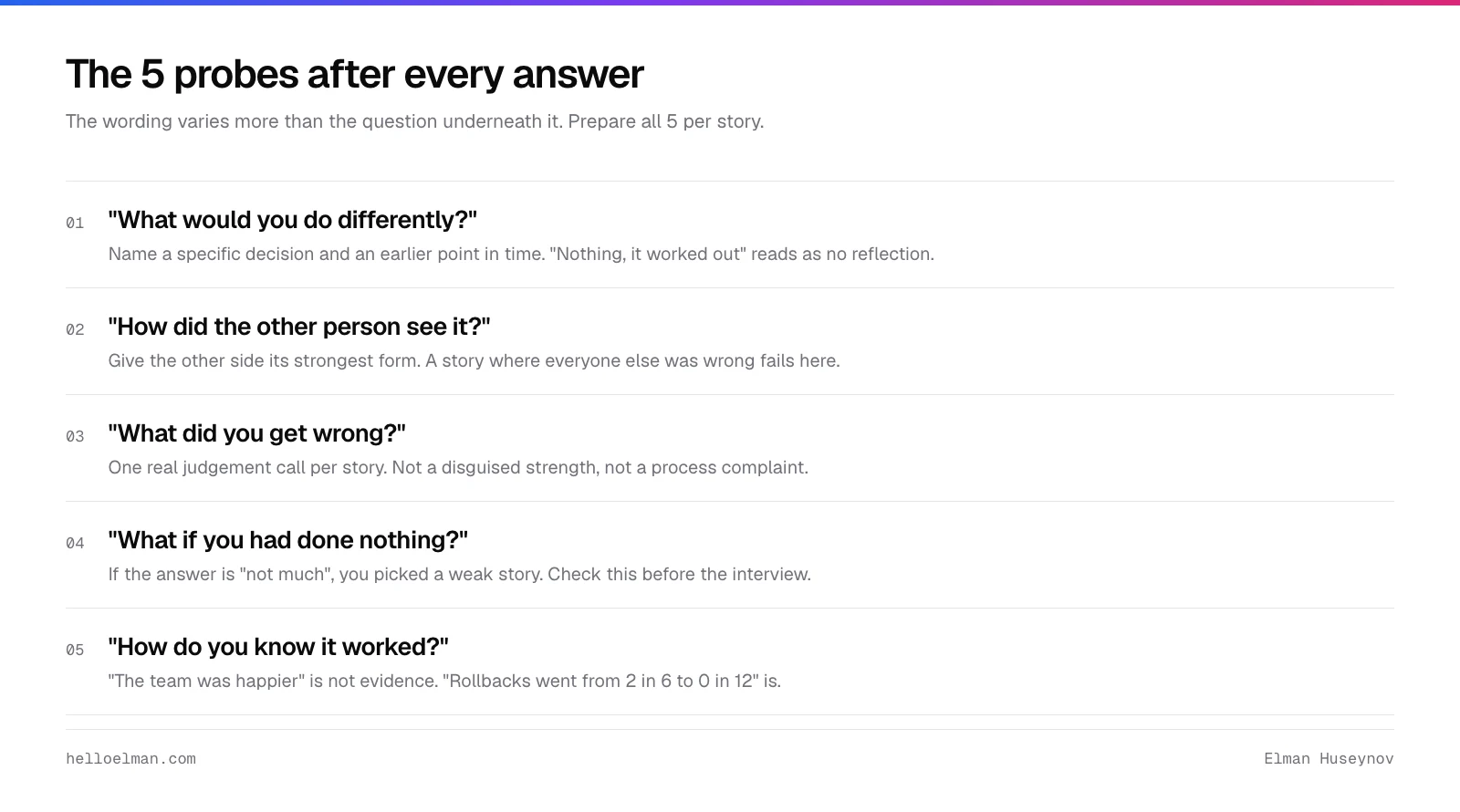
Prepare the 5 probes that come after every answer.
Your STAR answer is fine. You lose the round on question 2.
I have run 100+ interviews and written the scorecards. Here is what holds up.
Why does the STAR method run out?
Situation, task, action, result describes what happened. The round scores how you think.
Thinking becomes visible when the interviewer pushes on a decision.
STAR gets a story out in 2 minutes, in a shape the interviewer can follow. That is all it does.
Put the decisions on the surface, ready to be pushed on.
What 4 pieces do behavioral interview answers need?
A number in the situation. “The team of 8 was shipping every 3 weeks. 2 of those releases had rolled back.”
Without it, every story sounds the same size.
The option you rejected.
“We could have frozen the release and fixed the flaky tests first. I did not. The campaign date was fixed.”
The single highest-value sentence in the round. Most candidates present the decision as inevitable, which reads as luck.
What you specifically did.
“The team decided. My part was the migration plan, and taking it to the director.” We is a scoring problem.
What it cost. “It worked. We carried the flaky suite for another quarter, and I justified that in the retro.”
Every real decision has a bill. Saying yours makes the story believable.
The 5 probes
The wording varies more than the underlying question. Prepare all 5 for every story.
“What would you do differently?”
The most common, and the most failed.
“Nothing, it worked out” reads as no reflection. “I would have communicated more” fits every story ever told.
Right: a specific decision, an earlier point in time, and why you missed it.
“I would have raised it with the director in week 1 rather than week 4.”
“I wanted a proposal ready. What I needed was 10 minutes of his opinion.”
“How did the other person see it?”
Scores whether you can hold a view that is not yours. Give the other side its strongest form.
“He was right that the migration was risky. He had been on call for the last one.”
“What did you get wrong?”
One real answer per story. Not a disguised strength, not a process complaint. A judgement call you would not make again.
“What would have happened if you had done nothing?”
Scores whether the work mattered. Any story where the answer is “not much” gets cut before the interview.
“How do you know it worked?”
“The team was happier” is not evidence. “Rollbacks went from 2 in 6 releases to 0 in the next 12” is.
How long should behavioral interview answers be?
Two minutes for the story, 30 seconds per probe.
Past 3 minutes on the first answer, the interviewer has stopped scoring and is waiting.
Almost every answer that reads well at 2 minutes takes 4 to speak. Say it out loud, timed, once.
Which stories should you prepare?
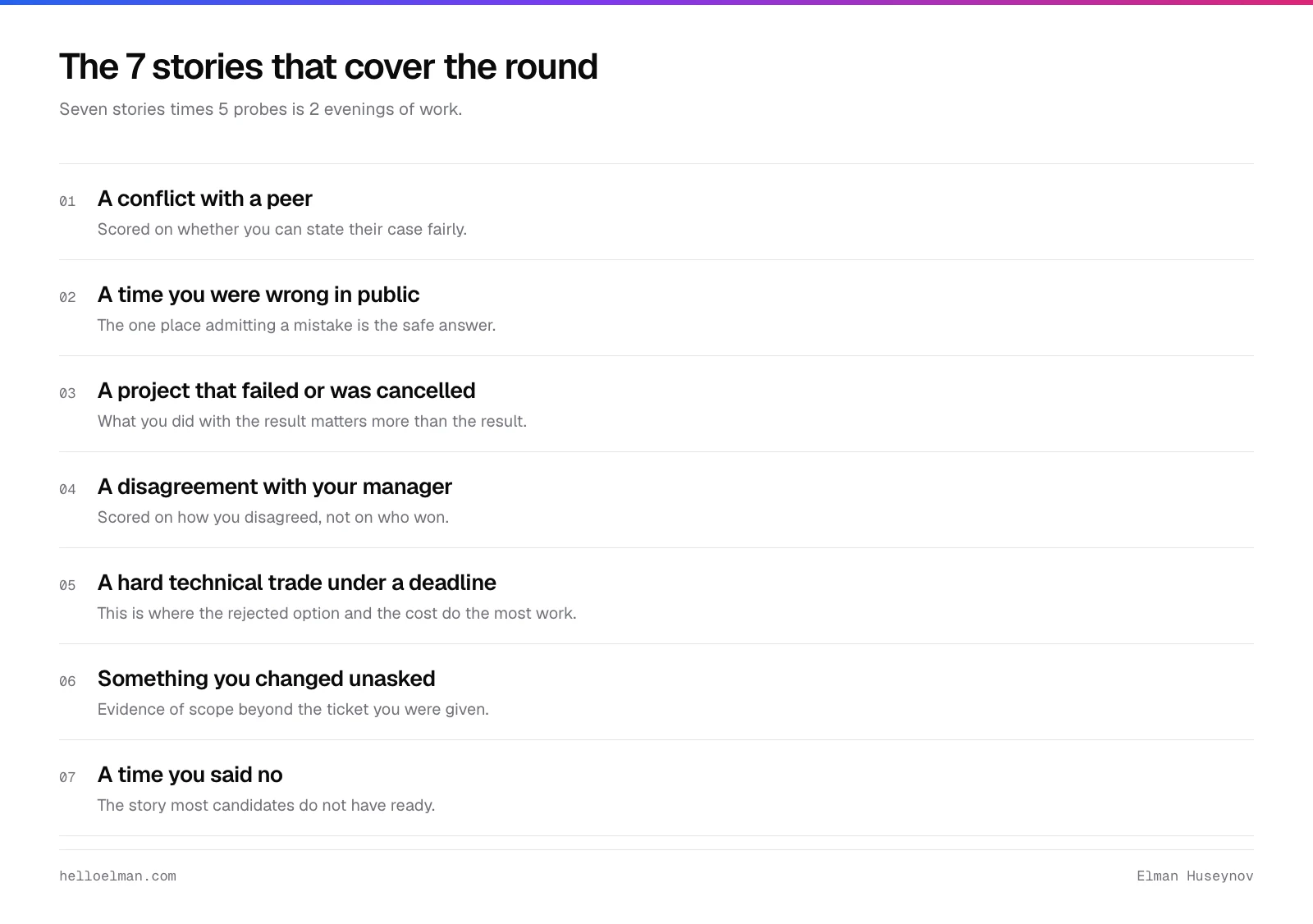
Seven cover almost every question in the round.
A conflict with a peer. A time you were wrong in public. A project that failed or was cancelled. A disagreement with your manager.
A hard technical trade under a deadline. Something you changed that nobody asked you to. A time you said no.
Each needs the number, the rejected option, your part, and the cost. Then the 5 probes.
Seven stories times 5 probes is 2 evenings.
Managers need a different set. It is in the EM interview loop.
Behavioral interview answers examples, from the scorecard
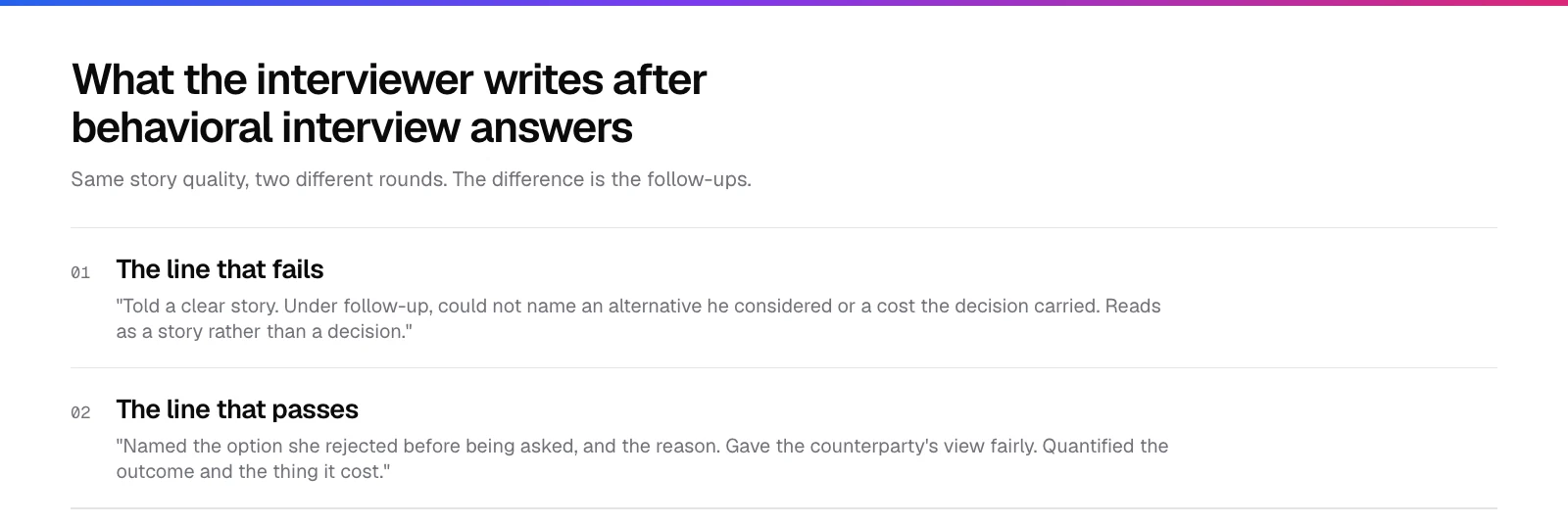
I write 2 kinds of line after this round.
“Told a clear story. Under follow-up, could not name an alternative he considered or a cost the decision carried.”
“Reads as a story rather than a decision.”
“Named the option she rejected before being asked, and the reason. Gave the counterparty’s view fairly.”
“Quantified the outcome and the cost.”
Same story quality. Different round.
Common questions
Can you use the same story for 2 different questions?
Once, and say you are doing it. Reusing a story silently reads as a thin set. The second telling always emphasises different decisions anyway. Say “I am going back to the migration example, because it also covers this”. The interviewer then notes deliberateness rather than repetition.
What if your best story is from 5 years ago?
Use it, and expect a probe about recency. Panels weigh recent evidence more heavily. So lead with something from the last 2 years. If the old story is your strongest, say what you have done since. Name what would make the same decision easier now.
Is it safe to say you got something wrong?
Admitting a mistake is the safest thing in the round. A disguised strength is not. Interviewers tell the difference instantly. The fake version costs more than the real one ever would. Have 1 genuine mistake per story, with what you would do instead.
What if you have no number for the outcome?
Say what you observed and label it as an observation. That is honest, and it scores better than a number you invented. An invented number will not survive the next probe. Before the interview, test every story against doing nothing. Cut any where the answer is “not much”.
How do you answer behavioral interview questions?
Name the situation, your decision, what you did, and what changed. STAR gets you through the first 60 seconds and then runs out. What scores is the 5 follow-up probes after it. Prepare the decisions you made and why, because that is what the interviewer writes down.
The short version
Keep STAR for the shape. Inside it: a number, the option you rejected, your part, and what it cost.
Prepare the 5 probes, not just the story. Say every answer out loud once, timed.
Cut any story where nothing bad would have happened if you had done nothing.
To have them asked at you properly, with the follow-ups, book a behavioral mock interview. Written scorecard within 24 hours.