What Interviewers Actually Write on the Scorecard
Related service: Mock interviews
An interview scorecard runs about 200 words, typed within an hour of the round.
The scorecard holds a verdict, a signal rating, and an evidence box quoting you.
The evidence box is where candidates are made and lost. Your job in the hour is to give the interviewer a quotable sentence.
On this page
You will never attend the debrief where it gets read. At some companies a hiring committee reads it instead.
I have written more than 100 of these and read more in debriefs.
Candidates prepare for the conversation and never for the write-up. The write-up is what travels.
What does an interview scorecard look like?
A coding round scorecard has 4 or 5 signals, each with an evidence box.
The form ends with a verdict: strong hire, hire, no hire or strong no hire.
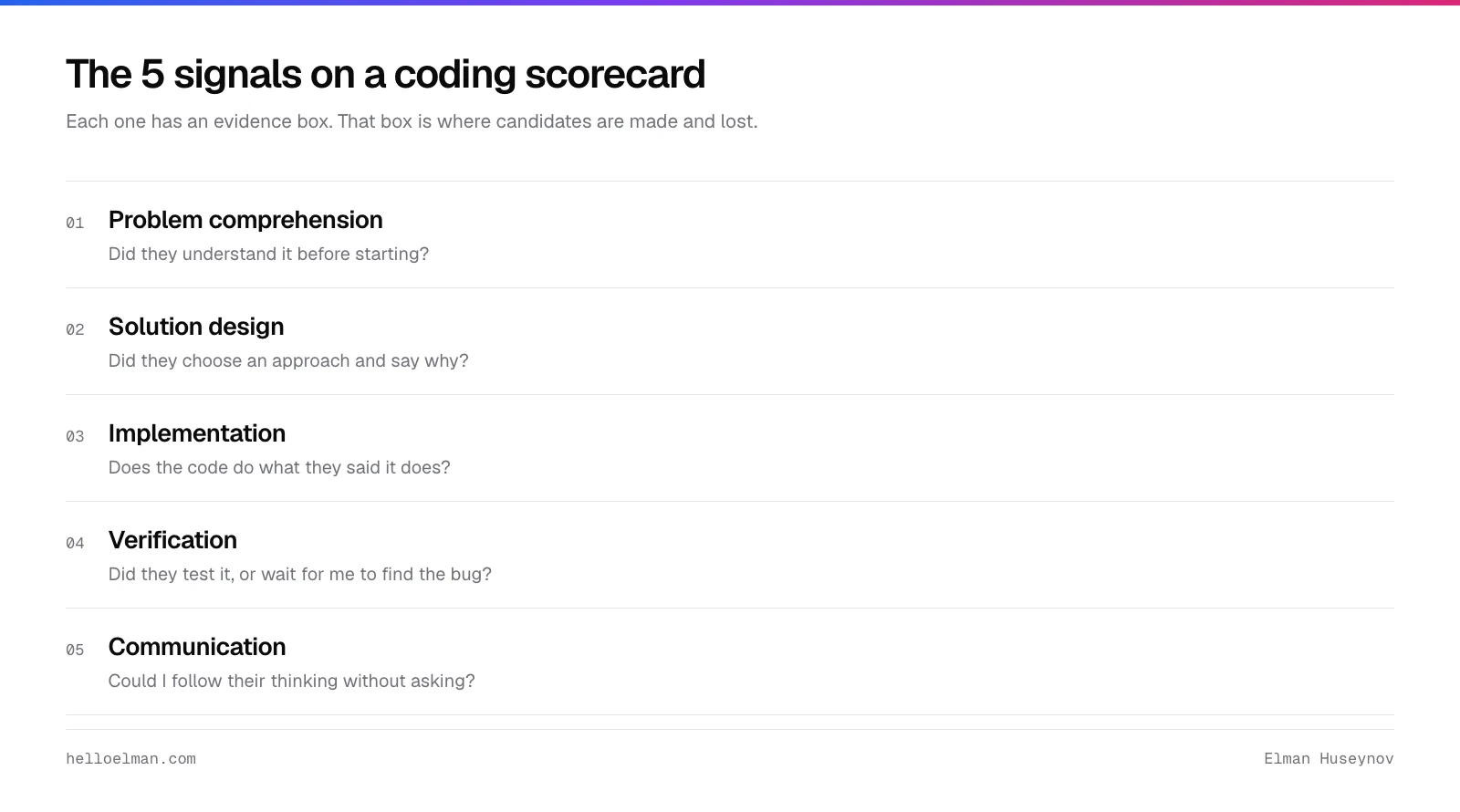
Each signal is a question the interviewer answers about you, in writing:
| Signal | What the interviewer is asking themselves |
|---|---|
| Problem comprehension | Did they understand it before starting? |
| Solution design | Did they choose an approach and say why? |
| Implementation | Does the code do what they said it does? |
| Verification | Did they test it, or wait for me to find the bug? |
| Communication | Could I follow their thinking without asking? |
An interviewer who cannot fill the evidence box writes something vague. Vague notes lose in a debrief.
Interview scorecard examples, line by line
Shapes from real write-ups, details changed.
Good, specific scorecard notes
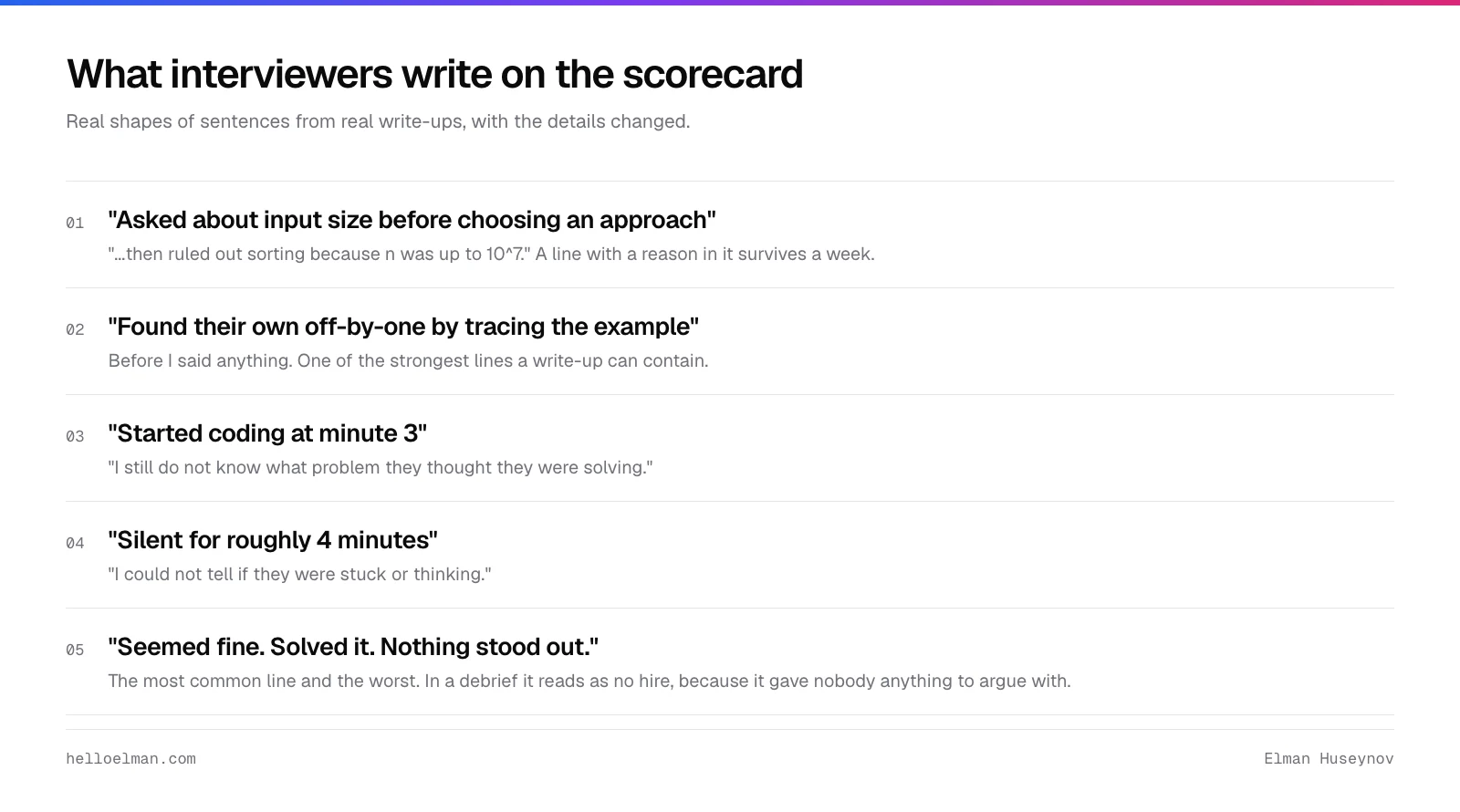
- “Asked about input size before choosing an approach. Ruled out sorting because n was up to 10^7.”
- “Found their own off-by-one by tracing the example, before I said anything.”
- “Named the tradeoff explicitly: more memory for 1 pass instead of 2.”
- “When I pushed back on the schema, they changed it and named the cost.”
Bad, equally specific notes
- “Started coding at minute 3. I still do not know what problem they thought they were solving.”
- “Silent for roughly 4 minutes. I could not tell if they were stuck or thinking.”
- “Said the complexity was O(n log n). It was O(n^2). Did not catch it when walking an example.”
- “Answered a different question than the one I asked, twice.”
The worst and most common note
- “Seemed fine. Solved it. Nothing stood out.”
In a debrief, “nothing stood out” reads as no hire. Nobody has anything to argue for.
Why do vague notes sink you?
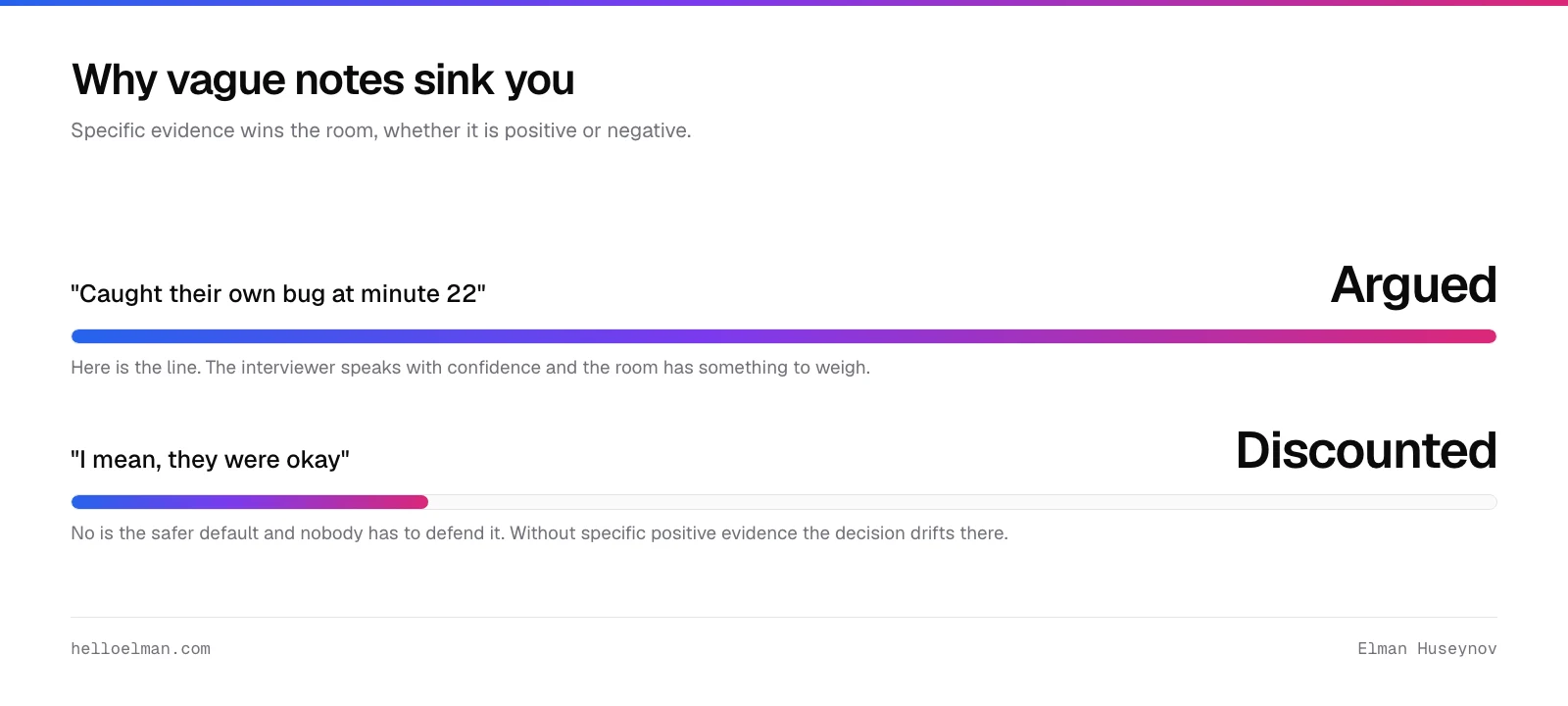
The interviewer with evidence speaks with confidence. The one with impressions hedges.
Without specific positive evidence, the decision drifts toward no, the safer default.
“They caught their own bug at minute 22, here is the line.” That beats “I mean, they were okay” every time.
How to shape what interviewers write
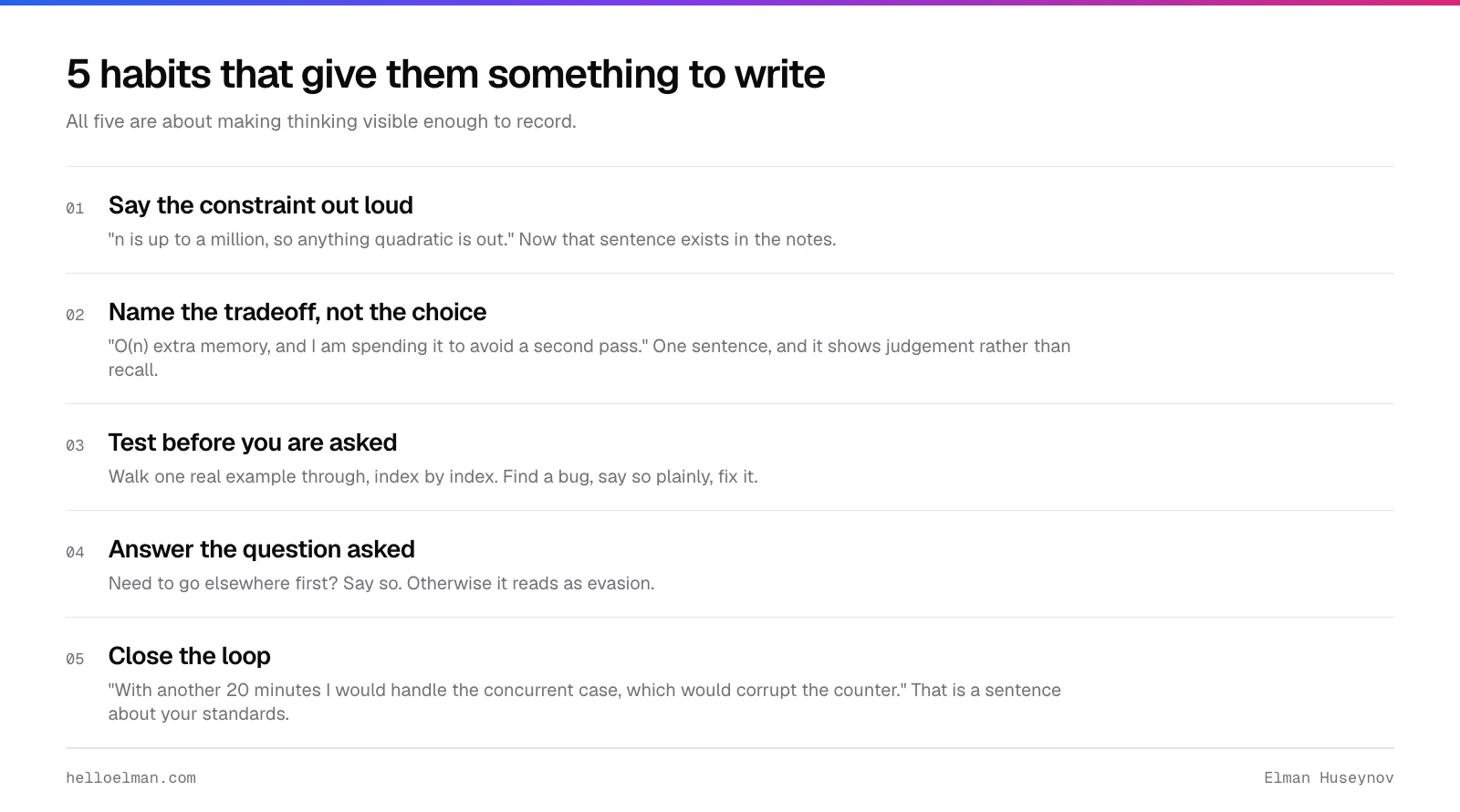
Five habits make your thinking easy to record.
Say the constraint out loud before you use it
“n is up to a million, so anything quadratic is out.” Now that sentence exists in the notes.
Name the tradeoff
“I will use a hash map. That is O(n) extra memory, spent to avoid a second pass.”
One sentence shows judgement rather than recall.
Test before you are asked
Walk 1 real example through your code, out loud, index by index.
If you find a bug, say so and fix it. The phone interview questions post shows where this matters most.
“Found their own bug” is among the strongest lines a write-up can contain.
Answer the question that was asked
If you need to go elsewhere first, say so. “Let me check 1 thing, then answer.” Otherwise it reads as evasion.
Close the loop
“With another 20 minutes I would handle the concurrent case, which would corrupt the counter.”
A line like that shows your standards, and it gets written down.
What does the behavioural scorecard score?
The behavioural scorecard scores you against the company’s written values. It has a line for what you did.
The behavioral interview questions post lists what each question measures.
“We decided to cut scope” produces no evidence about you.
“I proposed cutting the reporting module, and I was wrong about the follow-up cost.” That produces plenty.
Give every story a number. “Deploys from 4 a week to over 10” survives a debrief. “Improved our deployment process” does not.
Should you ask what the company is scoring?
Ask the recruiter what each round scores, before the loop starts.
Teams should write the scorecard before the job ad.
If a company cannot tell you what it is scoring, it does not know either.
Why tech interviews need rethinking explains how that happens.
Common questions
Can you ask to see the scorecard after an interview?
Ask, and expect a summary rather than the document. Most companies will not release the raw notes. Some will walk you through the signals if you ask the recruiter directly. A company that cannot tell you what it scored you on did not know beforehand.
Does the interviewer write the notes during or after the interview?
Both, and the during part matters to you. Most interviewers type fragments while you talk and turn them into prose within the hour. Anything you say that is quotable gets captured in the moment. Anything that needed reconstructing from memory arrives softer and vaguer in the write-up.
Is it bad if the interviewer types while you are talking?
Typing is the best sign available. Silence and no typing means nothing is landing. If you say something and hear keys, that sentence made it into the record. The written record decides the outcome, so give them more to type.
What does strong hire actually mean?
Strong hire means the interviewer will argue for you in the room, with evidence. Hire means they will not object. The gap between those two is about how much specific material you gave them. That is why nothing stood out lands as a rejection.
What is an interview scorecard?
An interview scorecard is the form each interviewer fills in after a round. It lists the signals being tested and asks for evidence against each one. The debrief reads the scorecards, not the interviews. This is why what got written down matters more than how the hour felt.
The short version
The write-up decides the round.
Say your constraints and tradeoffs out loud so they land in the notes. Test your own code before you are asked.
Give 1 number per story. Give the interviewer 1 sentence to quote in a room you will never be in.
A mock interview ends with your own filled-in scorecard within 24 hours. The same one a real panel would write.