The STAR method structures a behavioral answer as Situation, Task, Action, Result.
On this page
STAR keeps a 2-minute story in an order an interviewer can follow.
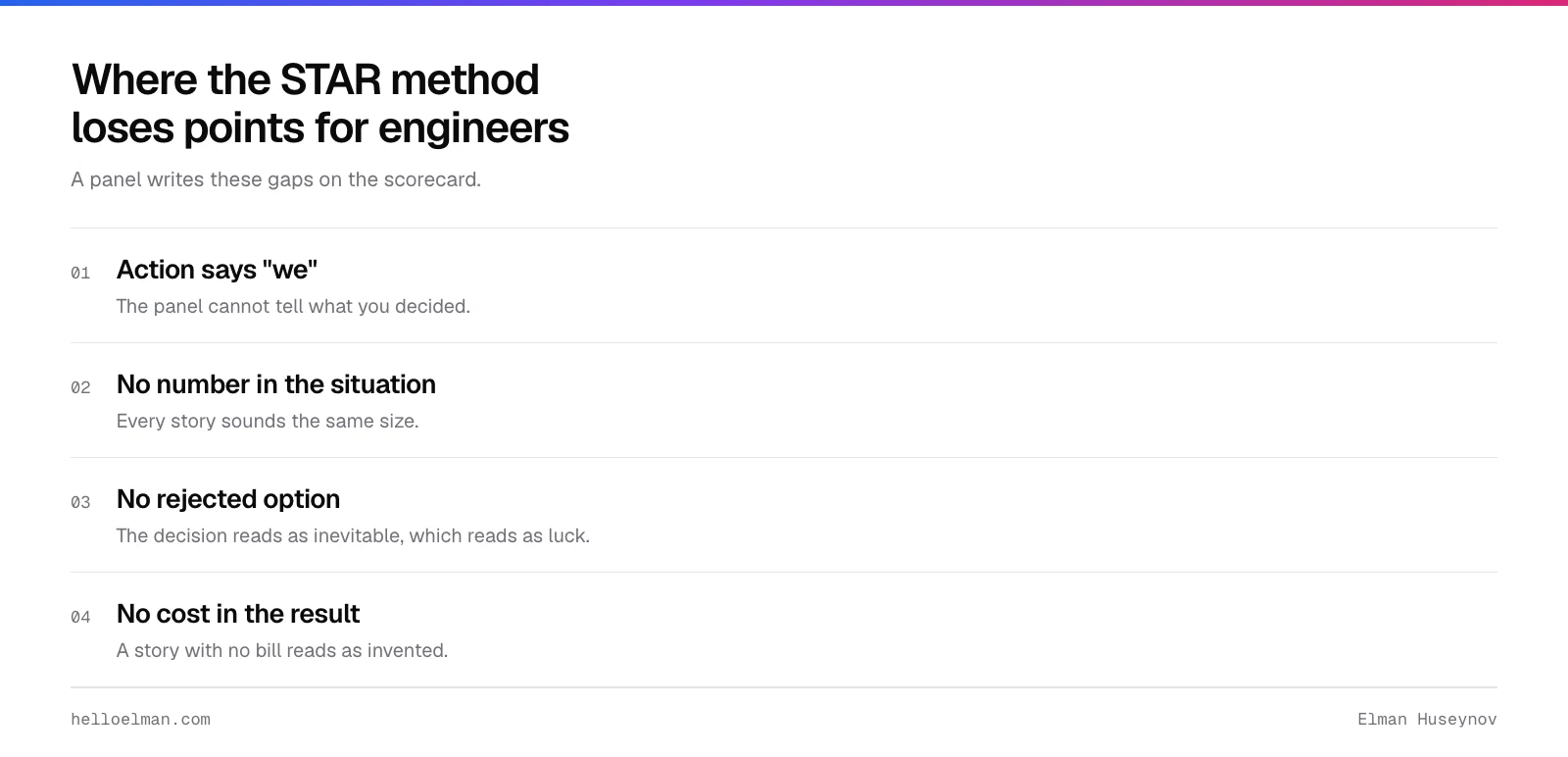
Software engineers lose points in one place: the Action step says “we”.
A panel scores your own decisions, so each answer needs them named.
Why does the STAR method fail engineers?
The STAR method fails engineers when the Action step turns into a team summary.
“We migrated the service” tells a panel what the team did.
The scorecard has a line for your own judgement. That line stays empty. Interviewers then probe for it, and the answer collapses.
What does each step of the STAR method need?
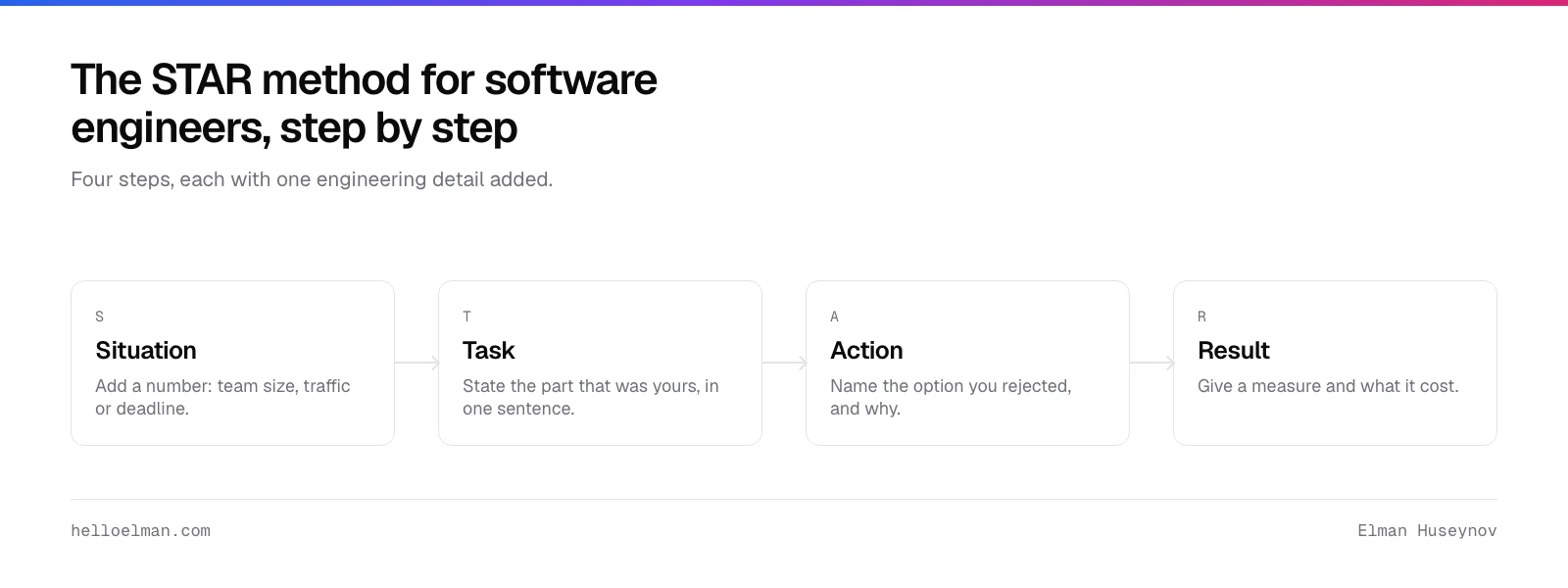
Each step of the STAR method needs one engineering detail added.
Situation needs a number. Task needs your owned scope. Action needs the option you rejected. Result needs a measure and a cost.
Four additions turn a story into evidence.
| Step | The template says | Add this |
|---|---|---|
| Situation | Set the scene | A number: team size, traffic, deadline |
| Task | State the goal | The part that was yours, in one sentence |
| Action | Say what you did | The option you rejected, and why |
| Result | Give the outcome | A measure, and what it cost |
What does a STAR answer look like for an engineer?
A strong STAR answer for an engineer runs 4 sentences and about 2 minutes.
The example below answers “Tell me about a time you reduced release risk.”
The numbers in this example are placeholders. Replace them with yours.
Situation. A team of 8 shipped every 3 weeks. 2 of the last 6 releases rolled back.
Task. I owned the release process. The director wanted zero rollbacks by the end of the quarter.
Action. I rejected a quarter-long feature freeze, because the campaign date was fixed. I chose canary releases and wrote the plan.
Result. Rollbacks went from 2 in 6 releases to 0 in the next 12. The cost was 2 weeks of platform work and a slower first month.
How long should a STAR answer be?
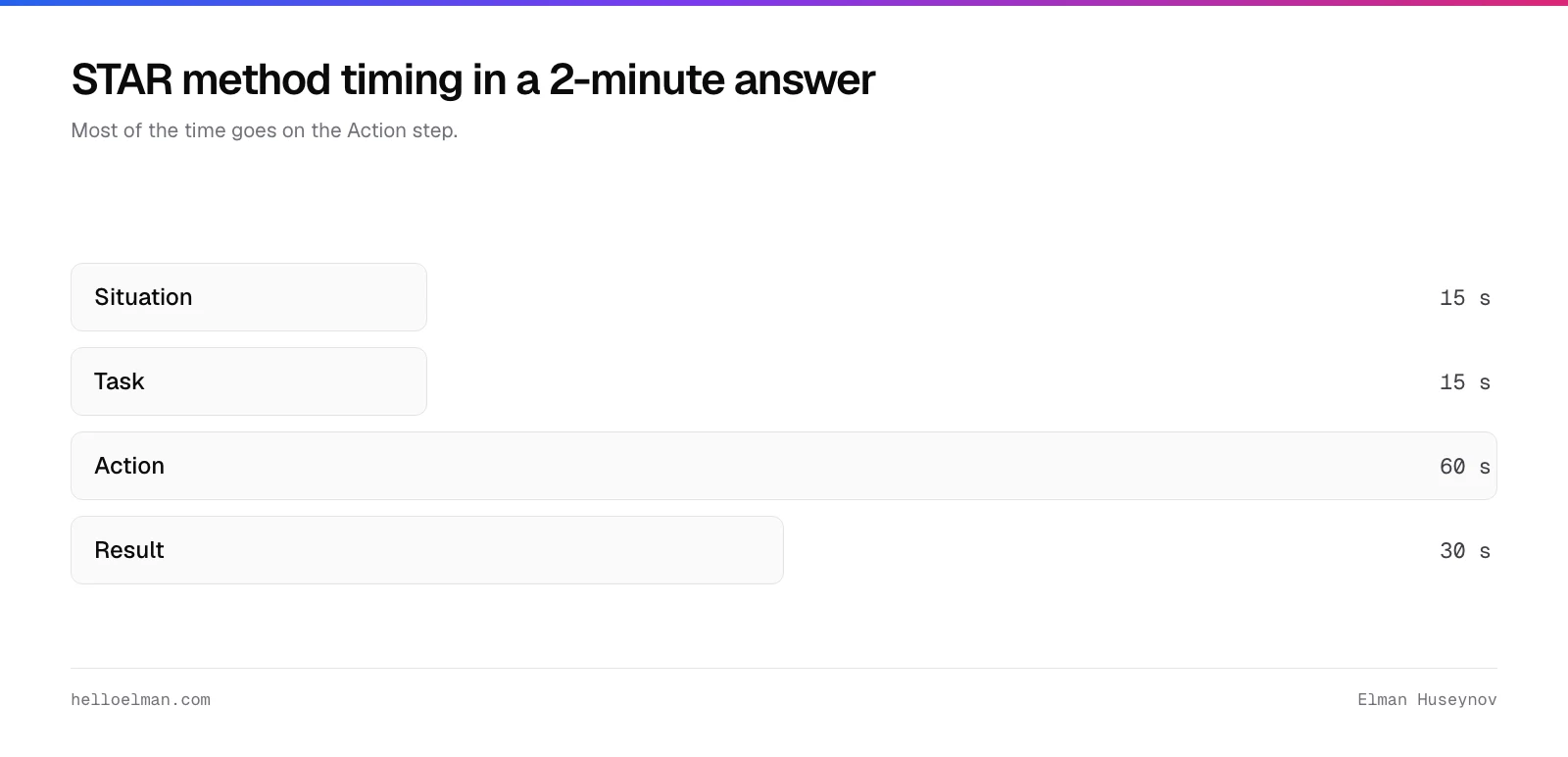
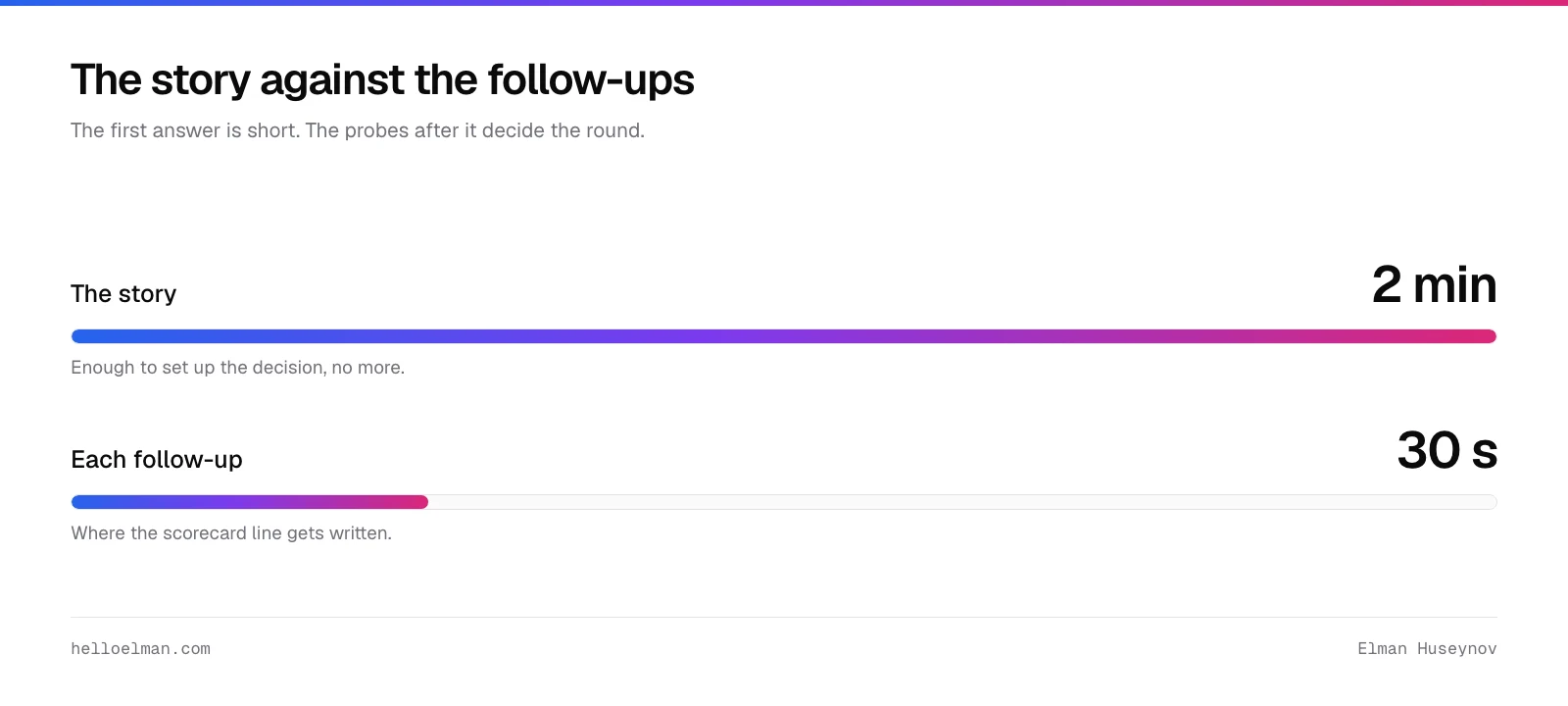
A STAR answer should run about 2 minutes, which is 250 to 300 spoken words.
Situation and Task take 30 seconds together. Action takes 60. Result takes 30.
The rest of the time belongs to the follow-ups, which carry the score. Prepare those too.
Which stories should you write in the STAR method first?
Seven stories cover almost every behavioral question, one per category.
Write each in the STAR method, then add the 4 details. The 47 common phrasings map onto those 7, so no question needs a new story.
Start with the story where you changed a decision, not the smoothest one.
STAR is a widely used format, and the follow-up probes go to the decision.
Common questions
Should you say “I” or “we” in a STAR answer?
Say “I” for your decisions and “we” for the team’s outcome. A panel scores your judgement, so the Action step needs “I decided” and “I wrote”. Using “we” throughout hides what you did. Using “I” for everything claims credit the team earned. Split the pronouns by who made the call.
What if the result of your STAR story was bad?
Use it. A bad-result story, told honestly, outscores a success with no cost. Name what you got wrong, what you would decide differently, and what changed afterwards. Panels trust candidates who can say that without hedging. A failure story is also the hardest to fake under follow-up.
Is the STAR method the same as the CAR method?
Close. CAR drops Task and runs Context, Action, Result, so it is shorter. STAR gives you a place to state your owned scope, which engineers need. If a company names a different format, use its shape. Both formats take the same 4 additions.
Does the STAR method work for system design questions?
No. System design is scored on requirements, trade-offs and numbers, not on a story. The STAR method belongs to the behavioral round. Mixing them wastes the system design hour on narrative. Use STAR when the question starts with “tell me about a time”. Use a structured walkthrough for design.
What is the STAR method?
The STAR method is an answer format for behavioral interview questions. It stands for Situation, Task, Action, Result. You set the scene, state your responsibility, describe what you did, and report the outcome. The format fits a story into 2 minutes, in an order a panel can score.
The short version
STAR is Situation, Task, Action, Result. Keep it for the shape.
Add a number, your owned scope, the rejected option, and the cost.
Write 7 stories, say each one aloud, timed. Then prepare the follow-ups.
To have them asked at you with the follow-ups, book a behavioral mock interview. Written scorecard within 24 hours.