Behavioral interview questions for software engineers come in 7 categories, asked 47 ways.
On this page
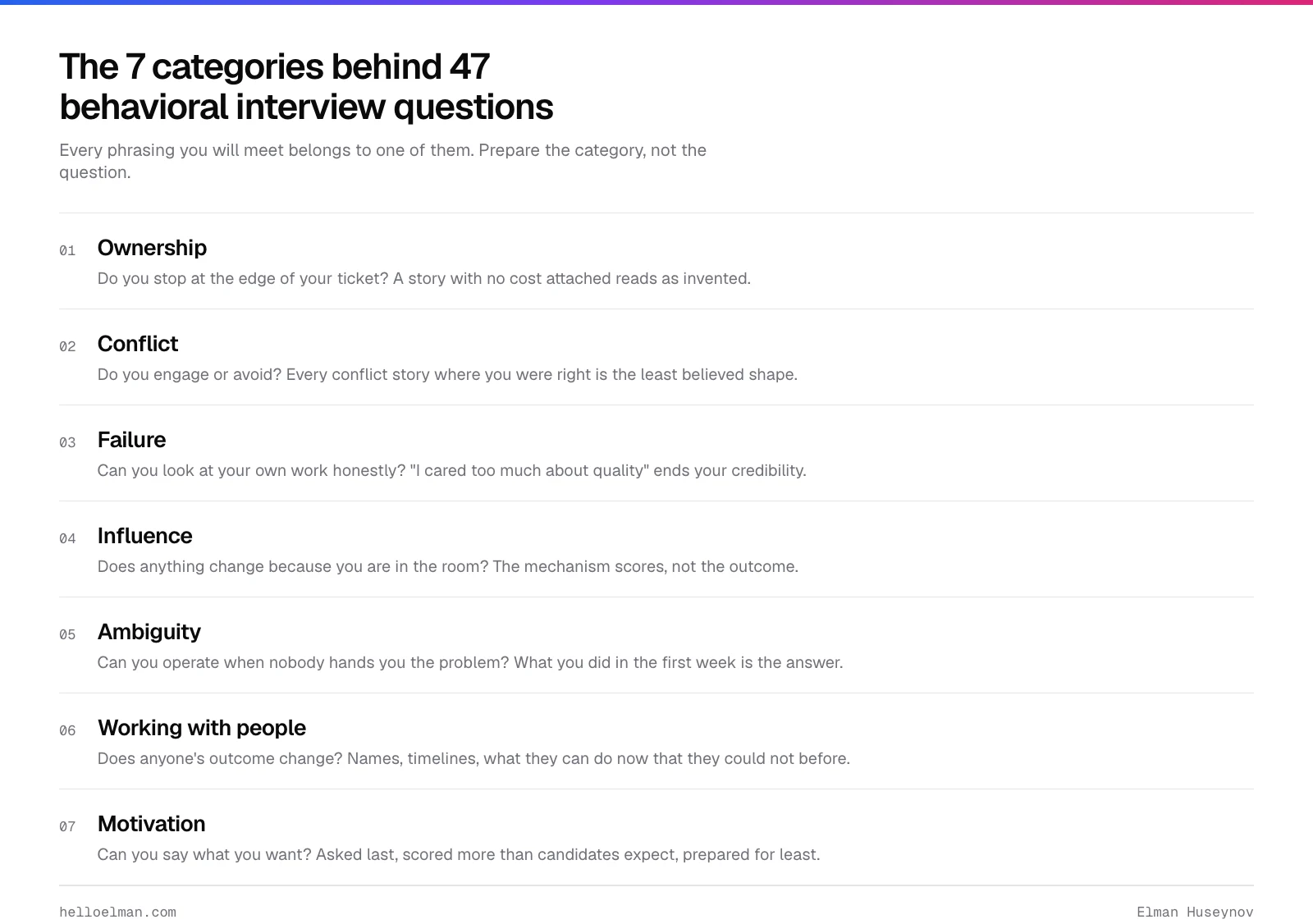
Ownership, conflict, failure, influence, ambiguity, working with people, motivation.
Write 7 stories, one per category, then index all 47 phrasings against them. The 2 or 3 with no story behind them are the point.
You bring the right story instead of the nearest one.
Here are the questions that come up in these rounds.
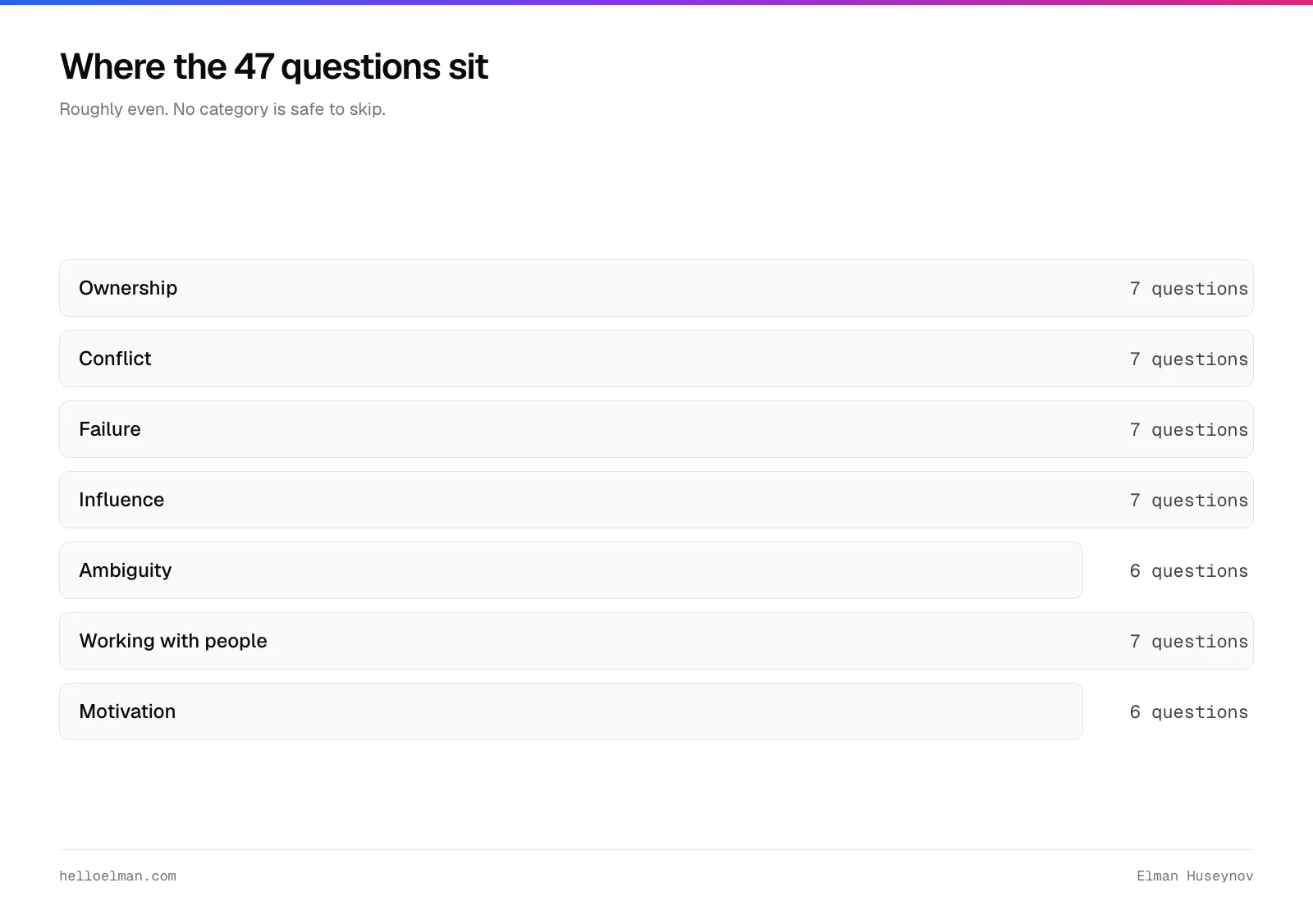
1. Ownership: do you stop at the edge of your ticket?
Ownership questions test whether you fix what sits past the edge of your ticket. The panel wants the time you did.
Scores: a specific thing, why it was yours to fix, what it cost you elsewhere. Ownership with no cost reads as invented.
| # | Question |
|---|---|
| 1 | Tell me about something you fixed that nobody asked you to fix. |
| 2 | Describe a time you took responsibility for a problem outside your remit. |
| 3 | Tell me about a project you saw through end to end. |
| 4 | When did you last push back on a requirement, and what happened? |
| 5 | Tell me about a time you inherited a mess. |
| 6 | Describe something you built that is still running. |
| 7 | What is the last thing you deleted, and why? |
2. Conflict: do you engage or avoid?
Conflict questions test whether you engage a disagreement or route around it.
Scores: the other side stated at its strongest. At least one resolution where you changed something.
Fails: every conflict story where you were right. The commonest shape, and the least believed.
| # | Question |
|---|---|
| 8 | Tell me about a disagreement with a colleague. |
| 9 | Describe a time you disagreed with your manager. |
| 10 | Tell me about working with someone difficult. |
| 11 | When did you have to say no to a stakeholder? |
| 12 | Describe a code review that turned into an argument. |
| 13 | Tell me about a time you were overruled. |
| 14 | How did you handle a teammate who was not pulling their weight? |
3. Failure: can you look at your own work honestly?
Failure questions test whether you can look at your own work without hedging.
Scores: real consequences, your part without hedging, what changed afterwards.
Fails: a strength in a costume. “I cared too much about quality” ends the credibility of everything after it.
| # | Question |
|---|---|
| 15 | Tell me about a project that failed. |
| 16 | Describe a decision you got wrong. |
| 17 | When did you last break production? |
| 18 | Tell me about a time you missed a deadline. |
| 19 | Describe feedback that was hard to hear. |
| 20 | What is the worst technical decision you have made? |
| 21 | Tell me about a time you had to abandon something you had built. |
4. Influence: does anything change because you are in the room?
Influence questions test whether a decision changed because you were in the room. Authority does not count.
Scores: the mechanism. A document, a prototype, 3 conversations before the meeting.
Fails: “I explained the benefits and they agreed.” That is an easy audience.
| # | Question |
|---|---|
| 22 | Tell me about a time you changed someone’s mind. |
| 23 | Describe how you got buy-in for a technical decision. |
| 24 | When did you drive a change across more than 1 team? |
| 25 | Tell me about a proposal that was rejected. |
| 26 | How did you convince a manager to invest in something invisible to users? |
| 27 | Describe a standard you introduced that outlived you. |
| 28 | Tell me about mentoring someone. |
5. Ambiguity: can you operate when nobody hands you the problem?
Ambiguity questions test what you do when nobody hands you the problem.
Scores: what you did in the first week. Who you talked to, what you wrote down, what you stopped being uncertain about.
Fails: waiting for clarity, then executing well. That is someone else’s judgement.
| # | Question |
|---|---|
| 29 | Tell me about the vaguest project you have been given. |
| 30 | Describe a time you had to make a decision without enough information. |
| 31 | When did requirements change underneath you? |
| 32 | Tell me about a time you had to choose between 2 reasonable approaches. |
| 33 | How do you decide what to work on when everything is a priority? |
| 34 | Describe a time you had to say what the problem actually was. |
6. Working with people: does anyone’s outcome change?
People questions test whether someone else’s outcome changed because of you.
Scores: names, timelines, what the other person can do now that they could not before.
A story about a team you enjoyed gives the panel nothing to write down. For managers this section becomes the whole round.
| # | Question |
|---|---|
| 35 | Tell me about the best team you have been on, and why. |
| 36 | How do you onboard someone new? |
| 37 | Describe giving difficult feedback. |
| 38 | Tell me about a time you asked for help. |
| 39 | How do you handle a teammate who disagrees with the team’s direction? |
| 40 | Describe a time you had to work with a team in another time zone. |
| 41 | Tell me about someone whose work you improved. |
7. Motivation: can you say what you actually want?
Motivation questions test whether you can say what you want without attacking anyone.
Asked last, scored more than candidates expect, prepared for least.
Scores: a specific reason that flatters nobody. “3 years on the same system. I want a harder distributed problem.”
| # | Question |
|---|---|
| 42 | Why are you leaving? |
| 43 | Why this company? |
| 44 | What kind of work do you want more of? |
| 45 | What would make you leave a job? |
| 46 | Tell me about the work you are proudest of. |
| 47 | What do you want to be doing in 3 years? |
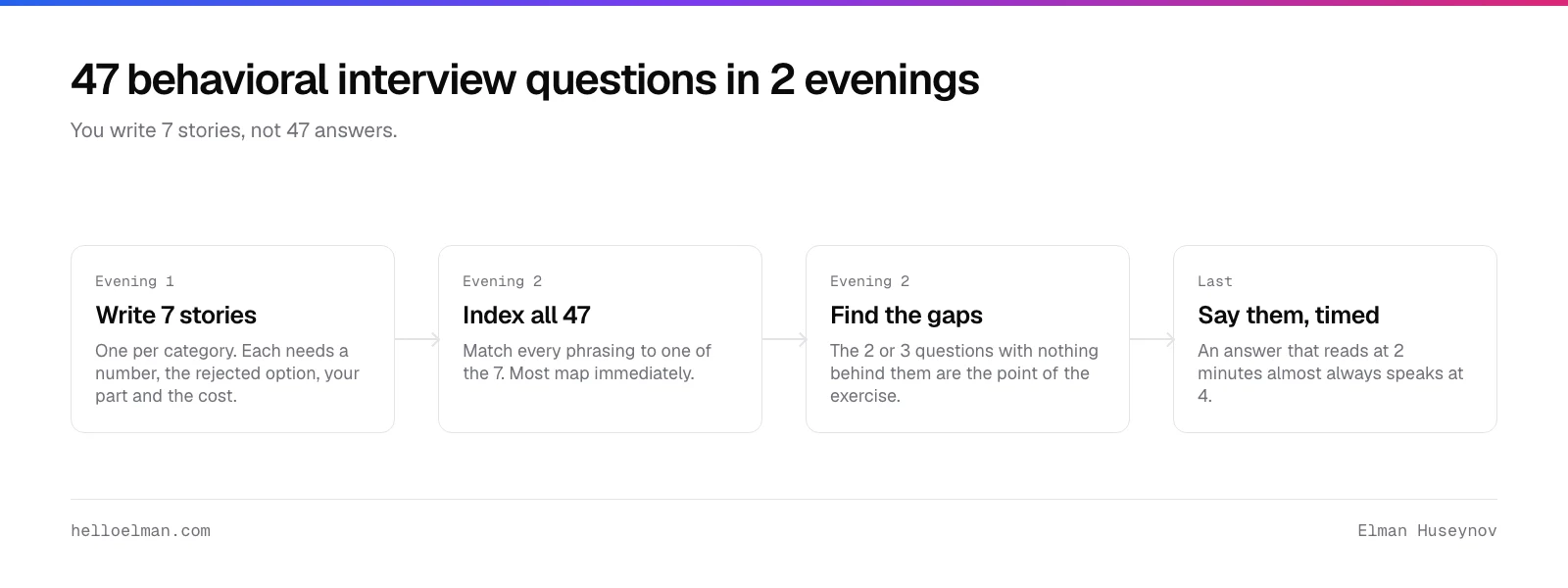
How to prepare all 47 behavioral interview questions in 2 evenings
Evening 1: one story per category. Each needs a number, the option you rejected, your part, and the cost.
Evening 2: index the 47 behavioral interview questions against the 7. Find the ones with nothing behind them.
The structure and the 5 follow-up probes are in the behavioral answer that survives.
Say the 7 out loud, timed. Answers that read at 2 minutes almost always speak at 4.
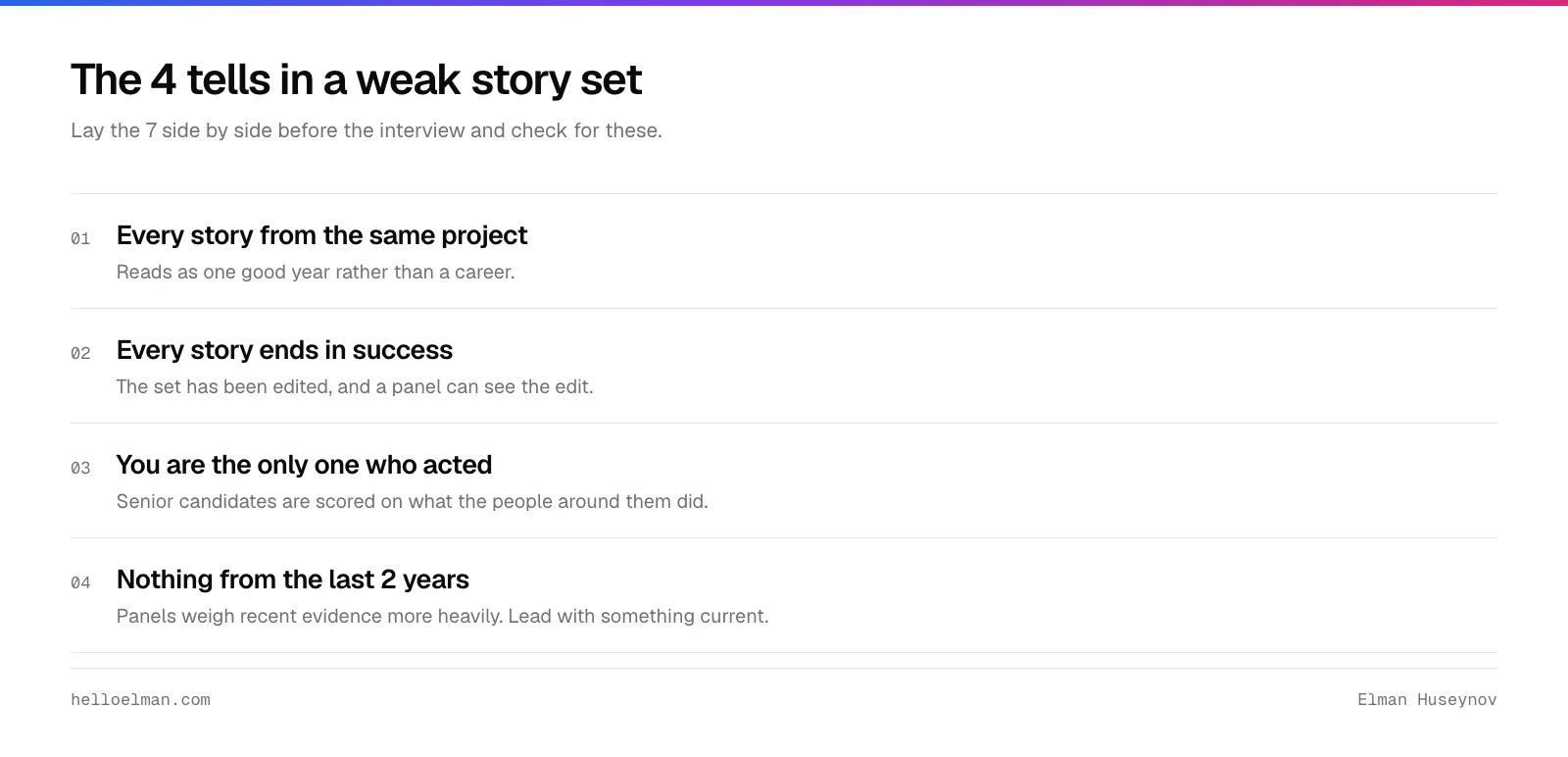
Four tells in a weak set of behavioral interview questions
Every story from the same project. Every story ending in success. You acting alone every time. Nothing more recent than 2 years.
Senior candidates are scored on what the people around them did. A set where you act alone works against you.
Common questions
How many behavioral stories do you actually need?
Seven, one per category, stretched across all 47 phrasings. More than 10 means you have not indexed them. You will reach for the nearest story rather than the right one. Fewer than 5 means at least 2 categories are empty. A panel finds that within 3 questions.
Which category is scored hardest at senior level?
Influence and ambiguity. Below senior the panel accepts good execution on defined work. At senior and above they want change across a boundary you did not own. And a call made before the information was complete. Ownership and failure carry the same weight at every level.
What do you do when a question has no matching story?
Say so, and answer with what you would do. That scores better than stretching an unrelated story. Those fall apart on the second probe. Finding the gaps is the point of indexing all 47 in advance. 2 evenings of preparation beats discovering one live.
Are motivation questions really scored?
More than candidates expect, and they come last, once people have relaxed. “Why are you leaving” checks whether you can say what you want. Without attacking your employer, and without saying nothing. Both failures read the same to a panel: unwillingness to be specific.
What are behavioral interview questions?
Behavioral interview questions ask what you actually did, not what you would do. They start with “tell me about a time”. The 47 you will meet fall into 7 categories. Ownership, conflict, failure, influence, ambiguity, working with people, and motivation. Prepare the categories, not the questions.
The short version
7 categories, 47 phrasings. Ownership, conflict, failure, influence, ambiguity, people, motivation.
Write 7 stories, index the 47 against them, find the gaps. Then say them out loud, timed.
To have them asked at you with the follow-ups, book a behavioral mock interview. Written scorecard within 24 hours.