What a Hiring Manager Interview Is Testing
Related service: Mock interviews

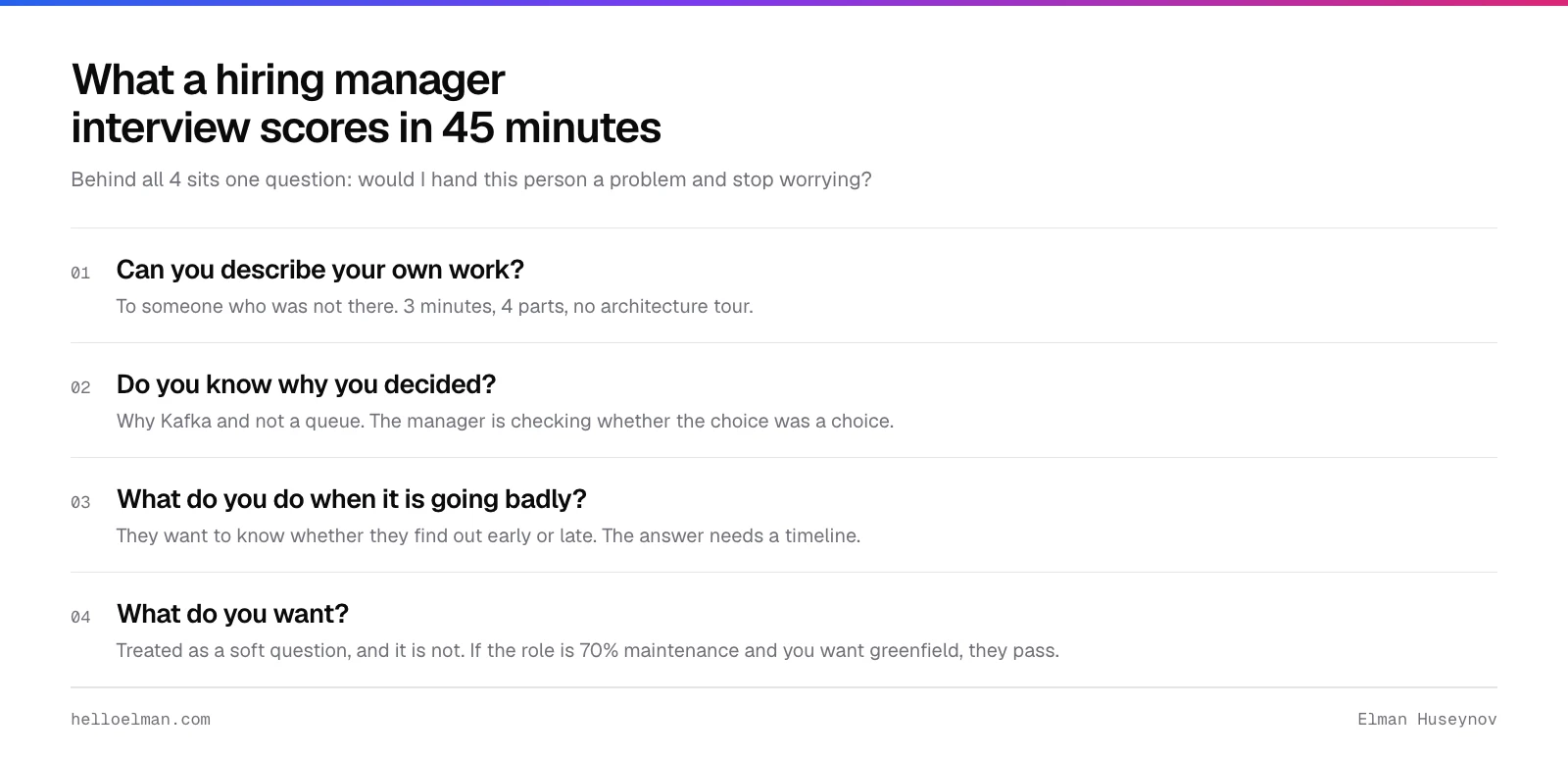
The hiring manager interview scores 4 things in 45 minutes.
Whether you can describe your own work to someone who was not there. Whether you know why you made your decisions.
What you do when a project is going badly. What you actually want.
On this page
Behind all 4 sits one question. Would I hand this person a problem and stop worrying?
Candidates often prepare for the hiring manager round least.
There is no whiteboard and nothing to revise.
1. Can you describe your own work to someone who was not there?
“Tell me about what you have been working on” is not small talk.
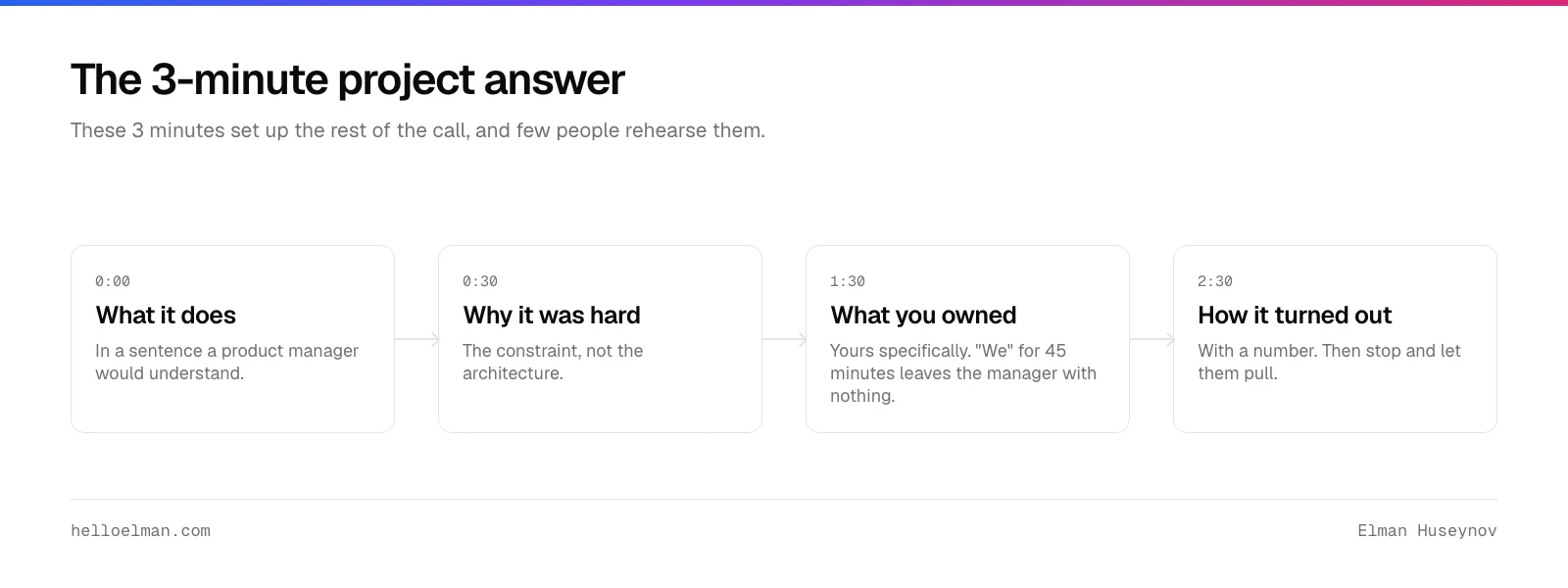
The answer that works takes 3 minutes and has 4 parts. What the system does, in a sentence a product manager would understand.
Why it was hard. What you specifically owned. How it turned out, with a number.
The answer that fails is the tour of the architecture. It says you cannot separate what matters from what is true.
Practise this out loud. These 3 minutes set up the rest of the call, and few people rehearse them.
2. Do you know why you made your decisions?
The follow-up is always a decision probe. Why Kafka and not a queue. Why did you split that service.
The manager is checking whether the choice was a choice. Your answer does not have to match theirs.
For every project on your resume, know 2 decisions and the option you rejected.
Strong: “We took the boring option. Two people on call, and nobody had run the alternative in production.”
“It cost throughput we did not need yet.”
Weak: “That is what we used.” True, and it makes you sound like a passenger on your own project.
3. What do you do when it is going badly?
The manager is imagining you on their team in a bad quarter. Do they find out early or late?
The answer needs a timeline. When you knew, when you said something, who you told. What you proposed alongside the bad news.
“I flagged it in week 2 with 2 options” is the shape that works.
“We worked weekends and got it done” means a hidden problem and luck.
4. What do you want?
Asked as “what are you looking for”, and treated as a soft question. It is a fit check against the actual job.
If the role is 70% maintenance and you want greenfield work, they will pass. Rightly.
“I want a system with real users and real load. And to be closer to the decisions about what we build.”
A specific answer tells the manager whether their job matches. That is the only useful outcome, and the alternative is a bad year.
Hiring manager interview questions to ask
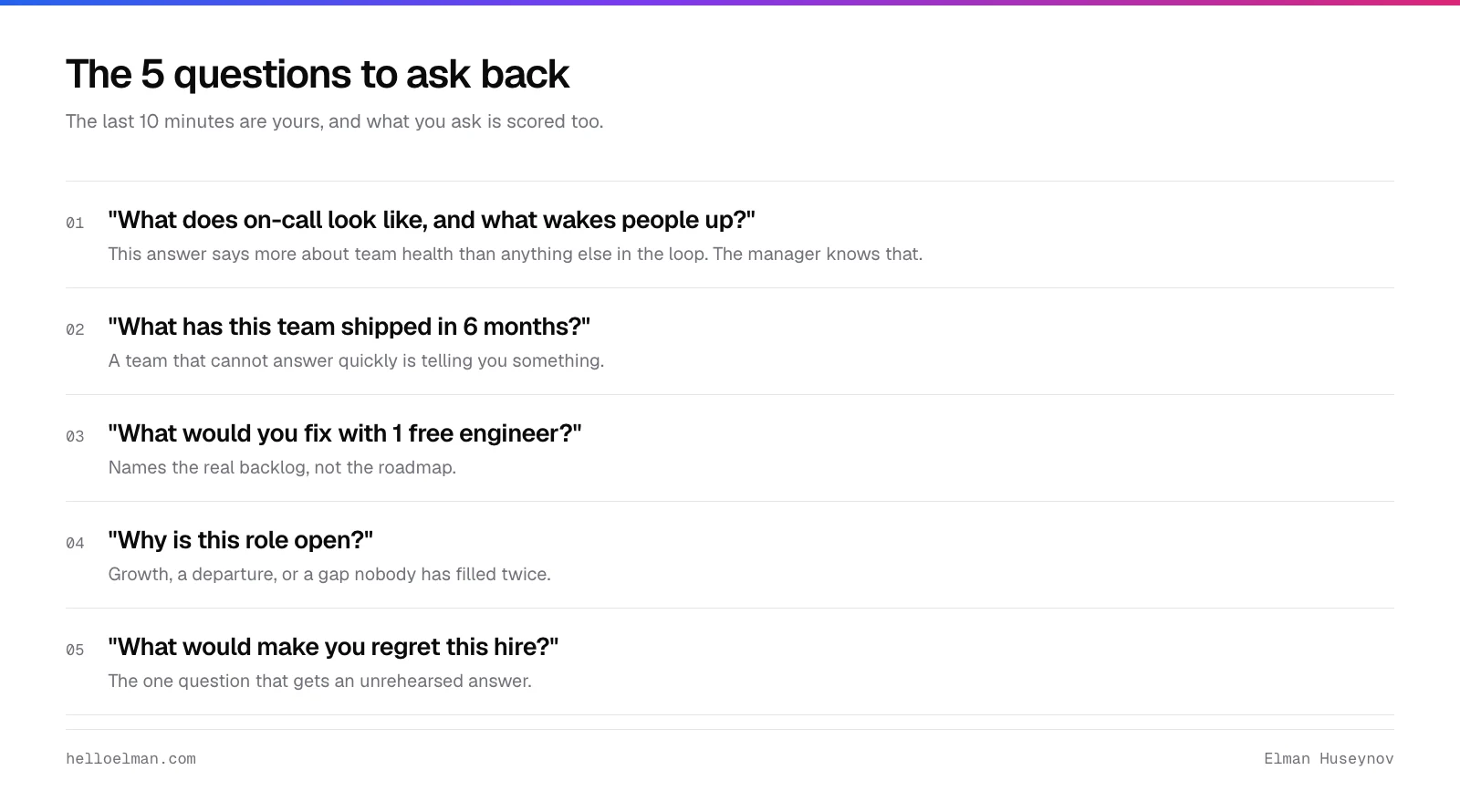
The last 10 minutes are yours. What you ask is scored too.
- “What does the on-call rotation look like, and what wakes people up?”
- “What has this team shipped in the last 6 months?”
- “What is the thing you would fix if you had 1 free engineer?”
- “Why is this role open?”
- “What would make you regret hiring someone into this role?”
Ask the on-call question. The answer says more about the team’s health than anything else. The manager knows it.
The 3 quiet hiring manager interview failures
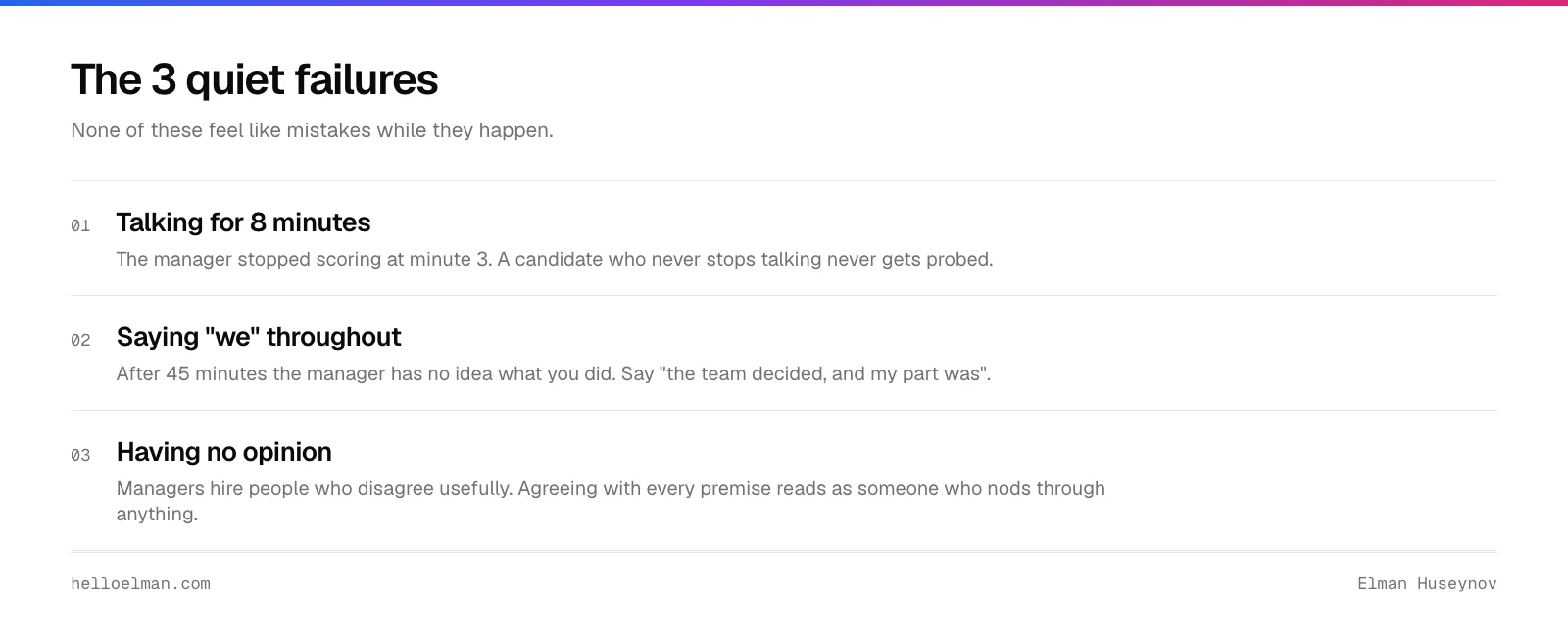
Talking for 8 minutes. The manager stopped scoring at minute 3. Answer, stop, let them pull.
Saying “we” throughout. After 45 minutes the manager has no idea what you did. “The team decided, and my part was.”
Having no opinion.
Managers hire people who will disagree with them usefully. Agreeing with every premise reads as nodding through anything.
What gets written after a hiring manager interview
When passing: “Clear owner, knew why, would put on the payments work.”
When rejecting: “Described the system well. Could not tell me why any of it was built that way.”
Nobody failed a test there. The candidate just never showed a decision.
Common questions
How long should the opening project answer be?
Three minutes, and stop. Many candidates run to 8, and the manager stopped scoring at 3. Answer, then stop, then let them pull. The pull is where the decision probes come from. A candidate who never stops talking never gets probed. That reads as nothing to probe.
What if your last project was mostly maintenance?
Say so and pick the hardest decision inside it. Maintenance work has real constraints. A system you cannot take down, a dependency nobody understands, a migration with no rollback. Those are more interesting to a hiring manager than a greenfield build with no constraints. Name what made it hard.
Which questions cost you points?
Anything on the careers page. Anything about promotion timelines before an offer exists. And what does a typical day look like. That last one reads as having no picture of the work at all. Two prepared questions beat 6 improvised ones, and the manager remembers whether you had any.
Is it bad to disagree with the hiring manager in this call?
Disagreeing well is one of the things being scored. Managers hire people who will push back usefully. A candidate who agrees with every premise reads as someone who will nod through anything. Give the reason and give the condition that would change your mind.
What is a hiring manager interview?
The round run by the person who will manage you day to day. It decides whether they want you on the team and at what level. One question runs underneath all of it: can this person own something without me watching?
The short version
Rehearse your 3-minute project story out loud. Know 2 decisions per project and the option you rejected.
Have a timeline for a project that went badly. Be honest about what you want. Ask about on-call, and why the role is open.
The rest of the loop is in the complete guide to FAANG technical interviews.
Interviewing for a manager role yourself? The engineering manager interview loop has 6 rounds.
To have this round run at you first, with a scorecard, book a mock interview.