Using AI to Prepare for Interviews, Properly
Related service: Mock interviews
AI interview prep works when the model interrogates you instead of answering you.
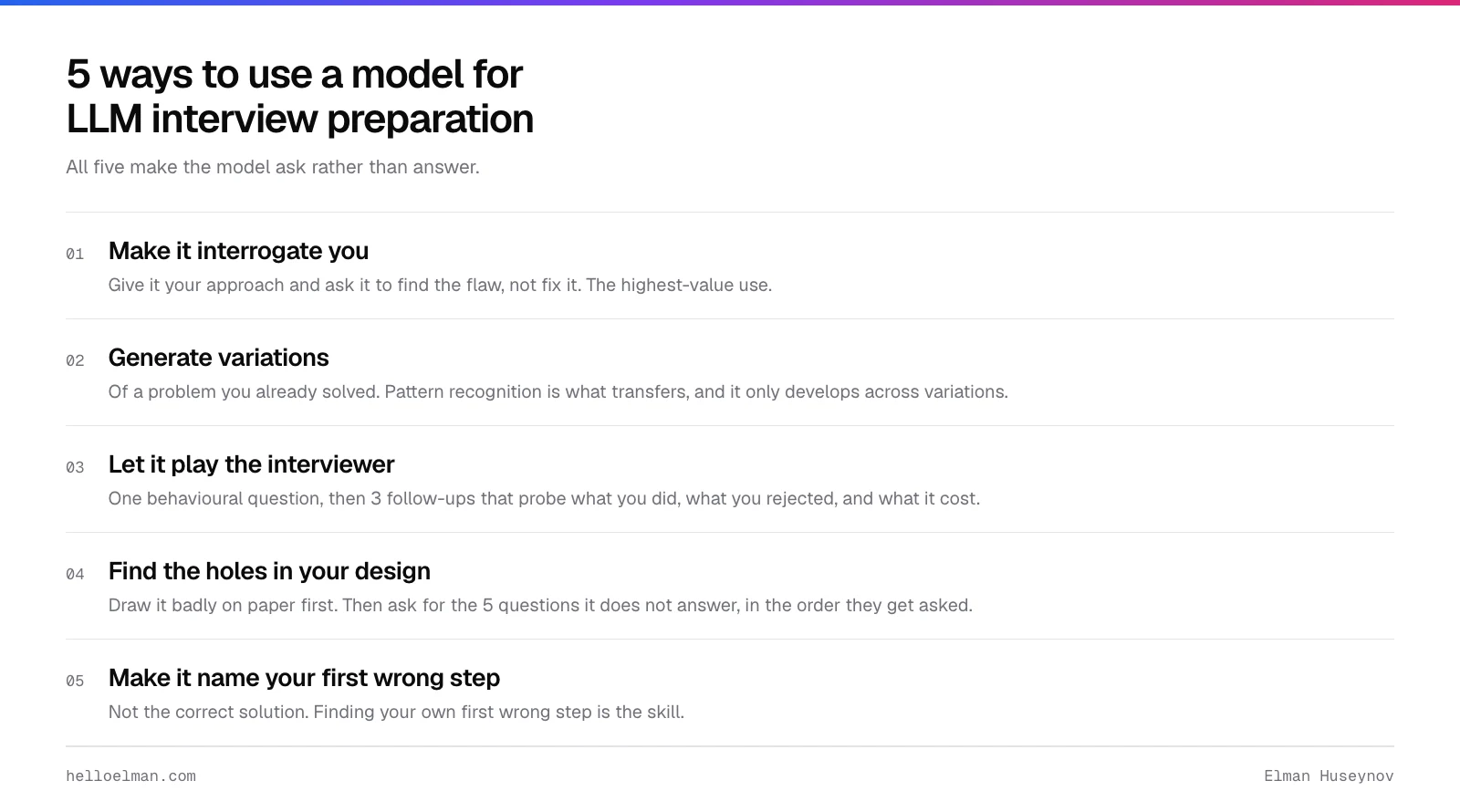
Have the model question your reasoning. Generate variations of a problem you solved. Play the interviewer for behavioural rounds.
Find the holes in a design you drew first. Ask you to explain your own mistake. Never read solutions.
On this page
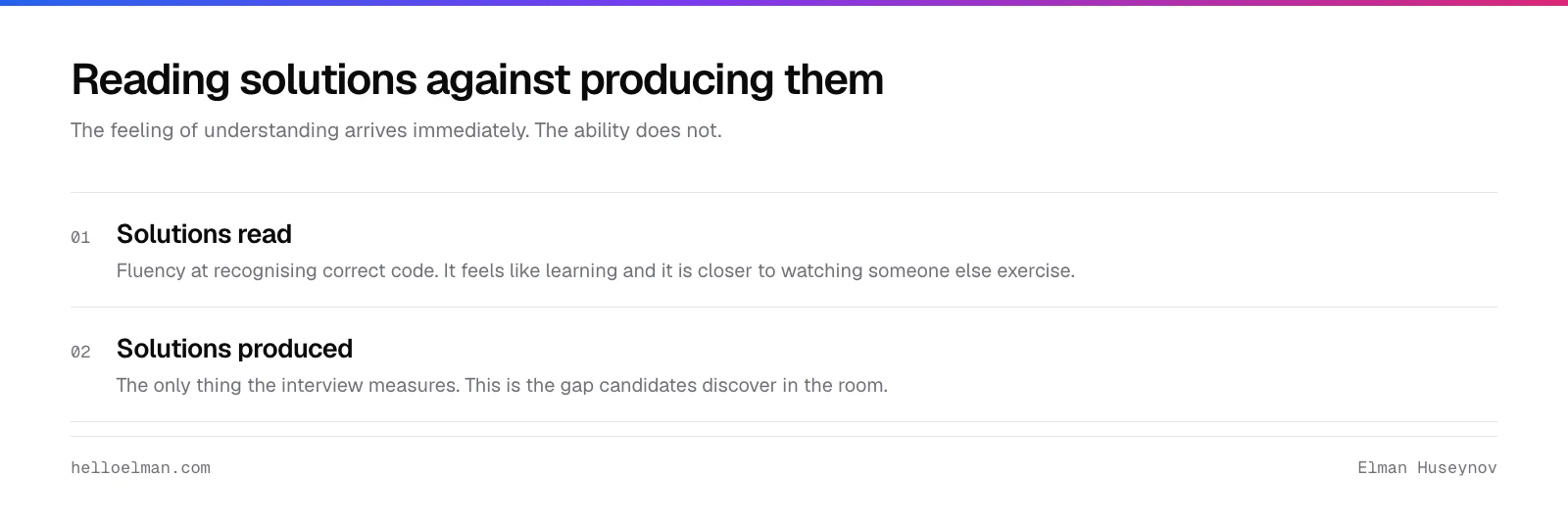
Reading a model’s solution feels like learning. It is closer to watching someone else exercise.
Candidates who prepared this way have read many solutions and produced few. They freeze in the room.
1. How do you make the model interrogate you?
Make the model interrogate you: give it your approach and ask for the flaw.
The model should find the weak step and leave the fix to you.
A fix hands you the answer. A flaw makes you defend the decision, which is what gets scored.
I am going to describe my approach to a problem. Do not give me the
solution or hint at it. Ask me one question at a time about my
reasoning, the way a senior interviewer would. Push hardest where I
am vague. After 5 questions, tell me which of my answers were weakest
and why.
Being interrogated trains what the interview decides on: defending a decision under pressure.
2. Generate variations of a problem you already solved
Here is a problem I have solved and my solution. Generate 3 variations
that use the same underlying technique but change what the pattern has
to do. Do not solve them. For each, tell me only which part of my
original approach no longer works.
Pattern recognition only develops across variations.
AlgoPath is built around patterns for this reason; see two-pointer problems.
3. Have it play the interviewer for the behavioural round
The follow-ups are what people fail on.
You are a hiring manager interviewing me for a senior engineer role.
Ask me one behavioural question. After my answer, ask 3 follow-ups
that probe for what I actually did, what I rejected, and what it cost.
Do not accept vague answers. Then tell me what a scorecard would say.
A model is gentle by default. Give it the 5 probes if it is too soft.
4. Find the holes in a system design
Design the system yourself first, on paper, badly. Then:
Here is my design for [system]. Do not improve it. List the 5 questions
an interviewer would ask that my design does not currently answer, in
the order they would ask them. Then tell me which one I am least
prepared for.
The value is in the ordering. Knowing where your design gets thin beats a better design you did not produce.
5. Make it find your first wrong step
I solved this incorrectly. Here is my attempt. Do not give me the
correct solution. Tell me the first point at which my reasoning went
wrong, and ask me what I should have checked there.
Finding your own first wrong step is the skill. Being shown the right answer skips it entirely.
What makes AI interview prep worse?
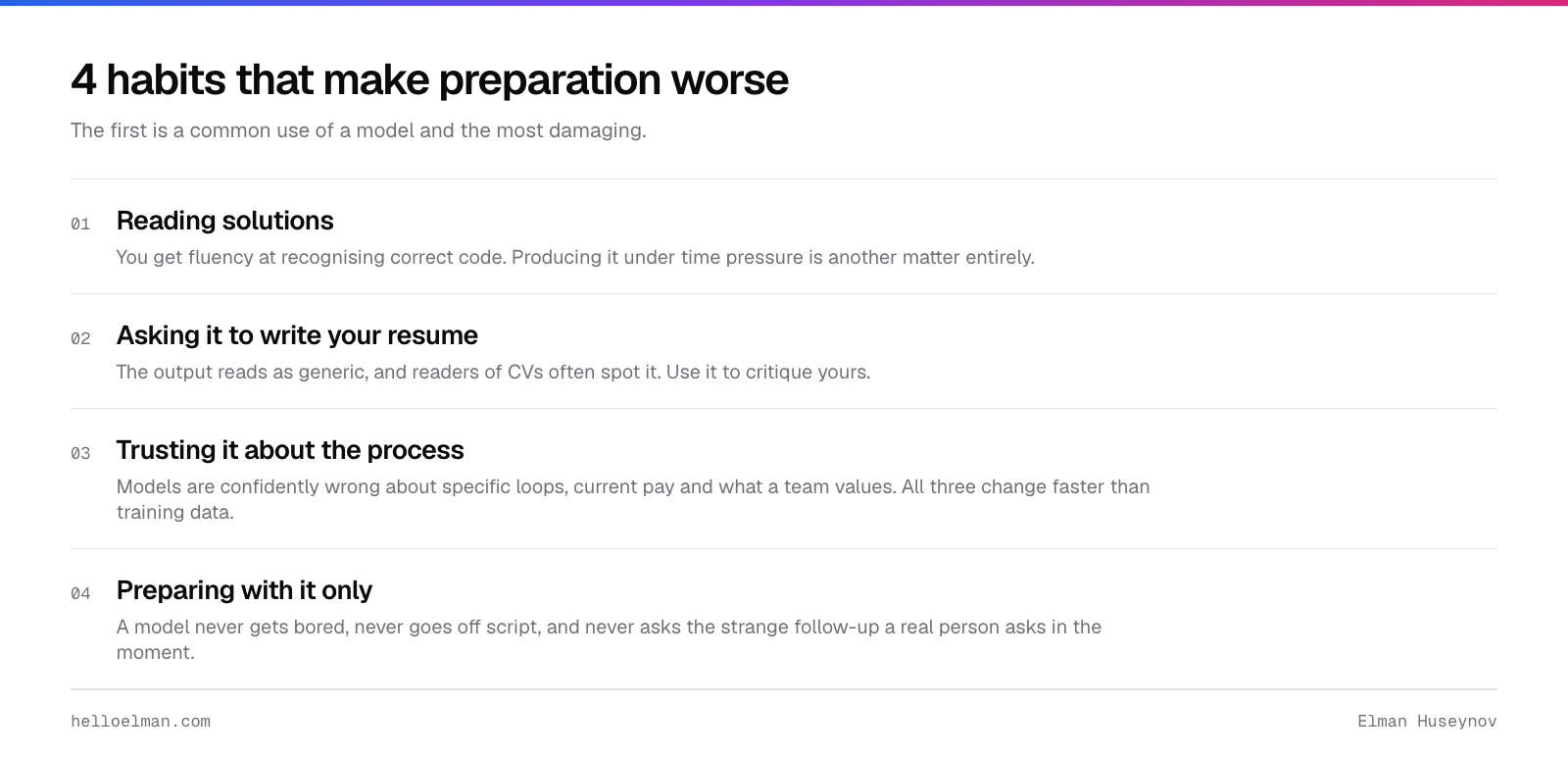
Reading solutions. You get fluency at recognising correct code, not at producing it under pressure.
Asking it to write your resume.
Readers of CVs often spot the generic output. Use it to critique yours; see 11 resume lines.
Trusting it about the process. Models are confidently wrong about specific loops, current pay and what a team values.
Preparing with it only. A model never goes off script the way a real person does.
Which AI should you use for interview prep?
Any current model works with these prompts.
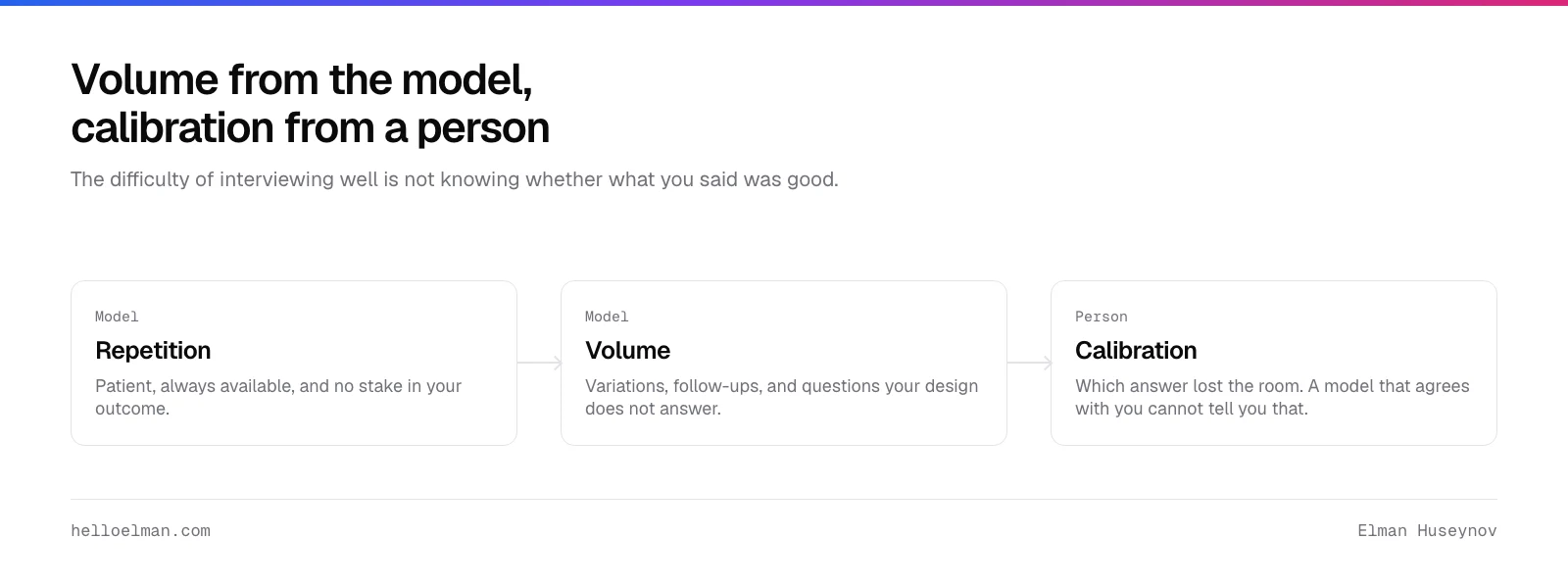
A model is a patient sparring partner with no stake in your outcome.
A person who has sat on hiring panels tells you which answer lost the room. Model for repetition, person for calibration.
Can you use it during the interview?
Using AI during the interview is increasingly allowed. Use it the way you would at work, and explain every line you keep.
The AI coding interview guide lists who allows it.
The question that now separates candidates: what did it suggest that you rejected?
More in stop trying to catch candidates using AI.
Common questions
Is reading model-generated solutions bad preparation?
Reading model-generated solutions is a common use and the most damaging one. Reading a correct solution gives you fluency at recognising correct code. Producing it with someone watching is another skill. The feeling of understanding arrives immediately and the ability does not. That is why candidates who prepare this way freeze.
What is the single best prompt for interview prep?
Ask the model to interrogate rather than answer. Here is my approach. Ask me 5 questions a senior interviewer would ask. One at a time, and do not give me the answer. That instruction turns the model from a solution generator into something useful.
Can a model replace a mock interview?
A model replaces the repetition and not the judgement. A model is a patient sparring partner. It has no stake in your outcome. It cannot tell you which answer would have lost the room. It has never sat in that room.
Should you use AI to write your resume?
Use it to cut and to tighten, never to draft. Model-written CVs read as generic, and recruiters often spot it. Write the bullets yourself, with the numbers in them. Then ask which lines a mediocre engineer could also have written.
How do you make an LLM ask you interview questions?
Give the model the role, the level and the round. Then tell it not to help. Ask it to interrogate one answer at a time and to stop after each question. Without that instruction it explains instead of asking. The value is in being pushed, not in reading a model solution.
The short version
Have the model interrogate your reasoning rather than answer your question.
Generate variations. Let the model run the behavioural round with real follow-ups.
Ask the model what your design fails to answer.
Make the model find your first wrong step without revealing the right one. Never read solutions.
Calibration still needs a human. A model cannot tell you which answer cost you the round.
A mock interview can, with a written scorecard within 24 hours.