Good tech interviews measure 4 things.
On this page
Can a candidate decompose an unfamiliar problem. Can they explain a decision to someone who disagrees.
Does the candidate notice what they do not know. Do they finish.
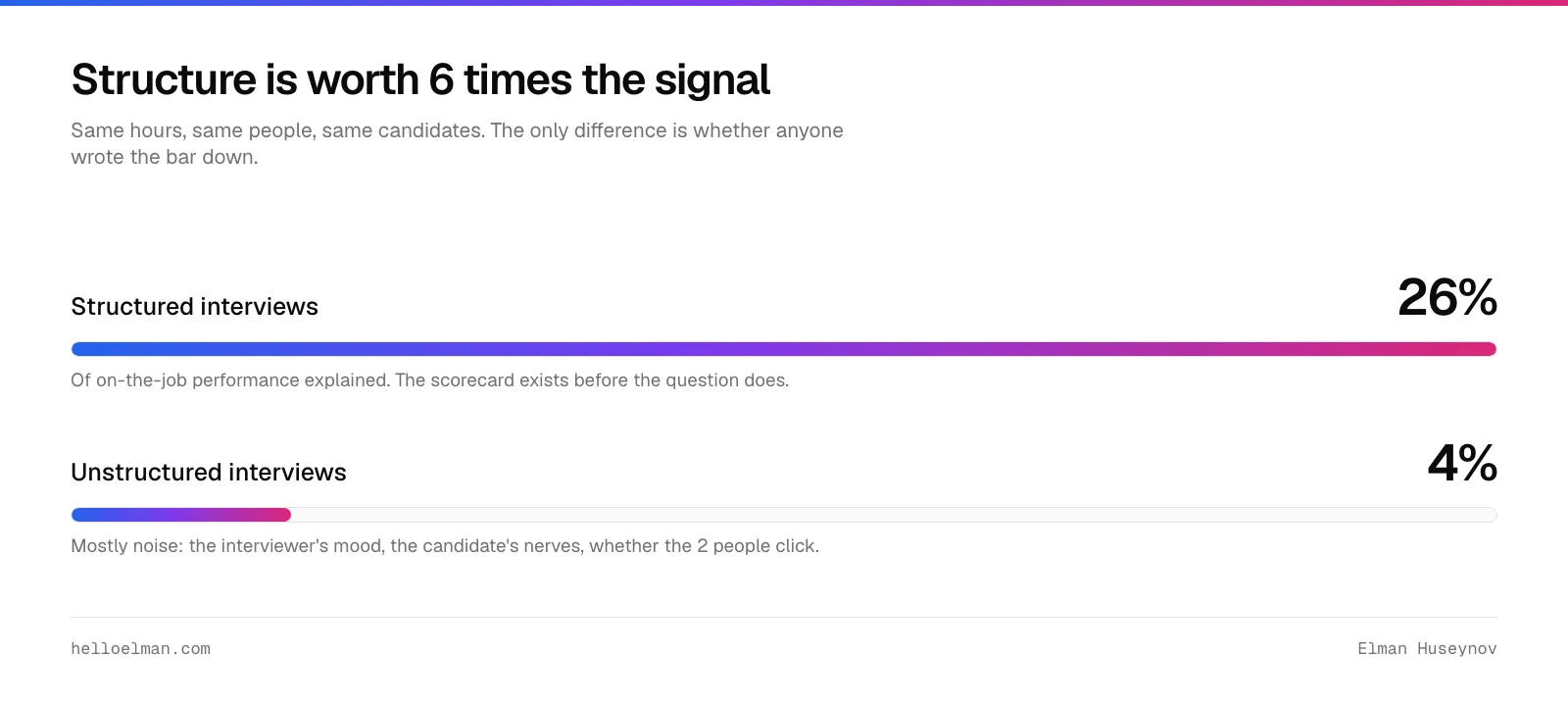
Unstructured interviews explain about 4% of on-the-job performance. Structured ones explain 26%.
Most tech interviews measure how well someone performs under artificial pressure. That is a different skill from doing the job.
I have run over 100 technical interviews and hired more than 10 engineers.
I have also watched strong engineers fail loops they should have passed. The pattern is consistent, and it is fixable.
Why does structure matter this much?
Structured interviews give every candidate the same questions and the same written bar.
Same hours, same people, 6 times more of the outcome explained.
An unstructured interview is mostly noise. The interviewer’s mood, the candidate’s nerves, whether the 2 people click.
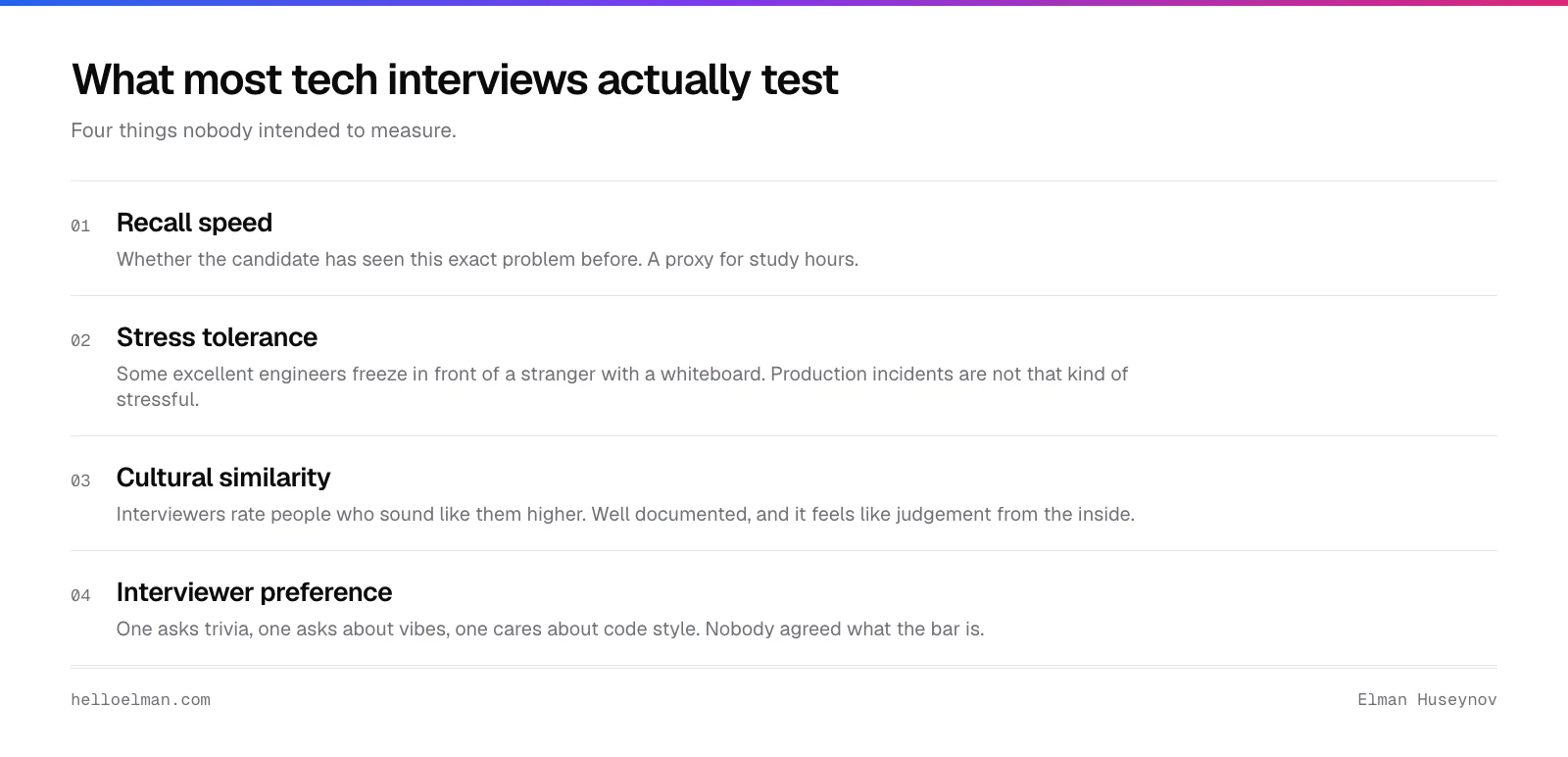
What do most tech interview questions test by accident?
Recall speed. Whether the candidate has seen this exact problem before. A study-hours proxy.
Stress tolerance. Some excellent engineers freeze in front of a stranger with a whiteboard.
Production incidents are stressful, and not that kind of stressful.
Cultural similarity. Interviewers rate people who sound like them higher. Well documented, and it feels like judgement.
Interviewer preference. One asks trivia, one asks about vibes, one cares about code style. Nobody agreed what the bar is.
What is worth measuring?
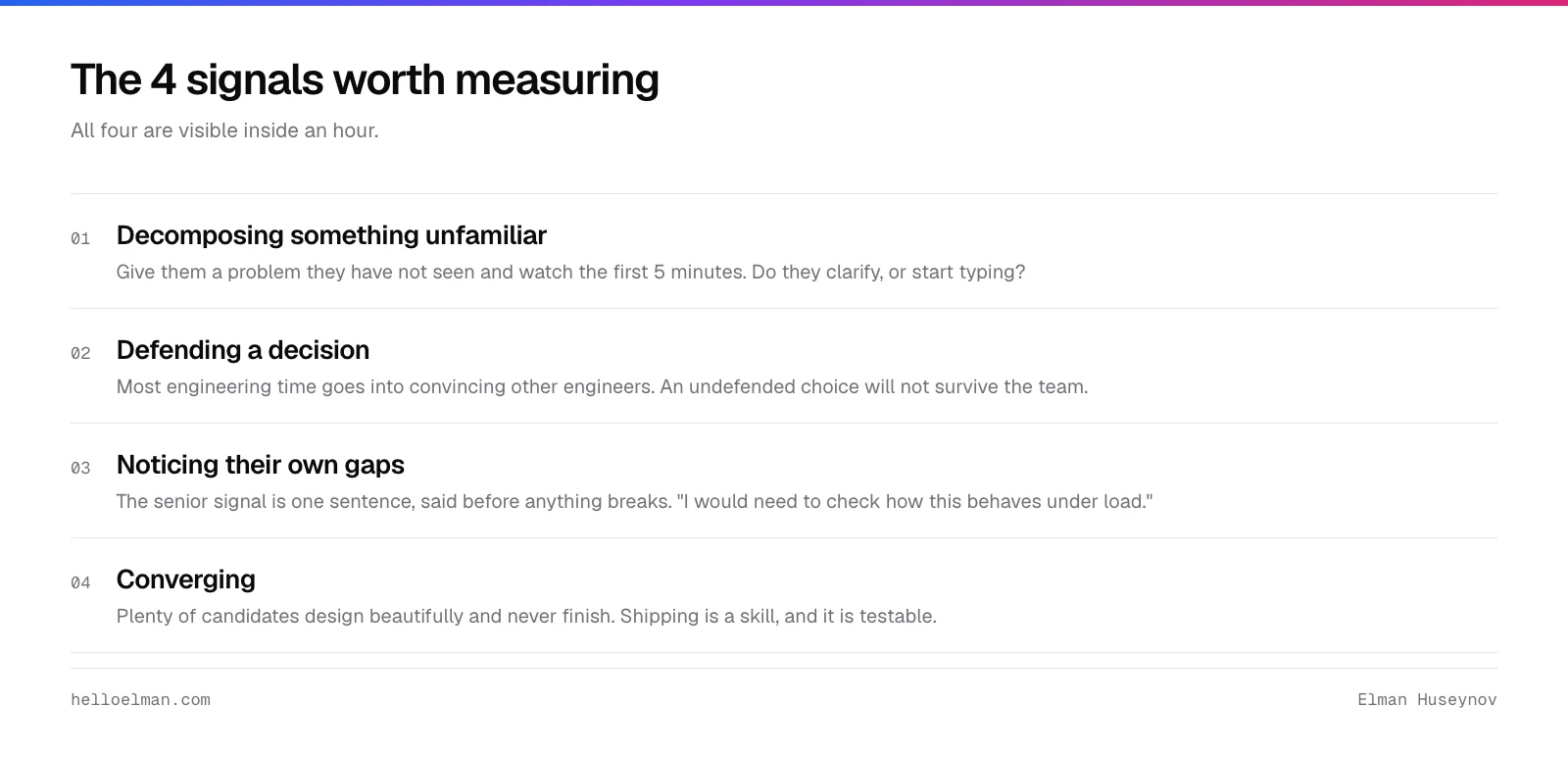
Four signals predict performance, and all 4 are visible inside an hour.
Decomposing a problem they have not seen. Watch the first 5 minutes. Do they clarify, or start typing?
Explaining a decision to someone who disagrees. Most engineering time goes into convincing other engineers.
Noticing what they do not know. The senior signal is one sentence, said before anything breaks.
“I would need to check how this behaves under load.”
Finishing. Plenty of candidates design beautifully and never converge. Shipping is a skill, and it is testable.
Three changes that fix most tech interviews
Write the scorecard before the question
Write down the evidence you expect at each level. If you cannot describe a strong answer in advance, the question is not ready.
Ground the question in the actual job
Do not ask for a red-black tree if nobody has touched one in 3 years.
Take something the team shipped last quarter. Strip it to 45 minutes. Now you are testing the work.
Submit scorecards before the debrief
Every interviewer writes their score before anyone speaks.
Without that rule, the loudest person sets the anchor and everyone drifts toward it.
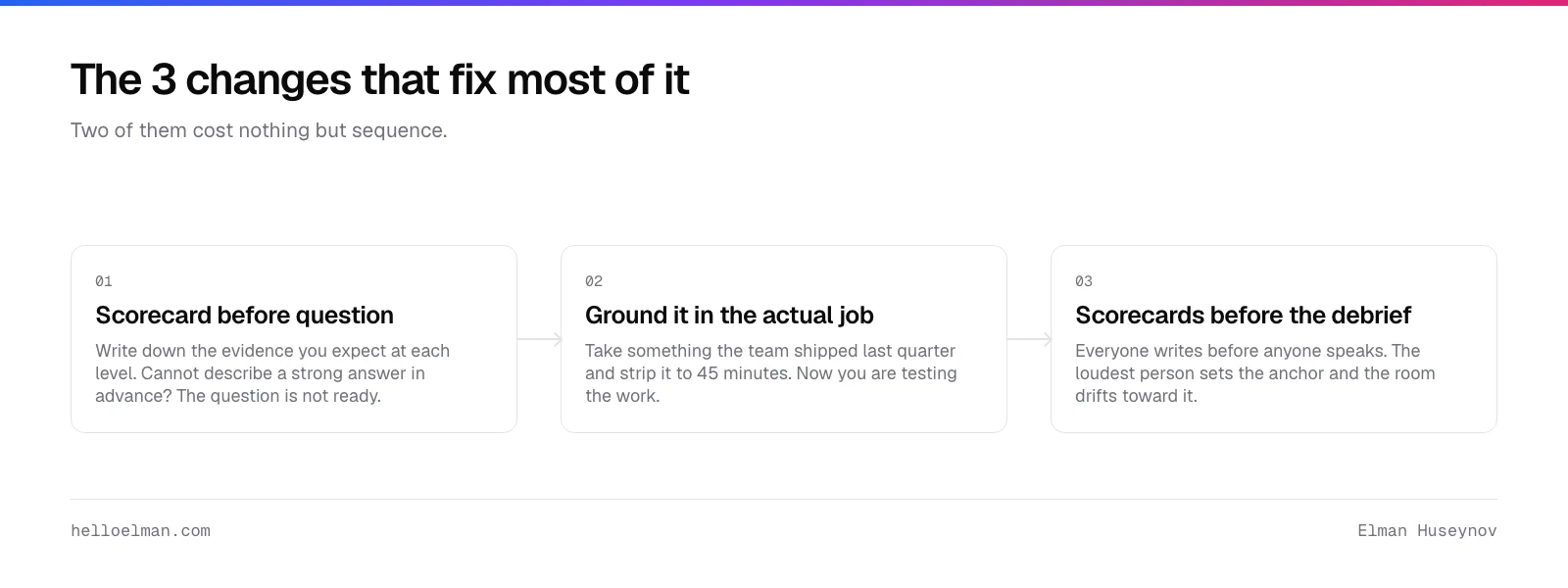
In a structured loop, the pre-written scorecard and the silent debrief matter most.
Disagreements stopped being about taste and started being about evidence.
Interviewers also got faster. They knew what they were looking for before the call started.
Which tech interview tips help the candidate?
You cannot fix someone else’s broken loop. You can make yourself easier to evaluate.
Say what you are doing while you do it. Silence gets scored as confusion.
Ask clarifying questions before you write code. Most candidates skip them, and it is a senior signal.
State your assumptions out loud. A wrong stated assumption looks thoughtful. An unsaid one looks careless.
Say when you do not know something, then say how you would find out.
Common questions
Is a take-home assignment better than a live interview?
Better signal, worse conversion. A take-home tests the actual work and removes whiteboard stress. It also costs candidates unpaid hours. Your strongest applicants drop out first. Cap it at 3 hours. Say so honestly. Never combine it with a full onsite.
Should interviewers see the candidate’s CV beforehand?
Enough to know the level and the domain, not enough to form a verdict. An interviewer who reads a full CV arrives with a hypothesis. They spend the hour confirming it. Give them the role, the level, and the 2 scorecard lines they own. Nothing else helps.
How do you test whether someone can finish?
Give a problem slightly too large for the time. Score the convergence. Watch whether they cut scope out loud, name what they drop, and land something working. Candidates who design beautifully and never converge are common. They behave the same way on a deadline.
Does interviewing get easier with a structured process?
Yes, and faster. An interviewer who knows their 2 lines stops assessing the whole person in 45 minutes. Debriefs get shorter, because each interviewer brings evidence for 2 signals. New interviewers become useful sooner, and the bar stops moving between them.
What is a technical interview?
A technical interview is a scored conversation about engineering work. It usually has 3 parts: coding, system design, and behavioural. Each round is meant to produce evidence against a written signal. Most do not. They test whether you have seen the puzzle before, which is a different thing.
The short version
Structure is worth 6 times the signal of a conversation.
Write the scorecard first. Ask about the actual job. Score before you talk.
To have the loop run at you first, book a mock interview. Everything else is detail.