How to Prepare for a FAANG Interview in 8 Weeks
Related service: Mock interviews

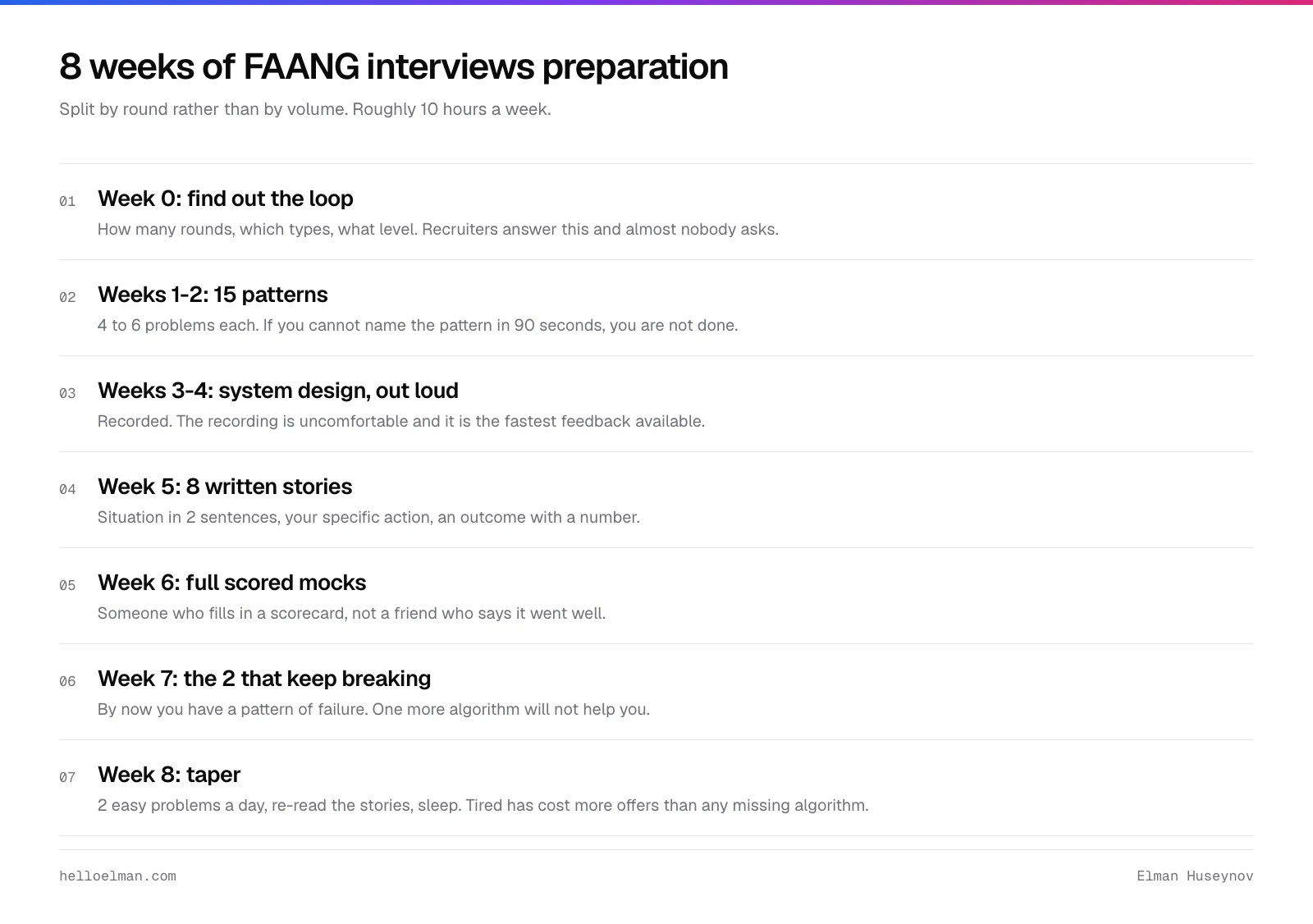
FAANG interview prep fits into 8 weeks if you sequence it. Week 0 is finding out the loop from the recruiter.
Weeks 1 and 2 are the 15 patterns, not 300 problems. Weeks 3 and 4 are system design out loud.
On this page
Week 5 is 8 written stories. Week 6 is scored mocks. Week 8 is rest.
I have run 100+ technical interviews and sat in the debriefs that follow them.
The plan assumes you know the 5 stages of a FAANG interview.
FAANG interview prep, week 0: find out the loop
Ask the recruiter how many rounds, which types, and what level. Recruiters answer this and almost nobody asks.
A Staff loop and a Senior loop share the same questions and score them differently.
Prepare for the wrong one and you pass every round with no offer.
Weeks 1 to 2: how do you prepare for the FAANG coding interview?
About 15 patterns sit behind most questions.
Two pointers, sliding window, binary search on the answer, BFS and DFS. Topological sort, heaps, intervals, union find.
Work 4 to 6 problems per pattern. Cannot name the pattern within 90 seconds? You are not done.
After each problem, write down what made the pattern applicable. That sentence is what you need under pressure, not the code.
I built AlgoPath around the 90-second test.
Weeks 3 to 4: system design, out loud
The round tests whether you can turn a vague prompt into requirements. Then pick a shape and defend it when pushed.
You already know what a queue is. Speaking is what collapses under pressure.
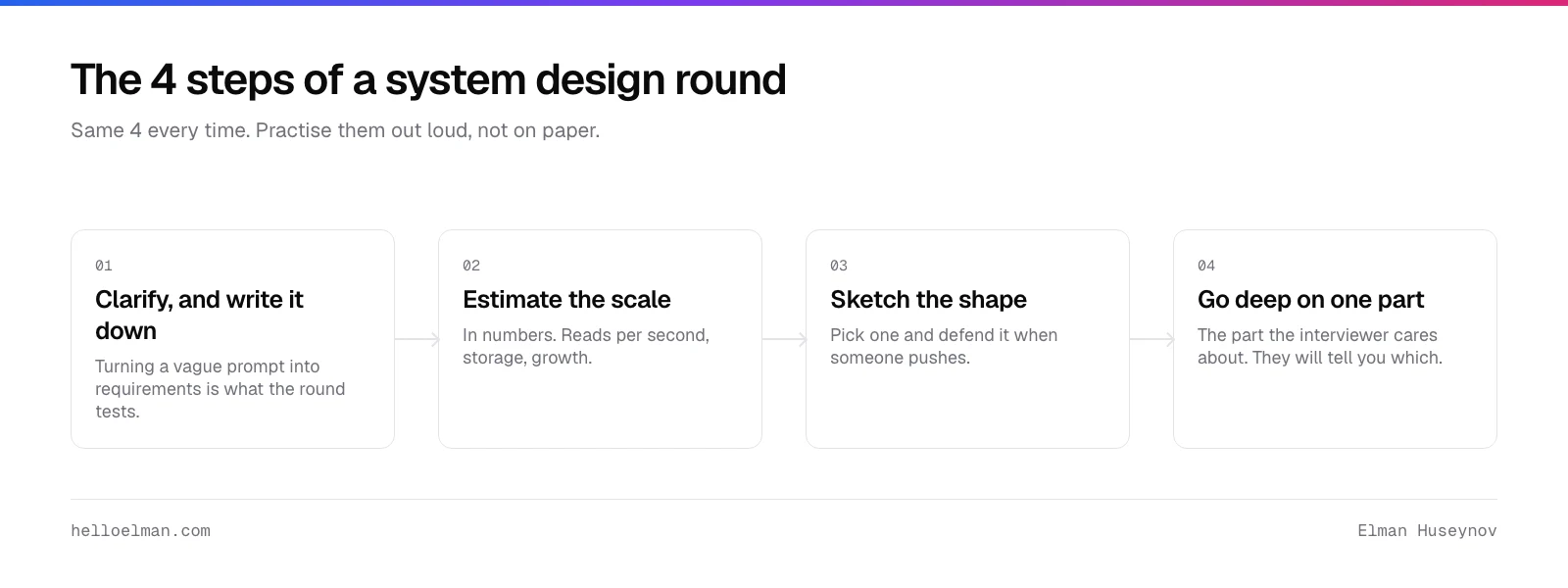
Practise the same 4 steps out loud, recorded. Clarify the requirements and write them down. Estimate the scale in numbers.
Sketch the shape. Go deep on the one part the interviewer cares about.
The recording is uncomfortable and it is the fastest feedback available.
System design is where senior candidates lose offers most often.
Week 5: behavioural, with real stories
Write down 8 stories from your actual work.
Conflict, failure, influence without authority, a decision you got wrong.
Changing your mind, delivery under pressure, mentoring, disagreeing with a manager.
Each needs the situation in 2 sentences, your action, and an outcome with a number.
Interviewers are trained to ask follow-ups. An invented story falls apart on the second question. A real one gets better.
Week 6: FAANG interview prep under pressure
Full-length mocks with someone who fills in a scorecard against a real bar. Not a friend who says it went well.
A watching stranger changes your thinking. That gap is what you are measuring.
Week 7: fix the 2 things that keep breaking
By now you have a pattern of failure. Everyone does.
You go silent when stuck. You start coding before clarifying. You cannot finish in time.
Pick the 2 biggest and drill only those. One more algorithm will not help you now.
Week 8: taper
2 easy problems a day to stay warm. Re-read your 8 stories. Sleep properly.
Walking into the room tired has cost more offers than any missing algorithm.
How long should you prepare for a FAANG interview?
FAANG interview prep takes 8 weeks at 10 hours a week. That assumes you write code daily and ship real systems.
From a standing start, it takes 4 to 6 months. Compressing the plan into 3 weeks produces recall without judgement.
What gets people rejected in FAANG interviews?
On the hiring side, rejections almost never say the candidate did not know the algorithm.
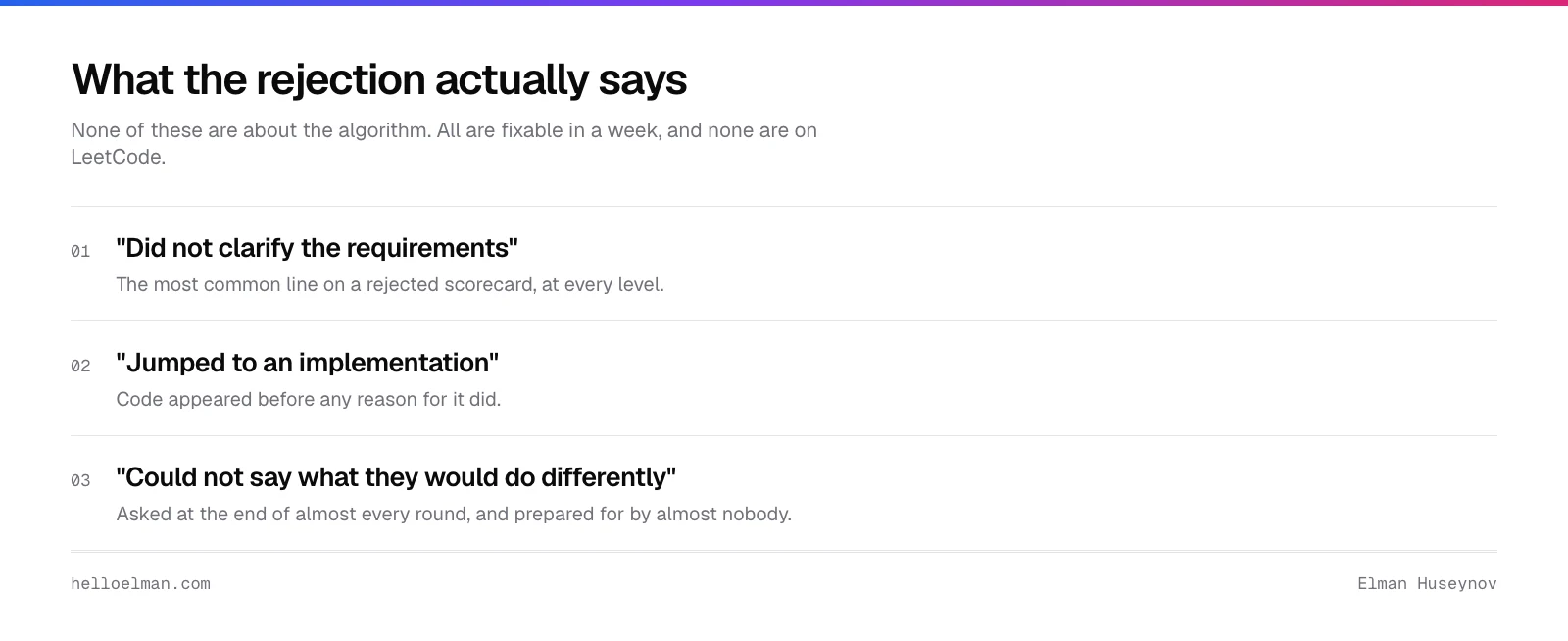
The rejection notes say: did not clarify the requirements.
Jumped to code without explaining why. Could not say what they would do differently.
All of those are fixable in a week. None are on LeetCode.
Does a referral help?
A referral gets your CV read, and it does not lower the bar.
Ask people who have seen your work. A referral is worth most in week 0, when you decide which loops to run.
A referral from a stranger carries almost no weight.
Common questions
Is 8 weeks enough to prepare for a FAANG interview?
Enough if you already write code daily and have shipped real systems. Not enough from a standing start, where 4 to 6 months is realistic. The 8 weeks assume roughly 10 hours a week. Compressing the plan into 3 weeks produces recall without judgement. That is what the loop screens out.
How many LeetCode problems should you do?
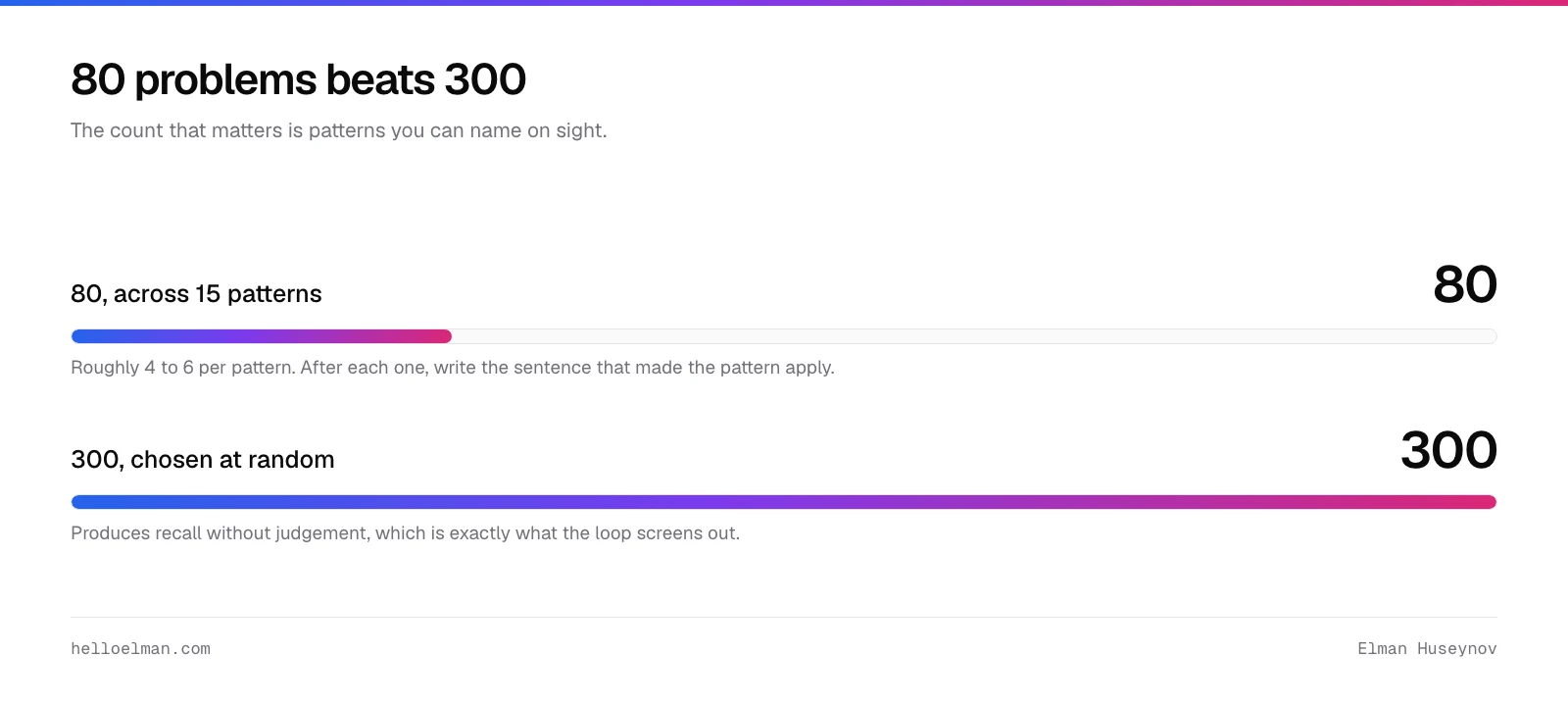
Around 80, spread across 15 patterns, beats 300 chosen at random. Count the patterns you can name on sight, and track that number each week. Stop adding problems once you can name a pattern in 90 seconds. Then move those hours to explaining solutions out loud.
Should you prepare in your strongest language?
Yes, and pick one and stay in it. The interview measures thinking under pressure. Switching languages adds a tax exactly when you have no room for one. Python and Java are safest for readability in a shared editor. Tell the interviewer which one you are using, and why.
When should you book the interview?
Book it at week 0, for week 9. An unbooked interview lets the preparation drift, and week 8 becomes week 20. Book a lower-priority company first. Run their loop for real, and treat it as the mock nobody can simulate. Then take the loop you want.
How do you prepare for a FAANG interview?
Eight weeks, split by round rather than by volume. Two weeks go on patterns. Two more on system design, spoken out loud. Then one week each: behavioural stories, a full mock loop, and your 2 weakest signals. The last week tapers. Most candidates fail on explanation, not on solving.
The short version
Find out the loop before you prepare. Learn 15 patterns, not 300 problems. Practise system design out loud.
Write your stories down. Get scored by someone real before it counts. That is what a mock interview is for.