
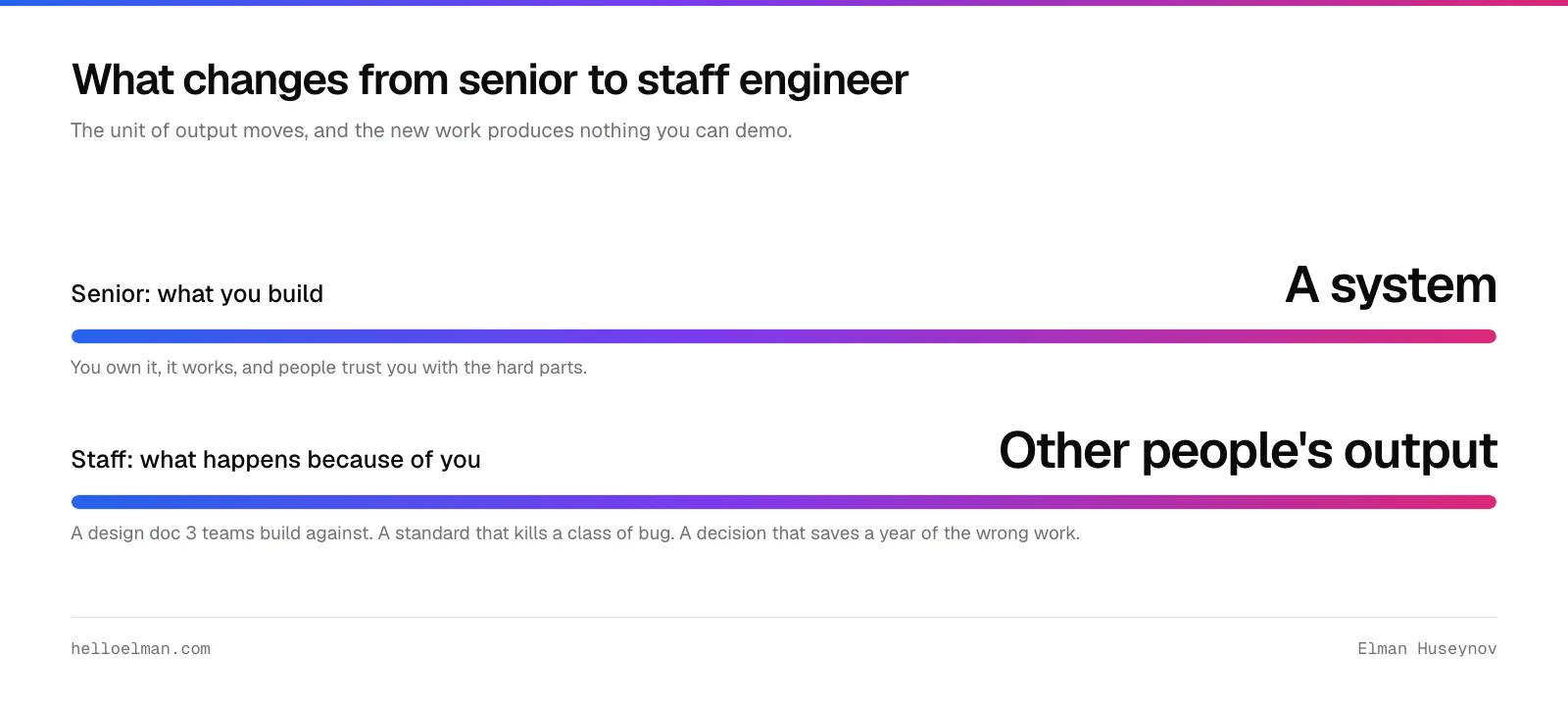
Going from senior to staff engineer changes the unit of output. Senior is measured by what you build.
On this page
Staff is measured by what happens to work you did not do.
The change in unit is why excellent senior engineers stall. They keep getting better at the thing that got them to senior.
Getting better at senior work produces no evidence for the next level.
I am a Lead Software Engineer, and I have been through levelling as the candidate.
Here is what the room talks about when a staff case comes up.
What changes from senior to staff engineer?
At senior, your output is a system. You own it, it works, people trust you with the hard parts.
At staff, your output is other engineers’ output. A design doc that 3 teams build against. A standard that stops a class of bug.
A decision that saves a year of the wrong work.
The saved year is the whole distinction, and it is uncomfortable. It produces nothing you can point at in a demo.
What does the calibration room ask?
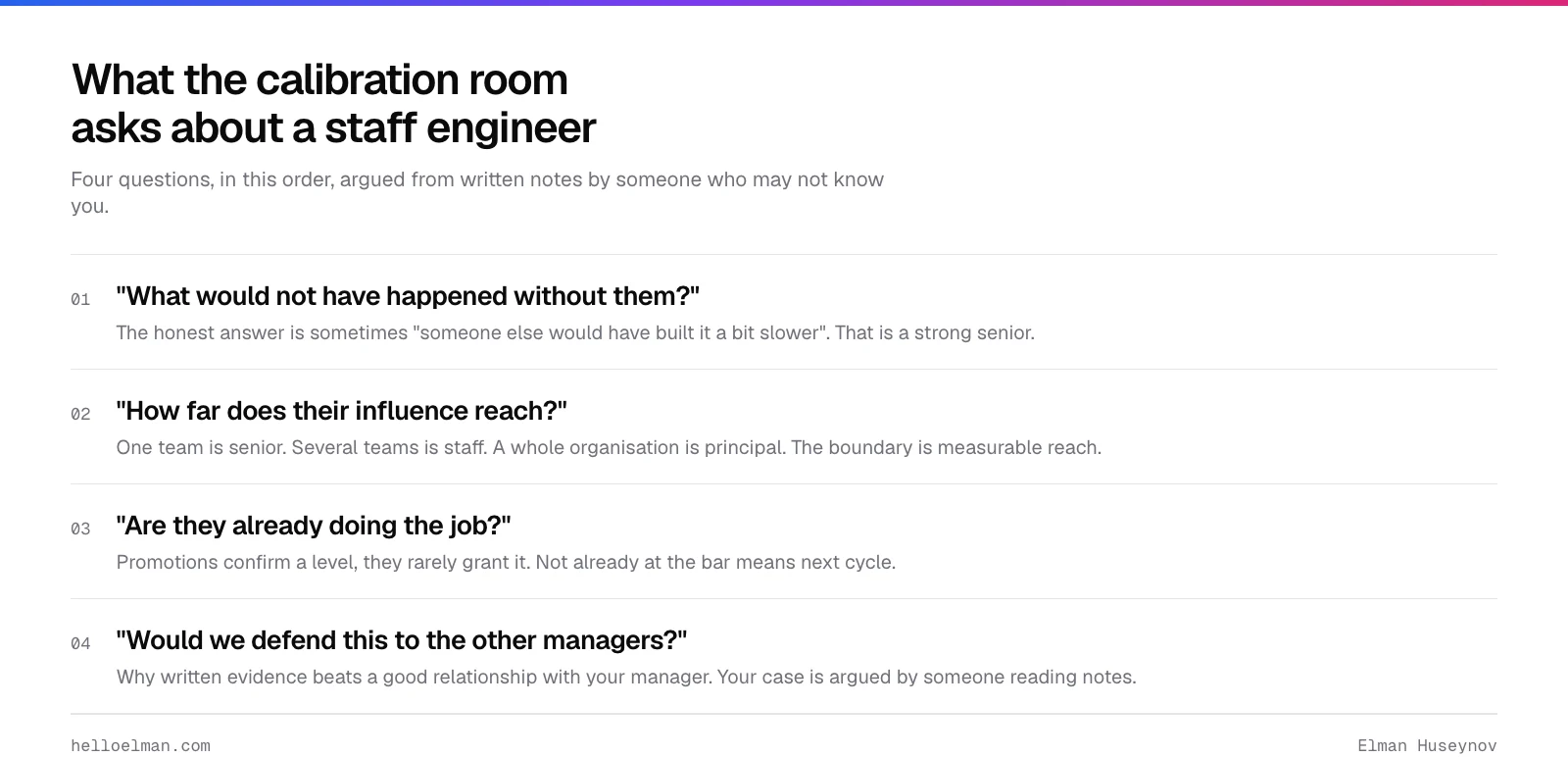
“What would not have happened without this person?”
Sometimes the honest answer is “someone else would have built it a bit slower”.
An answer like that describes a strong senior.
“How far does their influence reach?” One team is senior. Several teams is staff. A whole organisation is principal.
“Are they already doing the job?”
Promotions confirm a level, they rarely grant it. Not at the bar yet means next cycle.
“Would we defend this in front of the other managers?”
Your case is argued by someone reading written notes.
Evidence beats a good relationship with your manager, because the reader never met you.
The 4 shapes of the staff engineer role
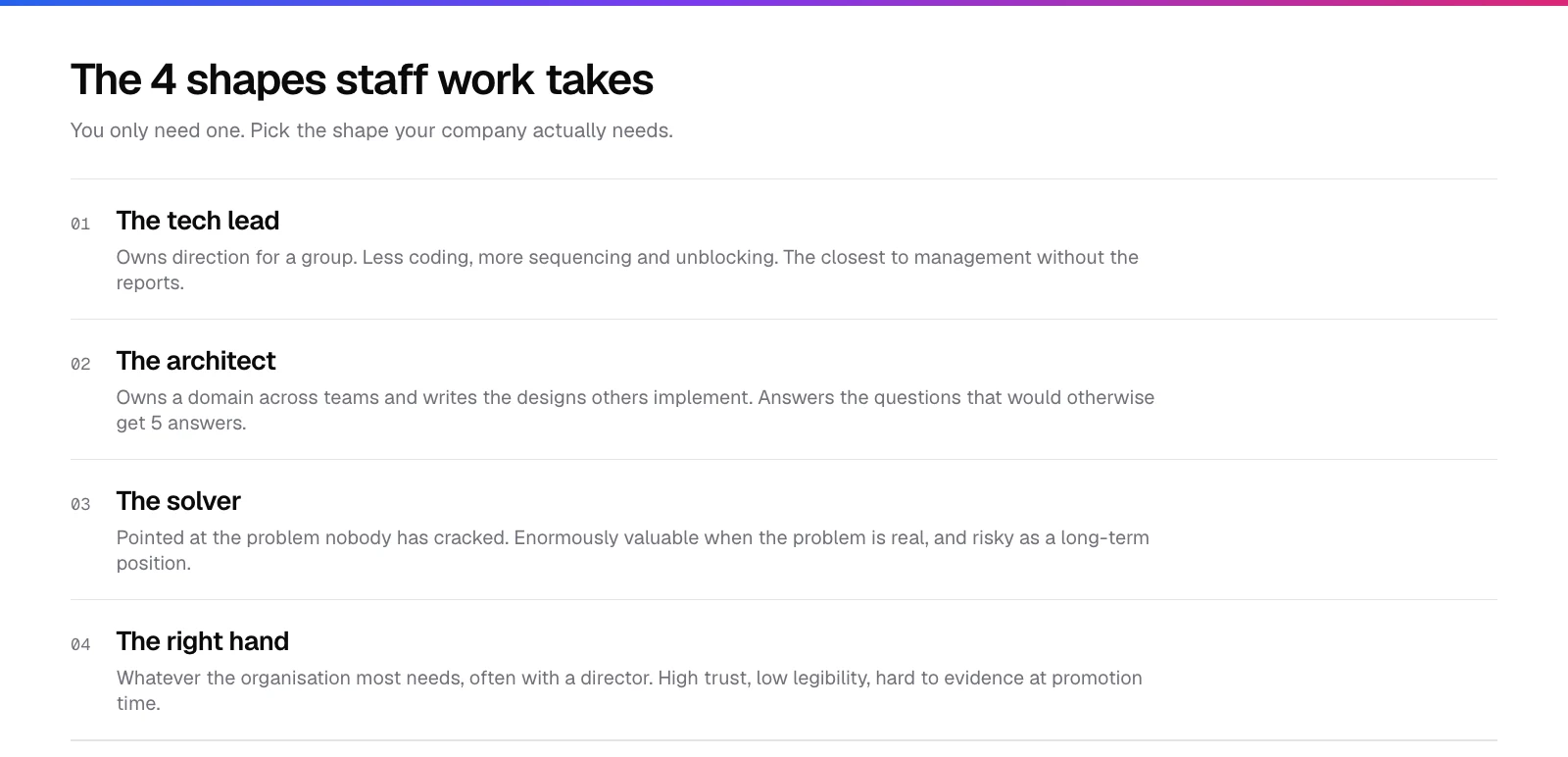
You only need one.
The tech lead. Owns direction for a group, does less coding, more sequencing and unblocking. The most common shape.
The architect.
Owns a domain across teams and writes what others implement. Answers questions that would otherwise get 5 different answers.
The solver.
Pointed at the problem nobody has cracked. Enormously valuable while the problem is real, risky as a long-term position.
The right hand.
Works on whatever the organisation needs most, usually with a director. High trust, low legibility, hard to evidence.
Pick the shape your company actually needs. A company with no cross-team problems does not promote architects.
Why do good engineers stall at senior?
Stalled seniors optimise for being needed.
Being the only person who understands the payment system feels like security.
In calibration it reads as a bus factor of 1.
Stalled seniors wait to be told. Staff-scope work is never handed out. It is scoped by noticing something broken across teams.
Stalled seniors do the work and never write it down.
Invisible influence gives the room nothing to argue with.
The most common failure, and entirely fixable.
The company has no staff roles open. Sometimes the ladder stops. Better to find out in month 3 than in year 3.
How do you become a staff engineer, starting this quarter?
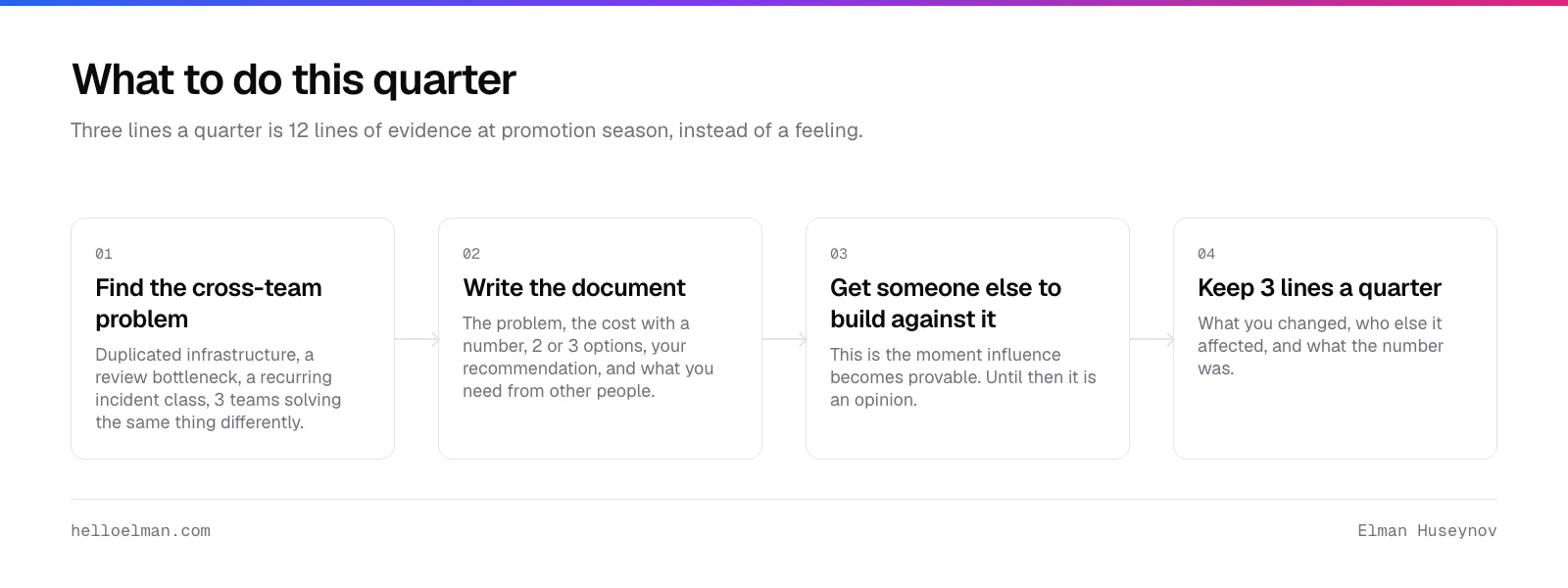
Find a problem that costs more than one team.
Duplicated infrastructure, a review bottleneck, an incident class that keeps recurring.
Write the document. The problem, the cost with a number, 2 or 3 options, your recommendation. What you need from others.
Get somebody outside your team to build against it. That is the moment influence becomes provable. Until then it is an opinion.
Keep a record. Every quarter, 3 lines: what you changed, who else it affected, the number.
At promotion season you have 12 lines of evidence instead of a feeling.
Why do staff engineers write so much?
Influence across teams travels through documents and conversations. There is no other channel.
The feedback loop goes from hours to months, the same way it does for managers. That is the trade.
If you dislike writing, the tech lead or solver shapes suit you better.
Common questions
How long does senior to staff usually take?
Three to 5 years at one company is common. It depends more on whether staff-scope problems exist than on your effort. Engineers who move companies to get the title often arrive without the reach. They struggle in the first year. Check the ladder before you commit 3 years to it.
Do staff engineers still write code?
Yes, and less of it, and the code changes character. More prototypes that prove a direction, and more of the risky first slice. Less of the steady feature work. A staff engineer writing the same volume as a senior is usually a senior. With a different title on the org chart.
Is staff engineer equivalent to engineering manager?
Same level on most ladders, same compensation band, different work. Both are measured on other people’s output. The manager owns the people and the process, the staff engineer owns the technical direction. Moving between them later is normal. Doing both at once is how people burn out.
What if your company has no staff level?
The honest answer is a different company. It is cheaper to learn that in month 3 than in year 3. Ask your manager how many staff engineers the organisation has. And when the last promotion happened. Two vague answers to those questions is the answer.
Is staff engineer above senior?
Yes. Staff is the level above senior at most companies. It is not a longer version of the same job. Senior is measured by what you build. Staff is measured by what happens to work you did not do. That is why time served at senior does not get you there.
The short version
Senior is what you build. Staff is what happens because of you.
Find a problem that spans teams. Write the document. Get someone outside your team to build against it.
Keep a quarterly record, so the room has something to read.
Check that your company has the role open before you spend 2 years earning it.
For an outside read on whether you are already at the bar, book career coaching.
Career coaching gives an honest answer from someone who has been through it.