Software Engineer Job Search: The Hidden Market Is Referrals
Related service: Resume and CV review
A software engineer job search works better on queues than on CVs.
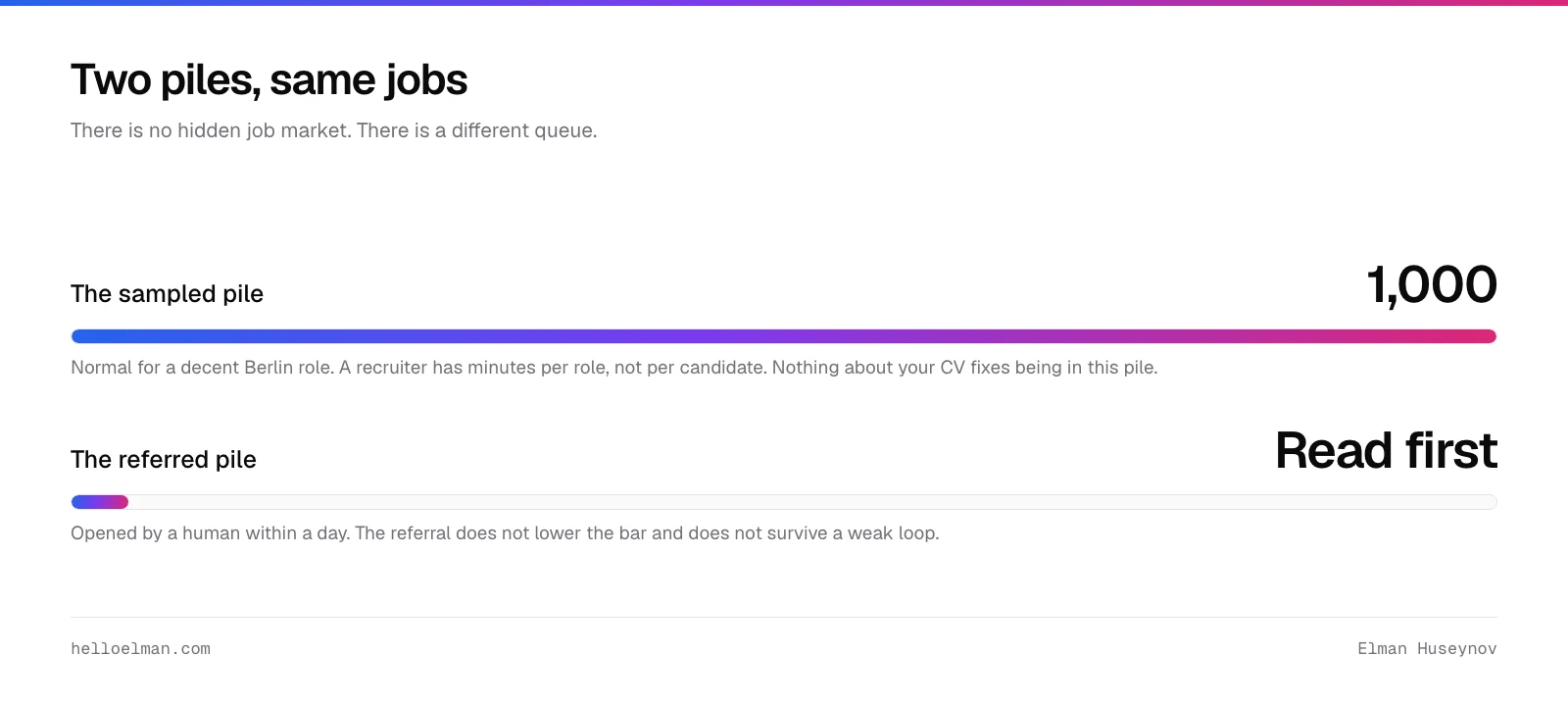
For a decent role in Berlin, 1,000 applications is normal.
Recruiters read the referred pile before sampling the rest.
A referral gets your CV read by a person within a day. It does not lower the bar, and it does not survive a weak loop.
On this page
There is no hidden job market.
Same jobs, different queue. In one you are application 847.
In the other a human opens your CV within a day.
Why does the software engineer job search feel like a void?
For a decent Berlin role, 1,000 applications is normal.
A recruiter has minutes per role, not per candidate.
Recruiters read the referred CVs and the ones a hiring manager forwarded.
The rest get sampled.
Nothing about your CV fixes being in the sampled pile. Being in a different pile does.
What does a referral actually do?
A referral gets your CV read by a person, quickly, and that is all.
A referral does not lower the bar. A company where it does has a different problem.
Most people ask for referrals wrong. They ask for the outcome.
What is actually being given is 5 minutes of attention.
How do you ask without being annoying?
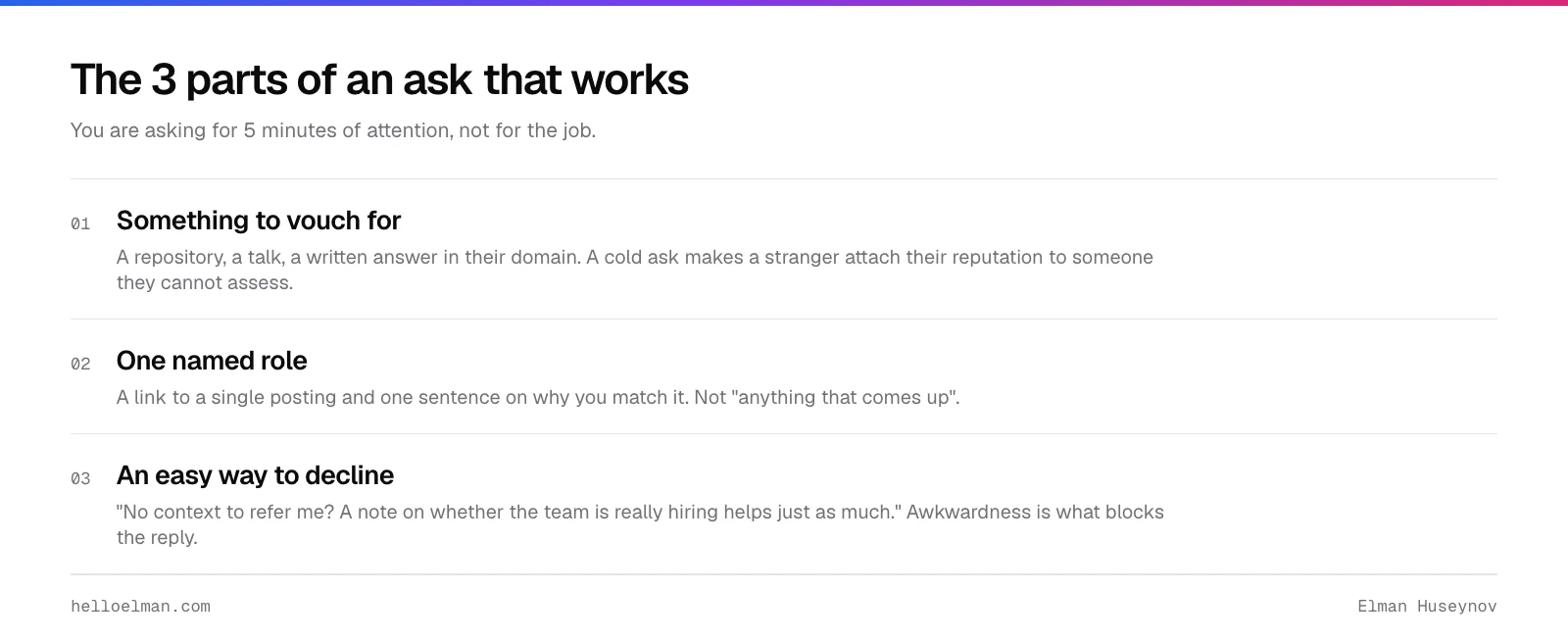
In 3 parts: evidence, one named role, and an easy way to say no.
The last of those raises the response rate more than anything else.
The bad version. “Hi, we have never spoken. Could you refer me to a role?”
A cold ask makes a stranger attach their reputation to someone they cannot vouch for.
Most decline, and the ones who agree are guessing.
Give the referrer something to vouch for. A repository, a talk, or a written answer in their domain.
Name the specific role. A link to 1 posting, and 1 sentence on why you match it.
Make declining easy. “No context to refer me? A note on whether the team is really hiring helps just as much.”
Making it easy to decline removes the awkwardness of saying no. Awkwardness is what blocks the reply.
Where do you find people worth asking?
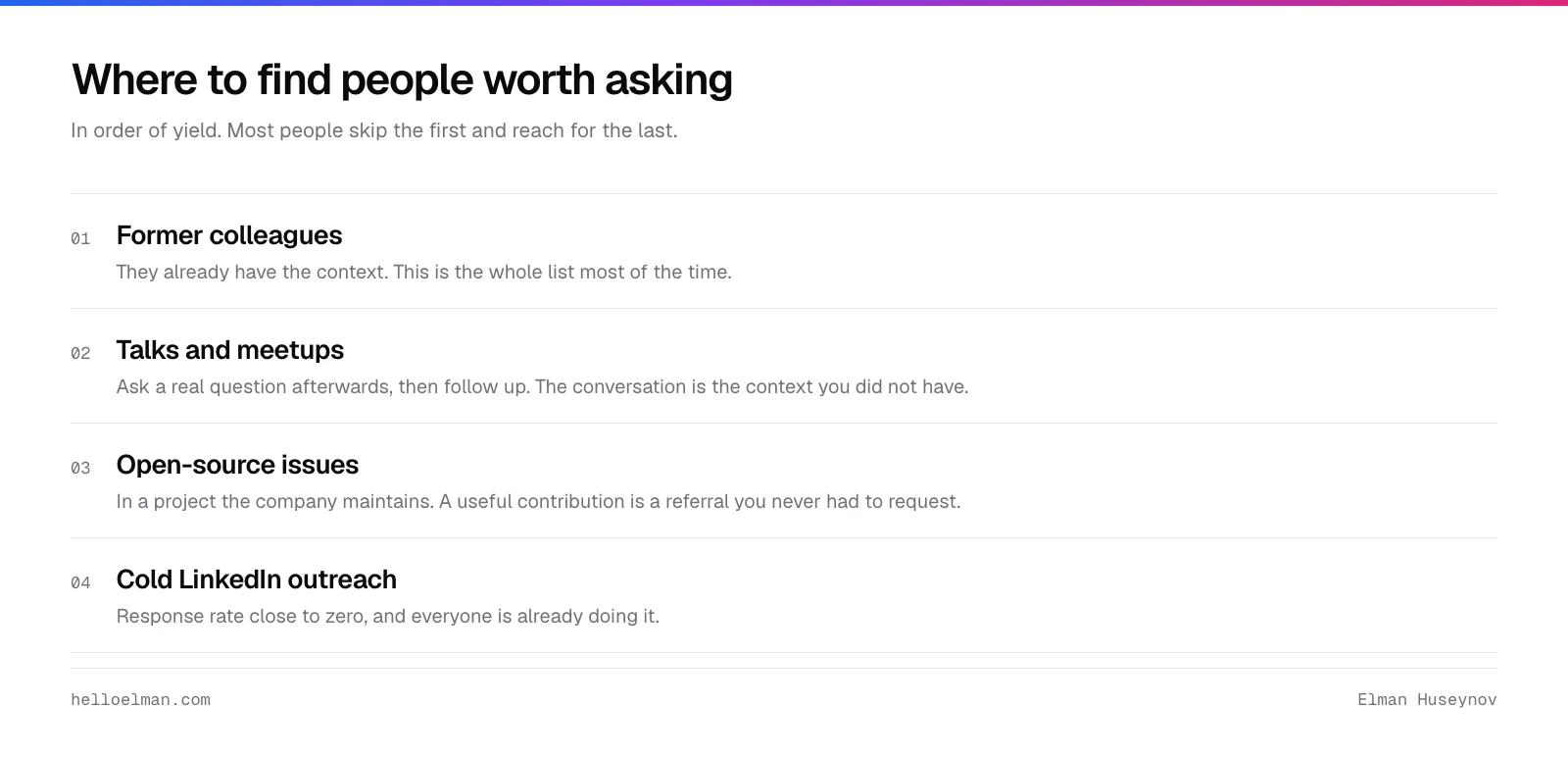
Former colleagues first. They already have the context.
Most people skip them and reach for strangers.
Conference and meetup talks come next. Ask a real question afterwards, and follow up.
Open-source issues in a project the company maintains work the same way.
A useful contribution is a referral you never had to request.
LinkedIn cold outreach has a response rate close to zero and everyone is doing it.
Are external recruiters worth using?
Yes, for what they are actually good at.
Recruiters are paid by the company, usually 15 to 30% of first-year salary.
A recruiter’s incentive is to place someone.
Recruiters know which companies are hiring and which post ghost roles.
A good recruiter knows the real band, and reaches a hiring manager the same week.
Be direct with them about what you want. Salary floor, location policy, level.
A vague candidate is a hard candidate to place and they will deprioritise you.
What do you do when you know nobody?
Write in public. Pick something you actually solved and write down how.
Three of those over 3 months and you have artefacts people can vouch for.
Building artefacts is the slow route, and the one that compounds.
The slow route is how you end up with people worth asking.
The software engineer job search mistake that wastes the most time
Applying to 200 roles with the same CV.
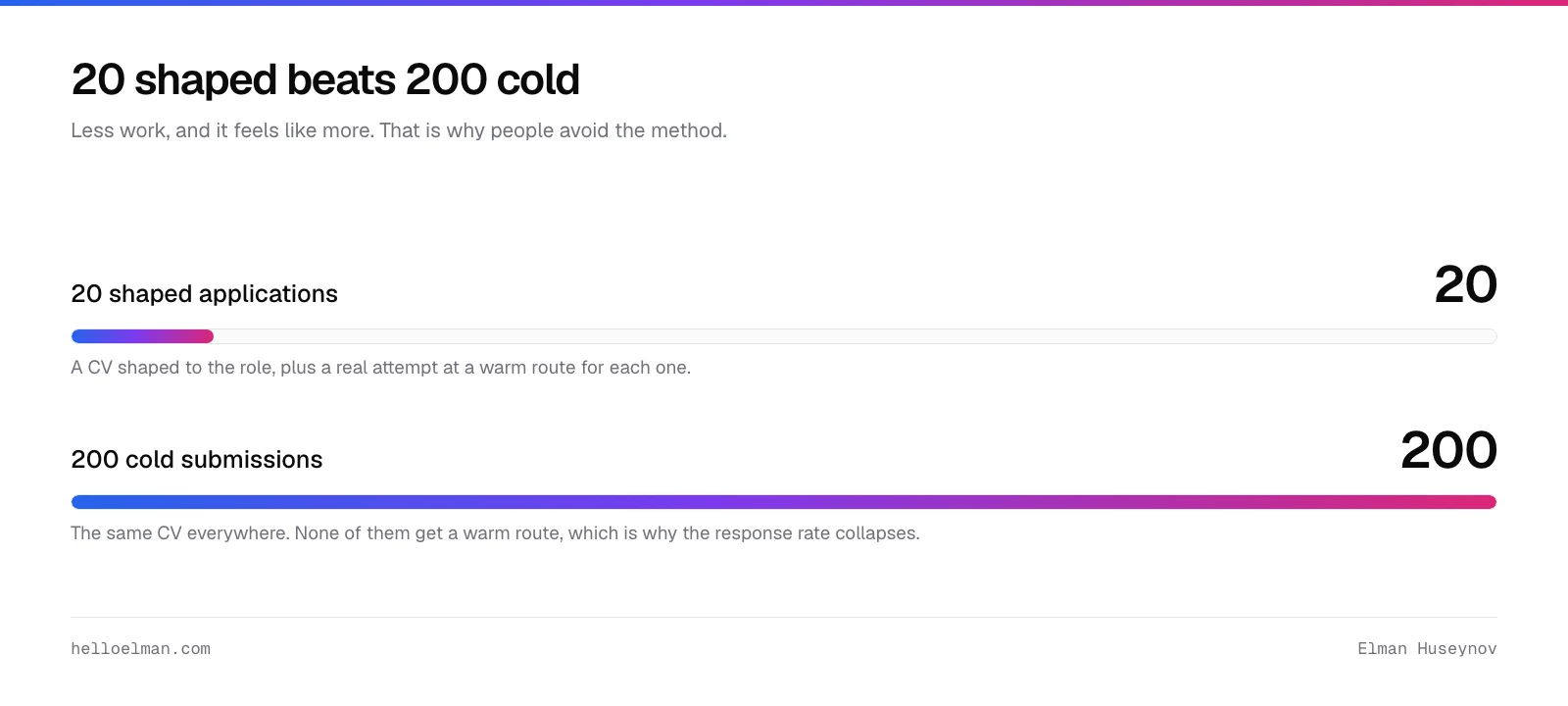
20 applications with a CV shaped to each role beats 200 cold submissions.
Each of those 20 needs a real attempt at a warm route.
Twenty shaped applications are less work, and they feel like more. That is why people avoid the method.
Common questions
What percentage of jobs are filled through referrals?
Estimates vary too much to quote a single number. The useful figure is different anyway. Referred candidates get read. Unreferred ones get sampled. Ask any recruiter how many CVs they open per role. The answer is a fraction of what arrives, and that fraction is the game.
Should you apply through the portal as well as getting a referral?
Yes, and let the referrer tell you the order. Some systems need the application to exist before a referral can attach. Others create it for you, and a duplicate causes confusion. One message asking how their system works saves a week of silence.
How do you ask someone you have not spoken to in 5 years?
Say the gap out loud and keep it short. Acknowledge the time. Say what you are looking for. Name the role. Give them the easy exit. Former colleagues respond far better than strangers, even after years. The context that makes a referral defensible is still there.
How many applications should you have running at once?
20 good ones beats 200 cold submissions, and it is less work than it feels. Each one needs a CV shaped to the role. And a real attempt at a warm route in. Running 200 at once means none of them get either. That is why the response rate collapses.
How do you find a software engineering job?
Not through the portal, if you can avoid it. A referral moves your CV from a pile of 1,000 to a pile of 5. Ask people who have worked with you. Apply through the portal as well. Treat external recruiters as a channel, not a strategy.
The short version
The queue you are in matters more than the CV you send.
Referrals get you read, not hired. Ask for 5 minutes of attention, not for the job.
Give people something to vouch for before you ask them to vouch.
Want the whole software engineering job search planned rather than improvised?
Resume and CV review is a written report and a 60-minute call.