Software Engineering Mentorship: What a Mentor Can and Cannot Do
Related service: Software engineer career coaching

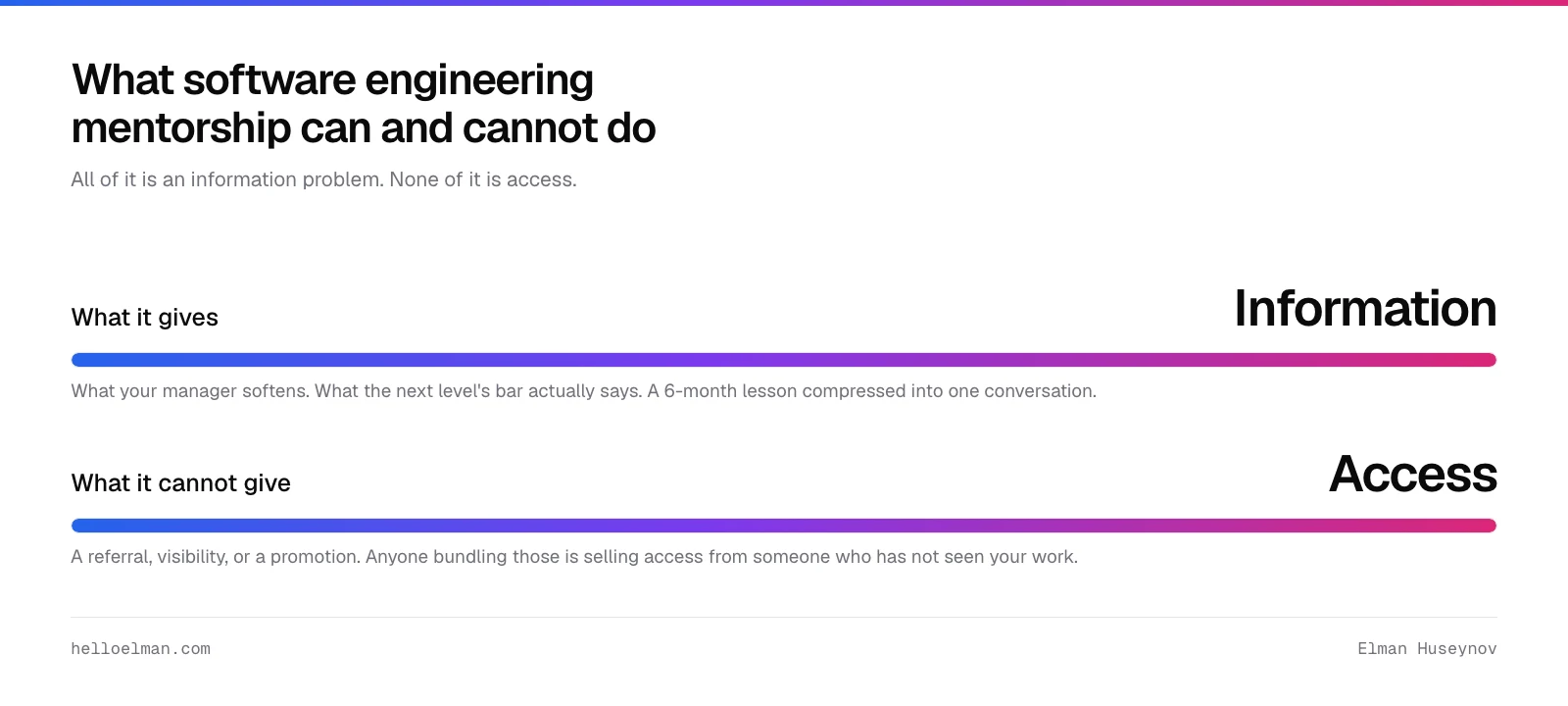
Software engineering mentorship gives you information you cannot get inside your own company.
A mentor tells you what your manager softens.
A mentor knows what the next level’s bar says. They shorten a 6-month lesson into one conversation.
A mentor cannot get you promoted, refer you anywhere meaningful, or make you visible.
On this page
A mentor cannot get you promoted. They can tell you exactly why you were not.
A precise reason for a rejected promotion is more useful, and much rarer.
I am a Lead Software Engineer. I have run more than 100 technical interviews.
Most of what gets written about software engineering mentorship skips the part that matters.
What does software engineering mentorship actually change?
Three things, and they are all information problems.
A mentor tells you what your manager will not. A manager has to work with you tomorrow.
Someone outside your company does not.
A mentor knows what the next level looks like from reading real promotion packets.
A good mentor shortens a 6-month lesson into 1 conversation.
Most engineers have never read a real promotion packet. They guess at a bar written down somewhere they cannot see.
Everything else people claim about mentorship is a side effect.
What can a mentor not do?
A mentor cannot do 3 things.
A mentor cannot refer you anywhere meaningful. A referral comes from someone who has seen your work.
Paid sessions are not that.
A mentor cannot make you visible, because visibility comes from work other people depend on.
A mentor also cannot fix a company with no path to your level.
What about referrals?
Anyone offering referrals as part of a mentoring package is selling something else.
A referral is a favour from someone who has seen your work.
What a mentor gives instead is the read on whether your case is ready.
Agree what happens between sessions before you book the first one.
Write the question down beforehand. Half the value is in choosing it.
One well-chosen question is worth more, and you cannot get the answer internally.
What do most people get wrong?
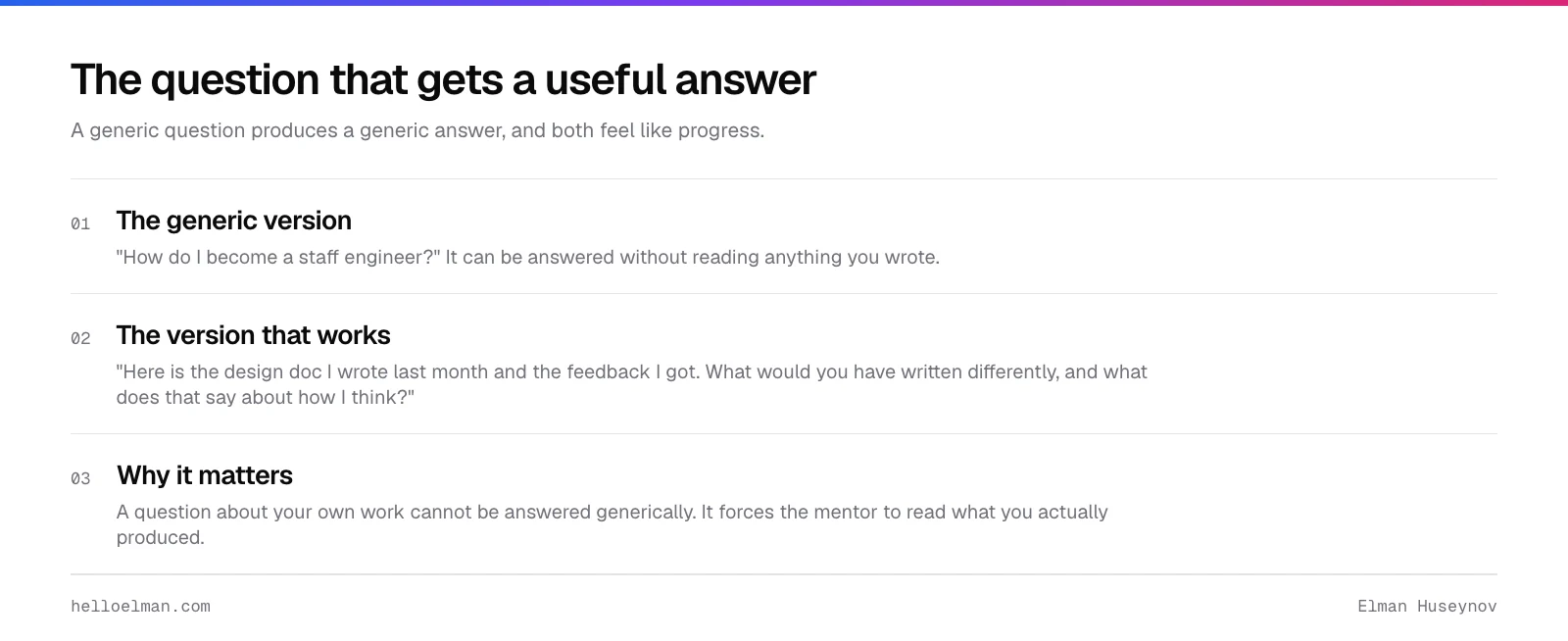
Most people ask for general advice. “How do I become a staff engineer” is a generic question.
A generic question produces a generic answer.
The useful version points at an artefact.
“Here is the design doc I wrote last month, and the feedback I got.”
“What would you have written differently, and what does that say about how I think?”
A question about your own work cannot be answered generically. It forces the mentor to read what you wrote.
How do you use a session properly?
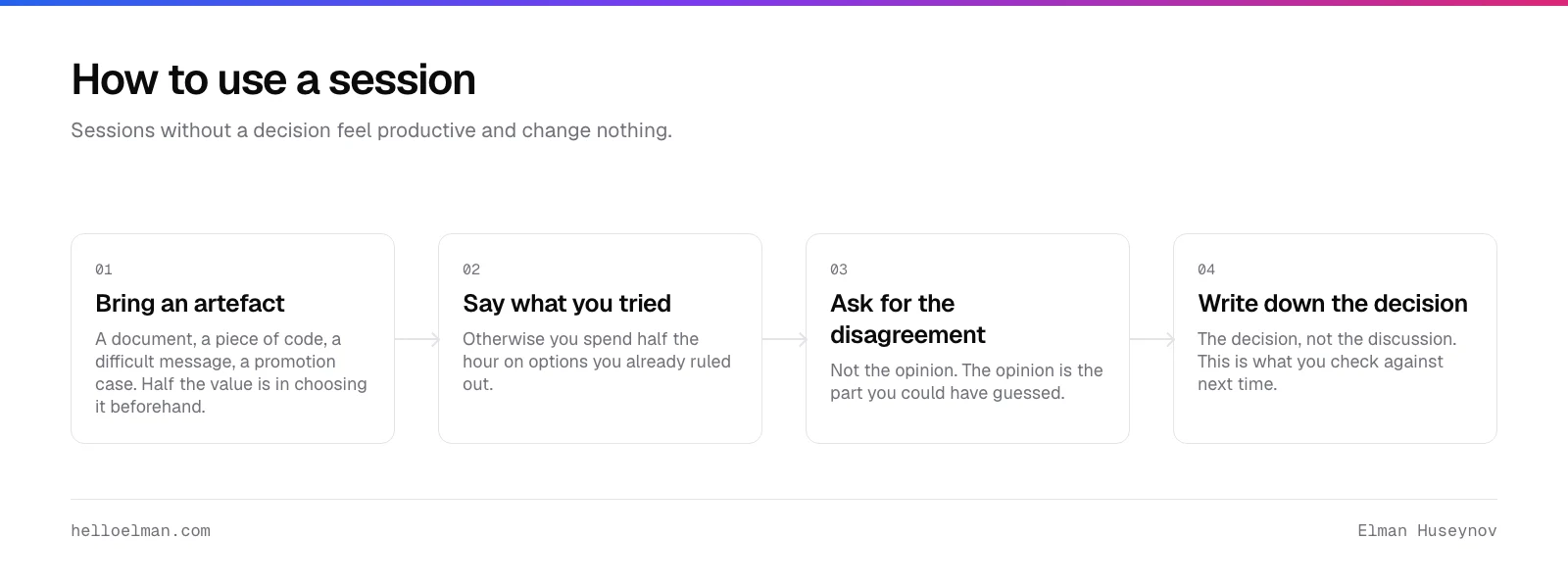
Bring an artefact: a document, a piece of code, a difficult message, a promotion case.
Say what you already tried. Otherwise you spend half the time on ruled-out options.
Ask for the disagreement rather than the opinion. Then write down the decision at the end, not the discussion.
Sessions without a decision feel productive and change nothing.
Peer mentoring is underrated
You do not always need someone senior.
Someone 1 level ahead remembers the specifics.
Someone 1 level ahead knows what the committee asked last quarter. They were in front of it.
Someone 5 levels ahead remembers the principles, which are useful and much harder to apply.
When is software engineering mentorship the wrong tool?
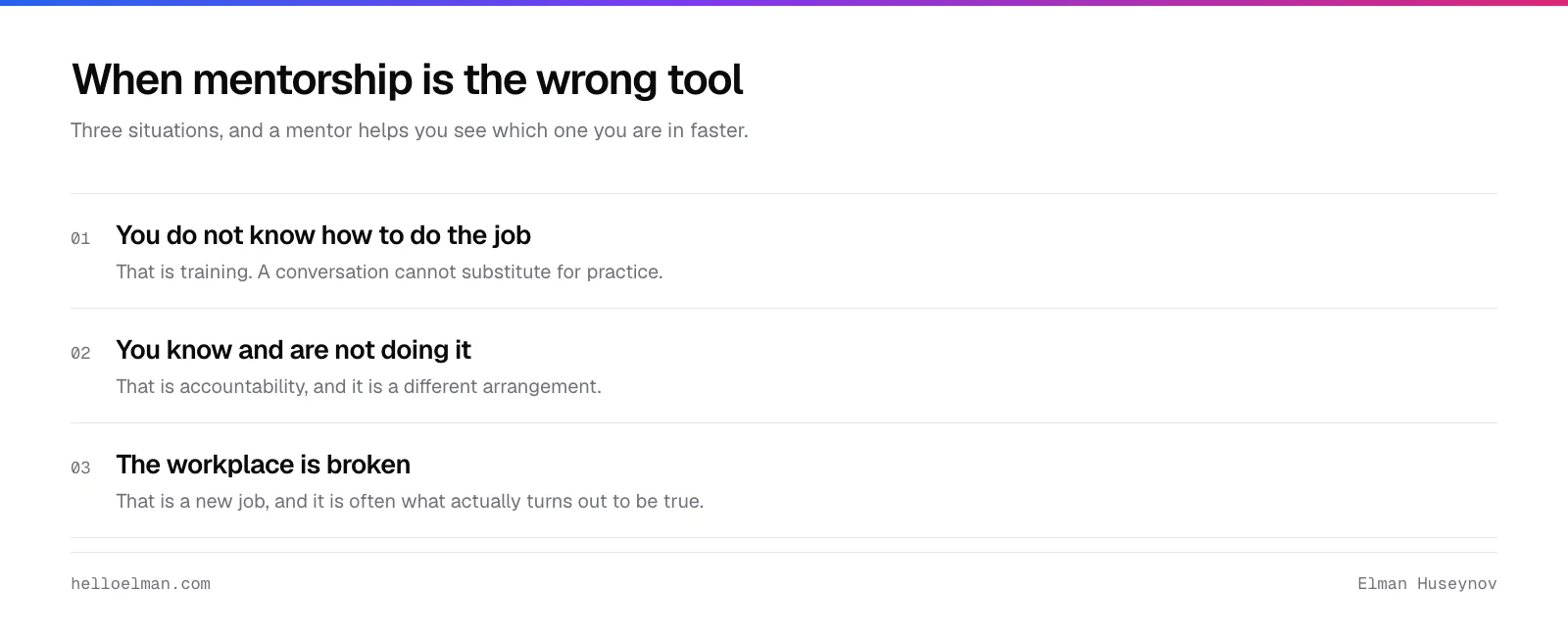
In 3 situations. If you do not know how to do the job, you need training.
If you know what to do and are not doing it, you need accountability.
If your workplace is genuinely broken, you need a new job.
A mentor helps you see that faster.
Needing a new job is often what actually happens.
What I look for as a mentor
The ones who improve fastest arrive with something they made.
The best mentees also bring a decision they are stuck on. And a willingness to be told they are wrong.
The ones who stall want reassurance. That is a legitimate need, and mentorship does not meet it.
Common questions
How often should you meet a mentor?
Every 2 weeks works better than weekly. You need time between sessions to have done something worth discussing. Monthly loses the thread. 4 sessions is enough to know whether the match works. A mentor who cannot say that honestly is the wrong mentor.
Should you pay for mentorship?
Paying buys you honesty and a scheduled hour. Free mentorship rarely sustains that past month 3. What it should never buy is a referral or an introduction. Anyone bundling those is selling access. Access from someone who has not seen your work is worth nothing.
Is a mentor inside your company better than an outside one?
Inside knows the politics. Outside will say the sentence nobody inside will. Use both if you can. An internal mentor cannot tell you the company has no path to your level. They work there, and that answer costs them something.
How do you know a mentoring relationship is working?
Something changed at work that would not have changed otherwise. A conversation you had, a decision you made differently, a case you wrote down. If after 3 months you cannot name one, the sessions are only company. Stop paying for them.
How do you find a software developer mentor?
Ask someone 1 or 2 levels above you who has seen your work. A stranger cannot mentor you, because mentorship runs on context. Inside your company is easier to arrange and worse for honest career advice. Outside is the reverse. Most people need both.
The short version
A mentor gives you information you cannot get from inside your own company.
A mentor cannot give you visibility, referrals or a promotion.
Bring real work. Ask for the disagreement. Leave with a decision.
Want that from someone who interviews in the real loop?
I no longer sell monthly mentorship. A 60-minute career coaching session ends with a written 6 to 12 month roadmap.
A leadership mock interview is scored like a real loop.