A software engineer promotion packet is read out by your manager. The room is other managers who have never seen your work.
On this page
Some companies call it a promotion document. The structure is the same.
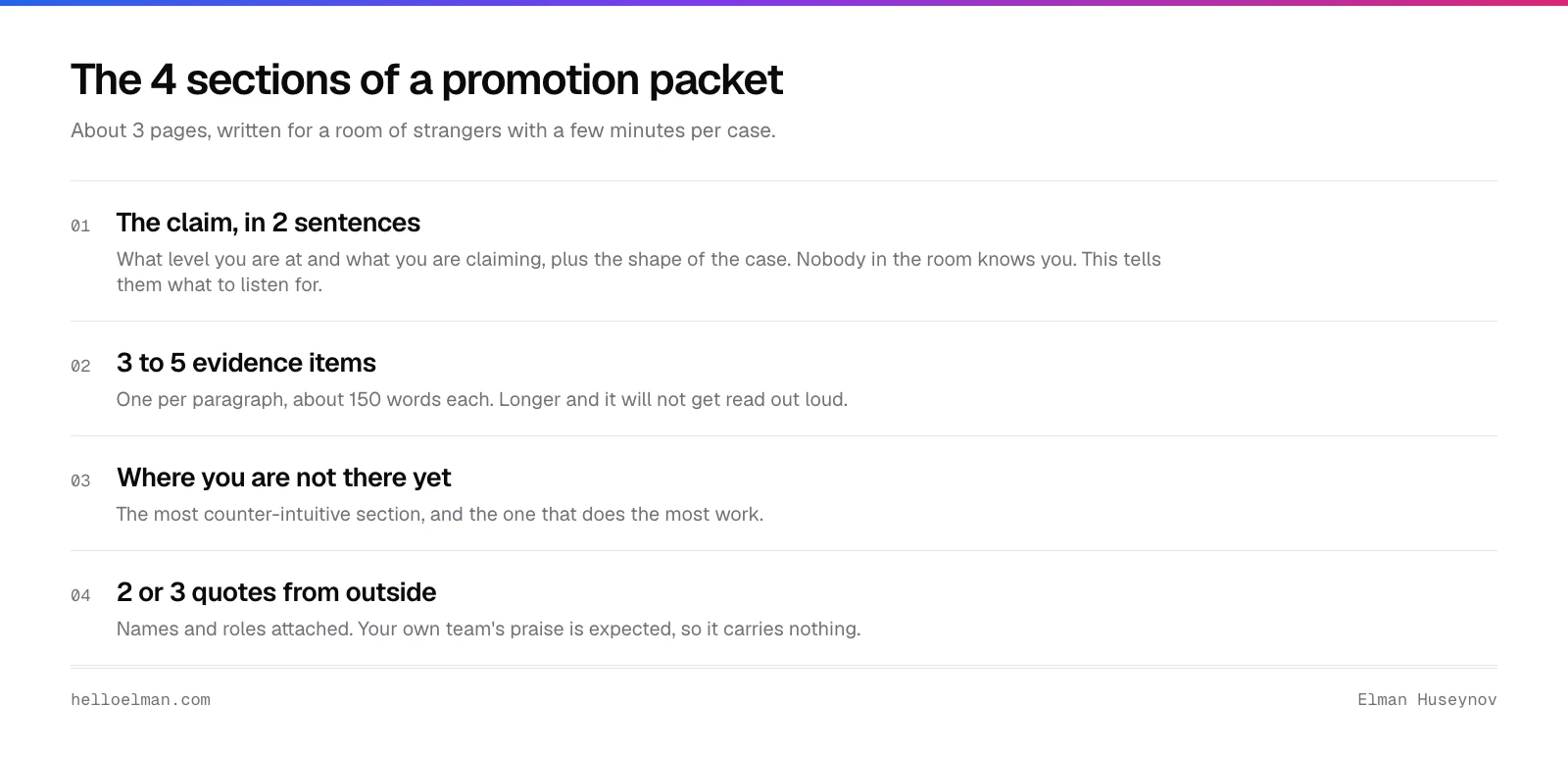
A promotion packet needs 4 sections. The claim in 2 sentences. 3 to 5 pieces of evidence with numbers.
The area where you are not there yet. Quotes from outside your team.
The packet has to survive being summarised by someone else, to strangers, under time pressure.
Here is what works and what quietly sinks people.
What is the promotion room doing?
Five to 10 managers, an hour, several candidates, so each case gets a few minutes.
Your manager reads a summary and someone asks a question. If the answer is in the packet, the room moves on.
If it is not, the case gets deferred, and deferred usually means next cycle.
The packet has 1 job: make the answer to the obvious question already present.
Promotion packet example: the 4 sections
About 3 pages.
1. The claim, in 2 sentences
I am claiming staff. Over the last 3 quarters I owned the migration off the legacy ingestion path, which 4 teams built against, and I now set the standard the whole platform group follows for schema changes.
Nobody in the room knows you. This tells them what to listen for.
2. The evidence, 3 to 5 items
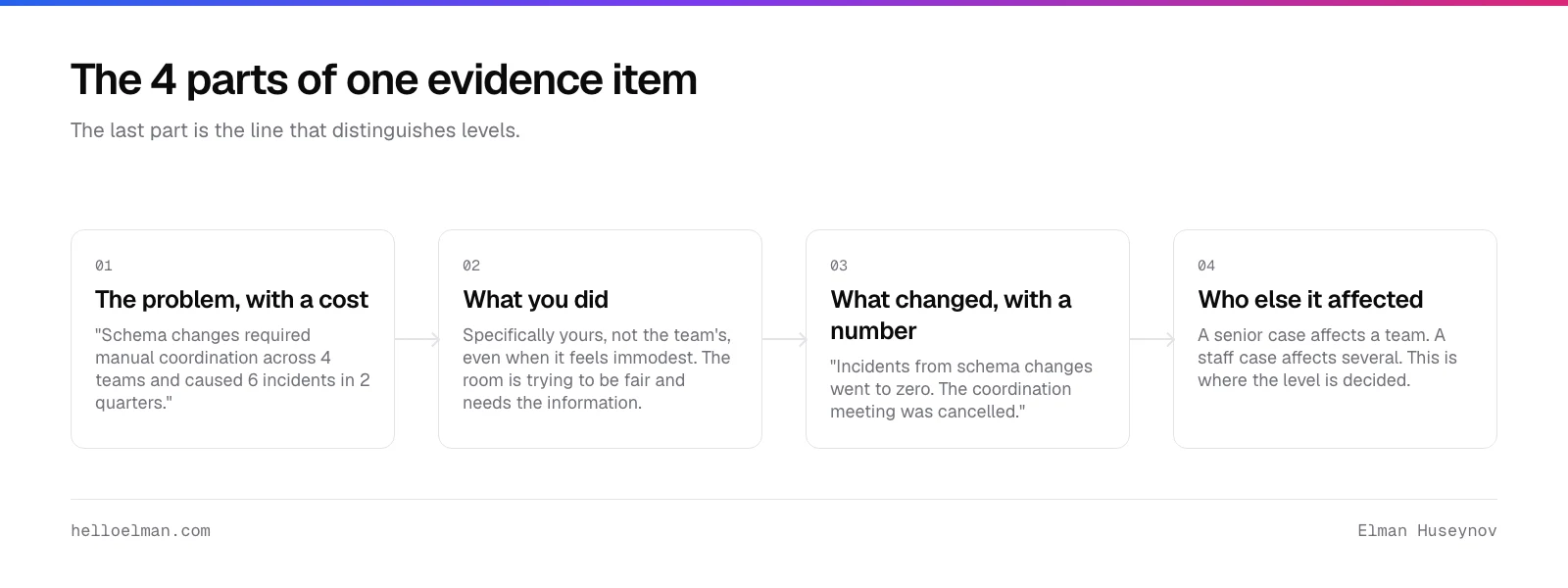
One item per paragraph, each with the same 4 parts.
What the problem was, with a cost.
“Schema changes required manual coordination across 4 teams and caused 6 incidents in 2 quarters.”
What you did, specifically yours. Not the team’s.
What changed, with a number. “Incidents from schema changes went to zero over 2 quarters. The coordination meeting was cancelled.”
Who else it affected. This line distinguishes levels. A senior case affects a team. A staff case affects several.
Keep each item to about 150 words. Longer and it will not get read out.
3. Where you are not there yet
The most counter-intuitive section, and it does the most work.
I have not led a project involving an external partner, which is the part of the staff bar I have least evidence for. The Q3 vendor migration is where I plan to build it.
The room stops hunting for the weakness, because you named it.
You read as someone who understands the bar rather than someone lobbying.
4. What other people say
2 or 3 short quotes from people outside your team, with names and roles. Your own team’s praise is expected.
Another team saying “we built our pipeline against their design” is evidence of reach.
Reach is what is being tested.
Ask early, and name the specific thing you want them to comment on. “Could you say something nice” produces something useless.
What sinks a promotion packet?
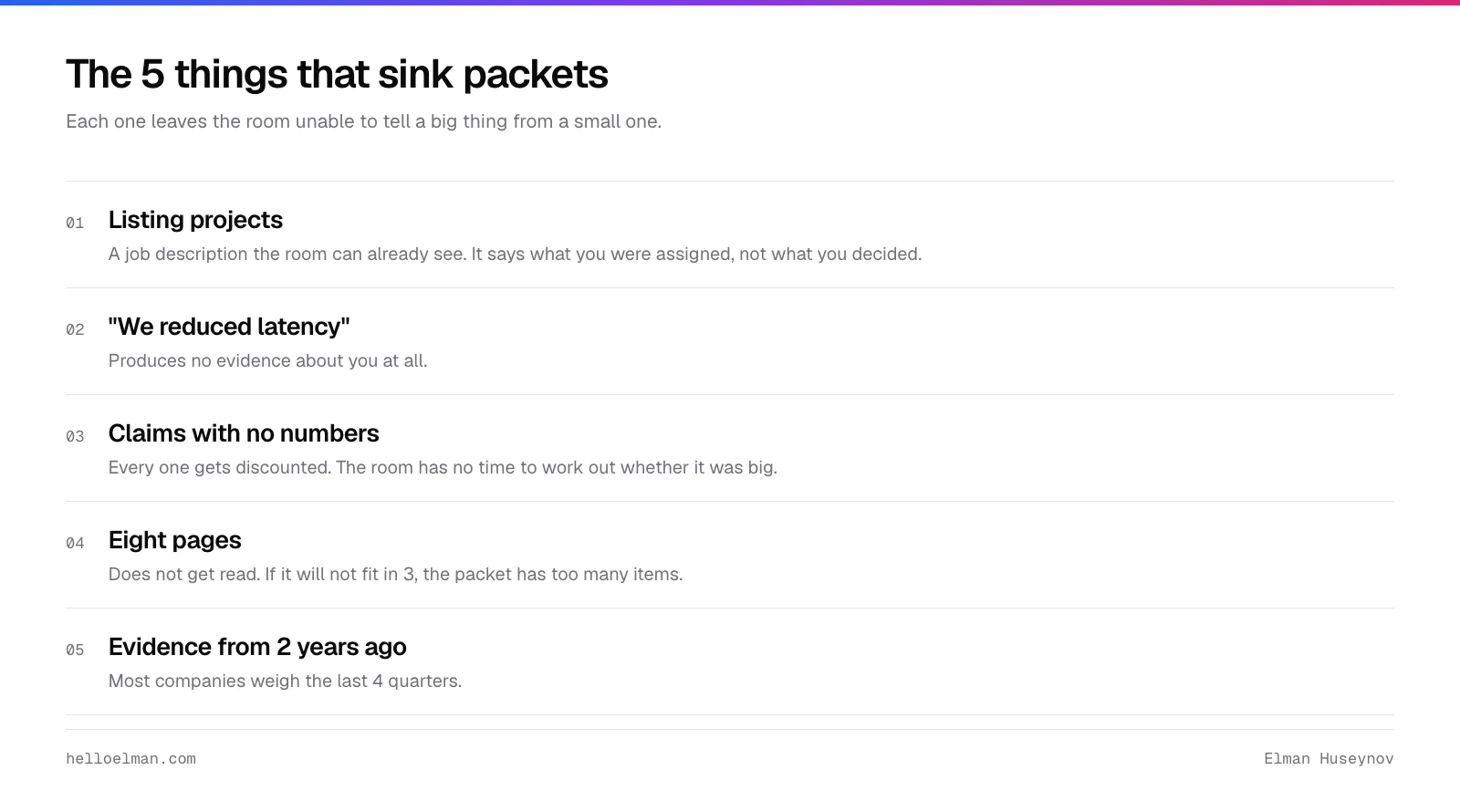
Listing projects, which is a job description the room can already see.
Team achievements in the first person plural. “We reduced latency” produces no evidence about you.
Claims with no numbers. The room cannot tell a big thing from a small one. It has no time to find out.
Eight pages, which do not get read. Evidence from 2 years ago, when most companies weigh the last 4 quarters.
Why start the packet 2 quarters early?
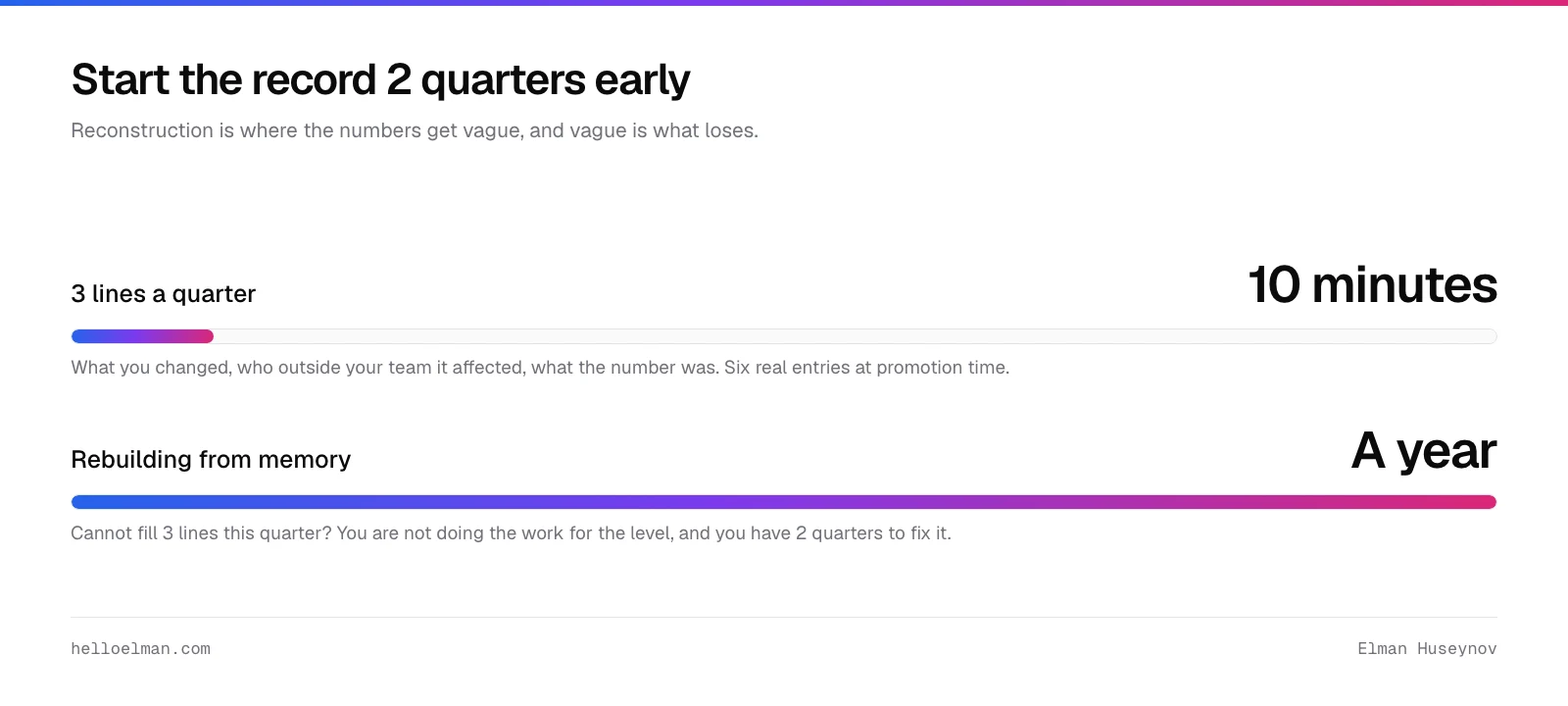
Reconstruction is where the numbers get vague, and vague is what loses.
Every quarter, write 3 lines. What you changed, who outside your team it affected, the number. Ten minutes.
At promotion time you assemble from 6 real entries. No rebuilding a year from memory.
The record also tells you something in month 2 rather than month 11.
Cannot fill 3 lines? You are not doing the work for the level yet.
What if the promotion does not go through?
Ask for the specific gap in writing, and ask what evidence would close it. A good manager gives you that in 2 sentences.
If yours cannot, the bar is probably not written down anywhere. Or the answer was never about your work.
You learned something either way.
Common questions
How long should a promotion packet be?
About 3 pages. Eight pages does not get read, and the room has a few minutes per case. Each evidence item stays around 150 words. Anything longer will not be read out loud. If it will not fit, the packet has too many items. The space is not the problem.
Should you really include a section on your weaknesses?
Yes, and it is the section that does the most work. Naming your weakest area stops the room hunting for it. It makes you read as someone who understands the bar. A packet with no weaknesses reads as written by someone who cannot see themselves clearly. The room notices.
How do you ask colleagues for a quote?
Ask early and name the specific thing you want them to comment on. Could you say something nice produces something useless. “Could you write 2 lines on how your team used the schema standard.” That produces evidence of reach. Prioritise people outside your team, because your own team’s praise is expected.
Does your manager write the packet or do you?
You write it, they argue it, and the split varies by company. Even where the manager formally owns the document, the numbers come from you. A manager reconstructing your year from memory writes a weaker case. A manager handed 6 quarterly entries with numbers writes a stronger one.
How do you request a promotion?
You do not ask, you build the case. Start 2 quarters early. Collect the work, the artefacts, and quotes from people it affected. Write it against the level you want. Your manager argues it in a room you are not in.
The short version
Write for a room of strangers who have a few minutes. Claim in 2 sentences.
3 to 5 pieces of evidence. Each with a cost, your specific action, a number, and who else it touched.
Name your own weakest area. Quote people outside your team. Start the quarterly record now.
What the next level even is sits in from senior to staff.
To argue the packet out loud, book a leadership mock interview. Scored like a calibration, by someone who has sat on both sides.