Generative Engine Optimization: What the Data Supports
Related service: Technical SEO audit and Core Web Vitals
Generative engine optimization makes a page easy for an AI answer to quote.
On this page
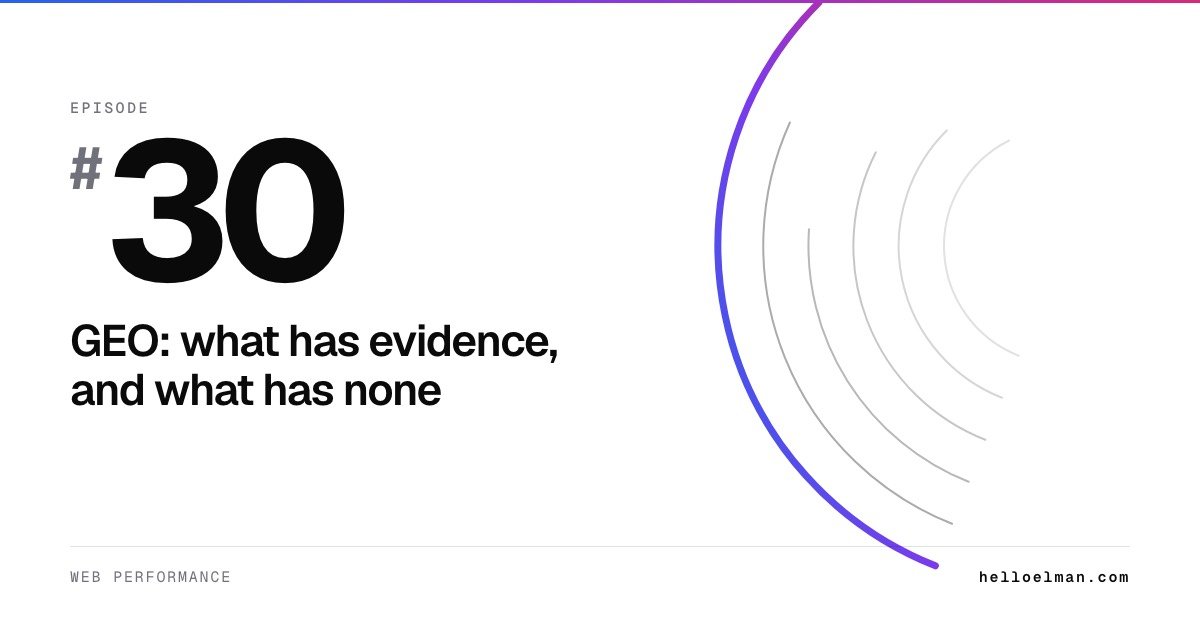
Statistics, quotations and cited sources have research behind them.
An llms.txt file shows no measurable effect on citations so far.
Crawler access and plain HTML come first. Fix those before anything else.
What is generative engine optimization?
Generative engine optimization (GEO) shapes pages so AI answers can cite them.
The term comes from a 2023 paper. Its authors worked at Princeton, Georgia Tech, the Allen Institute for AI and IIT Delhi.
GEO builds on SEO. A page that is not indexed or not readable cannot be cited.
What does the research say works?
The GEO paper reported up to 40% more visibility from statistics, quotations and cited sources.
The authors measured this on a benchmark of 10,000 queries. Results varied by topic.
Treat the 40% as a direction. A page with real numbers and named sources gives an answer engine something to quote.
Does llms.txt improve AI citations?
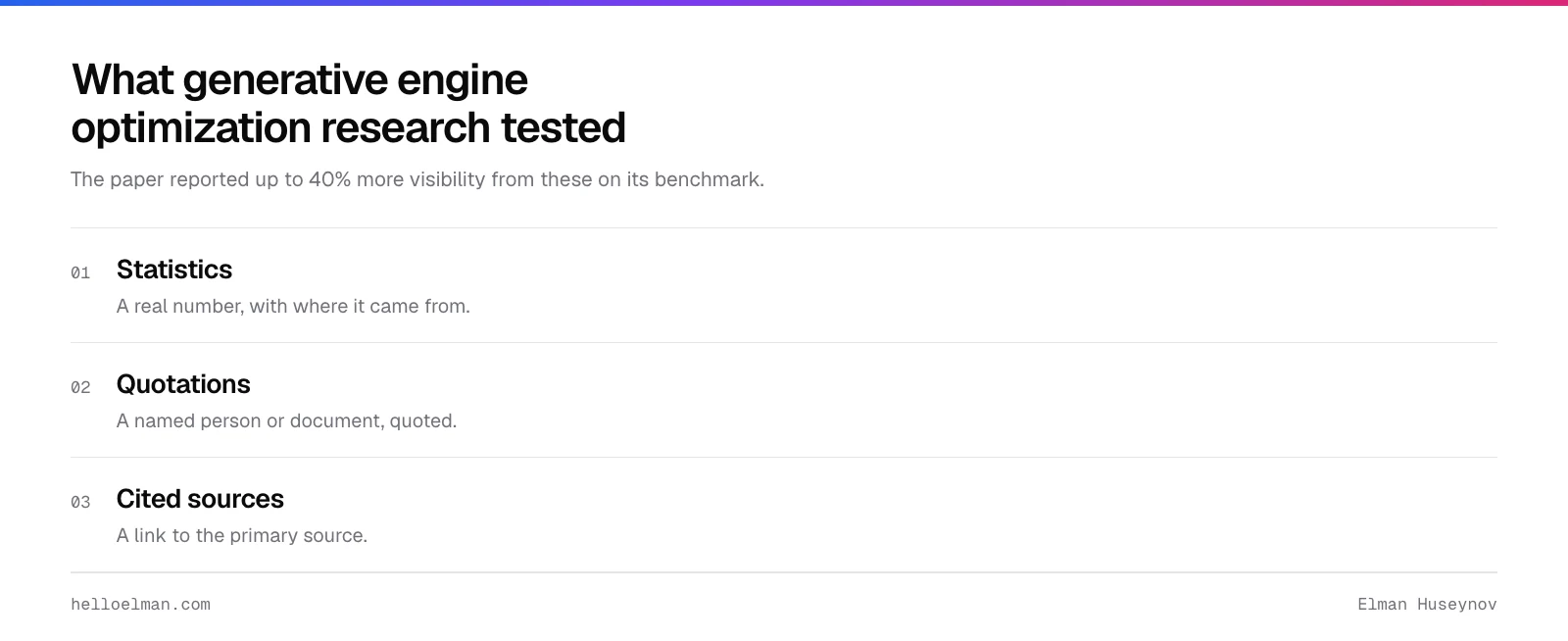
An SE Ranking study of 300,000 domains found llms.txt had no measurable effect on citations.
The file was present on 10.13% of the domains. SE Ranking found no relationship with citation frequency.
SE Ranking concluded that llms.txt does not seem to affect citations, at least not yet.
Writing one takes about an hour, so adding it is harmless. Expect no measured change.
What should you fix before llms.txt?
Fix crawler access and rendering before llms.txt. A crawler that cannot read a page cannot cite it.
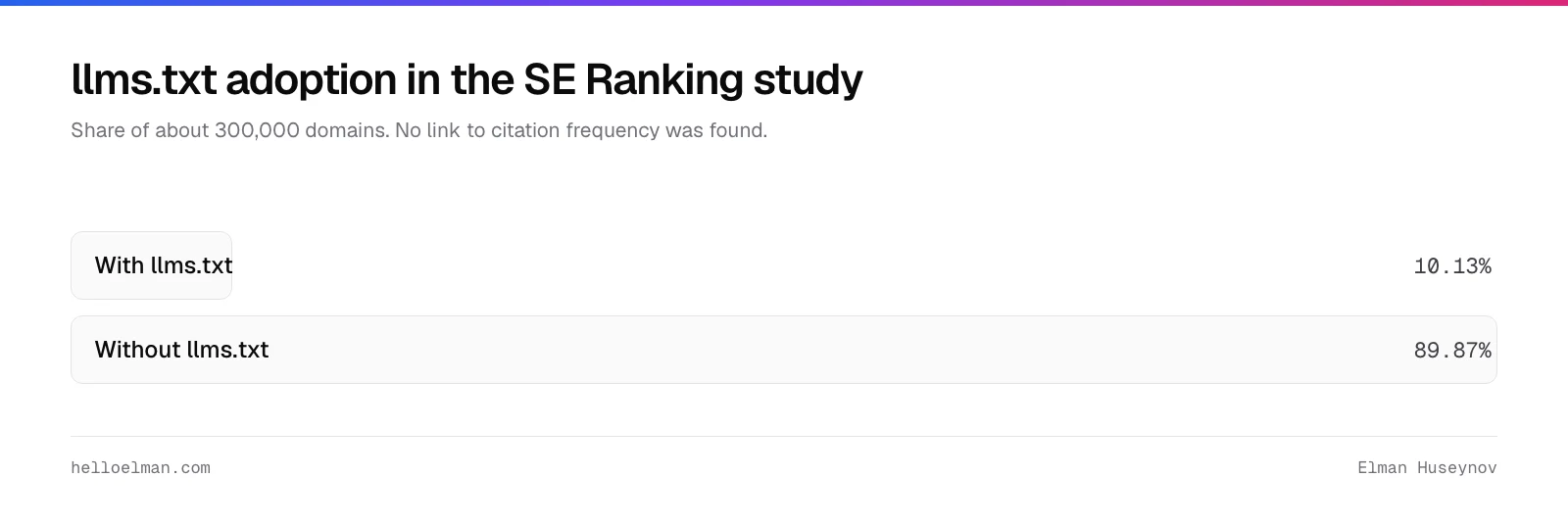
Four checks cover most sites. Each takes minutes on a single page.
Run them on your 5 most important pages first. Fix what fails before adding anything new.
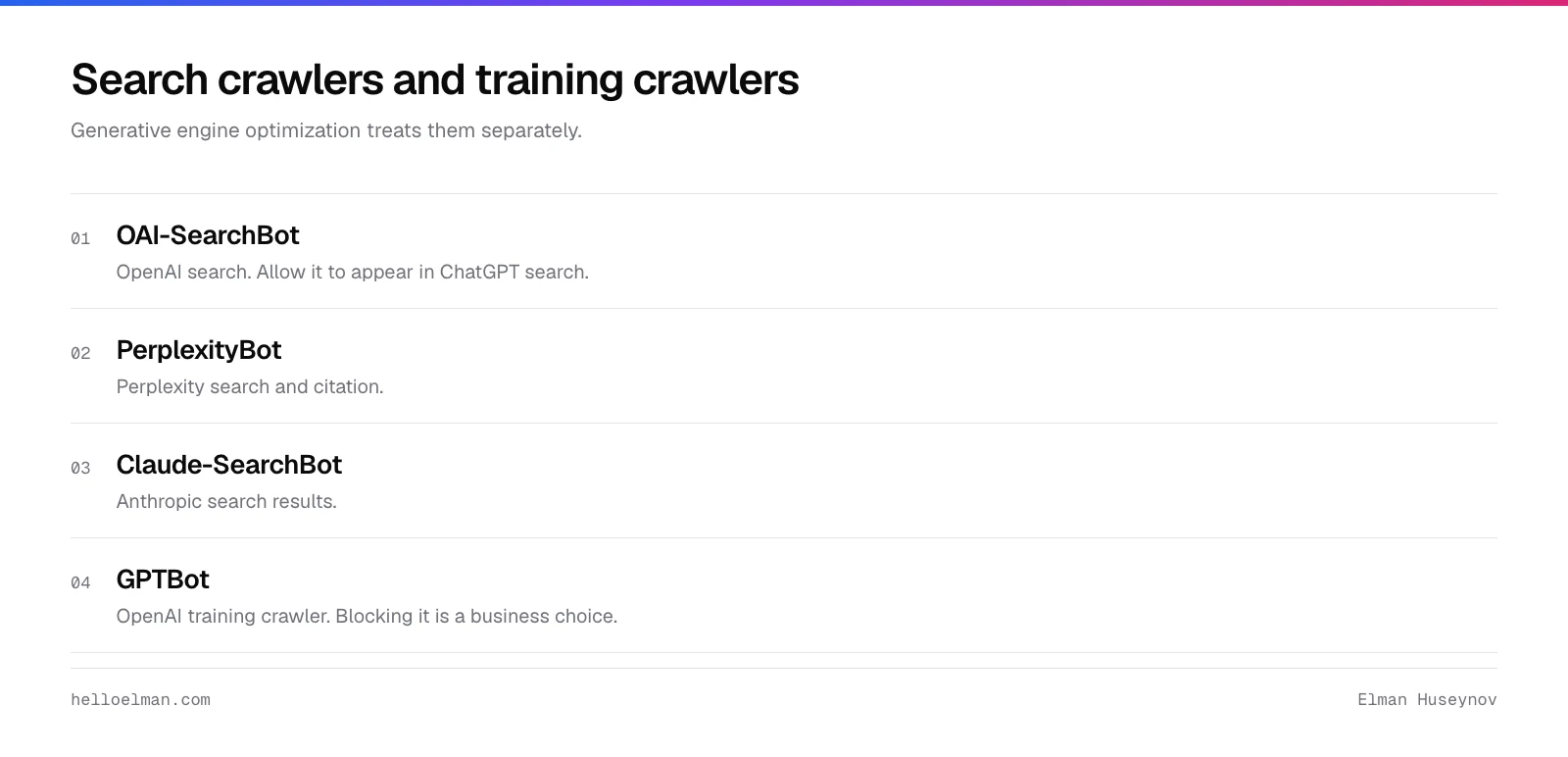
- robots.txt allows the search crawlers: OAI-SearchBot, PerplexityBot and Claude-SearchBot.
- The text sits in the HTML, not behind JavaScript.
- Each section opens with a direct answer.
- Claims carry a number and a named source.
Vercel’s crawler analysis found OpenAI and Anthropic bots fetch JavaScript files without executing them.
How do you check what an AI crawler sees?
Fetch the page without JavaScript and read what comes back. Search the output for your headline.
If the headline is missing, a crawler that skips JavaScript sees an empty page.
curl -sL https://example.com/ | grep -c "Your headline"Read your server log for GPTBot, OAI-SearchBot and PerplexityBot requests. A 403 means your firewall blocks them.
Speed fixes belong in the same audit. Start with Core Web Vitals explained.
Two case notes: the 1.1 MB bundle and the WordPress site at 100.
Common questions
Do AI crawlers run JavaScript?
Vercel’s crawler analysis found OpenAI and Anthropic bots fetch JavaScript files without executing them. A client-rendered page can look empty to them. Server-rendered or static HTML avoids the problem. Check your own pages with curl before assuming either way, and re-check after each redesign.
Should you block GPTBot?
Blocking the training crawler is a business choice. OpenAI documents GPTBot and OAI-SearchBot as separate crawlers. You can block one and allow the other. Blocking the search crawler can stop your pages appearing in ChatGPT search answers. Decide each bot on its own purpose.
Is generative engine optimization the same as SEO?
Mostly. GEO sits on top of SEO. Indexing, crawl access and clear content still decide whether a page can be found. GEO adds choices about the answer itself: direct first, with numbers and named sources. A page that fails the SEO basics gives GEO nothing to work on.
Can anyone guarantee a ChatGPT citation?
No. Nobody controls which sources an answer engine picks, and answers change between runs. A claim of guaranteed placement should make you cautious. What you control is access, readable HTML and content worth quoting. Measure by asking the same questions weekly and recording what each engine cites.
What is generative engine optimization?
Generative engine optimization shapes content so AI answer engines can retrieve and cite it. The term comes from a 2023 research paper. The authors reported up to 40% more visibility from statistics, quotations and cited sources. It was presented at ACM KDD 2024.
The short version
GEO sits on top of SEO. Fix crawler access and plain HTML first.
Add numbers, quotations and named sources. Skip expecting a change from llms.txt.
To see what crawlers read on your site, book a technical SEO audit. Findings ranked by impact.