A software engineer salary negotiation comes down to 3 sentences. A number, a reason, and a signal that you will sign.
On this page
The offer you receive is rarely the offer they approved. The sign-on bonus is the most flexible line.
The level is worth more than any base increase you will win.
A polite counter is expected. The recruiter usually has room above the first offer.
Where does a software engineer salary negotiation number come from?
Three things were decided before the offer reached you.
A band for the level. At a European tech company it can span 30% and it rarely moves.
Where in the band you land. Decided by your interview scores, your current pay, and how much the manager wants you.
What the recruiter can move without asking. A slice of the band, plus most of the sign-on bonus.
You are negotiating the second and third. The band itself stays; you can move a long way inside it.
Is the recruiter your opponent?
The recruiter is measured on closed offers. A candidate who declines is a failure for them.
When you name a number they cannot reach, their job becomes getting approval for it.
Give the recruiter what they need to argue it in a room without you. A number, a reason, and a signal that you will sign.
What if they ask your number first?
Decline politely, and ask for the band. Whoever names a number first anchors the conversation, and you have less information.
Recruiters hear the decline every day. In several European countries and US states they must disclose the band on request.
I would rather understand the level and the scope first. Once we both know what the role is, I am happy to talk numbers, and I would find it useful to know the band for this level.
If they insist, give a range whose bottom you would genuinely accept. A bottom you would resent is the number you will get.
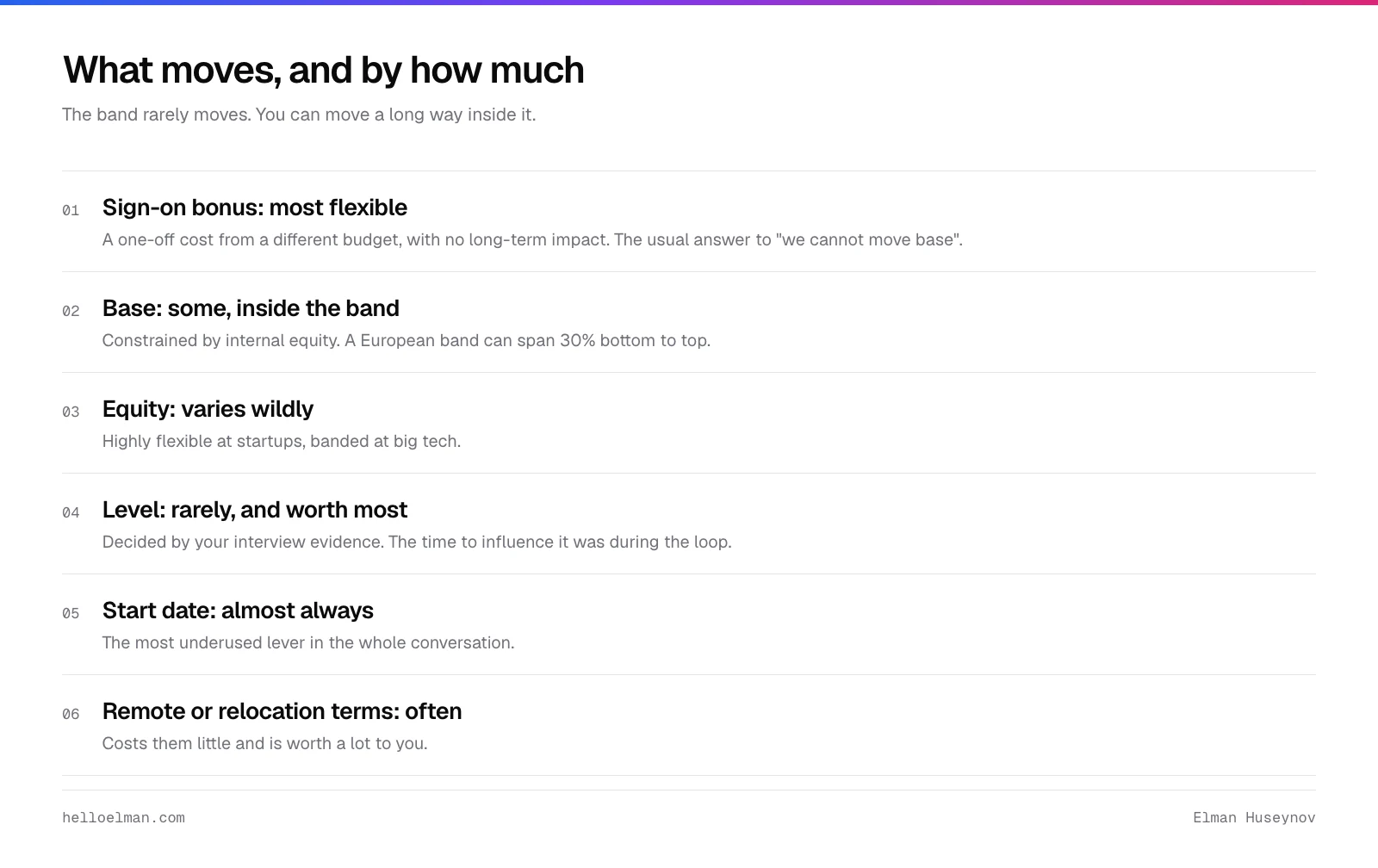
What moves in a software engineer salary negotiation
| Lever | How much it usually moves | Notes |
|---|---|---|
| Sign-on bonus | Most flexible line | One-off cost, no long-term budget impact |
| Base salary | Some, inside the band | Constrained by internal equity |
| Equity | Varies wildly | Highly flexible at startups, banded at big tech |
| Level | Rarely, but the biggest win | Needs interview evidence, not asking |
| Start date | Almost always | Underused as a lever |
| Remote or relocation terms | Often | Costs them little, worth a lot to you |
The sign-on bonus is the usual answer to “we cannot move base”. It comes from a different budget.
Level is decided by your interview evidence. The time to influence it was during the loop.
Software engineer salary negotiation email example
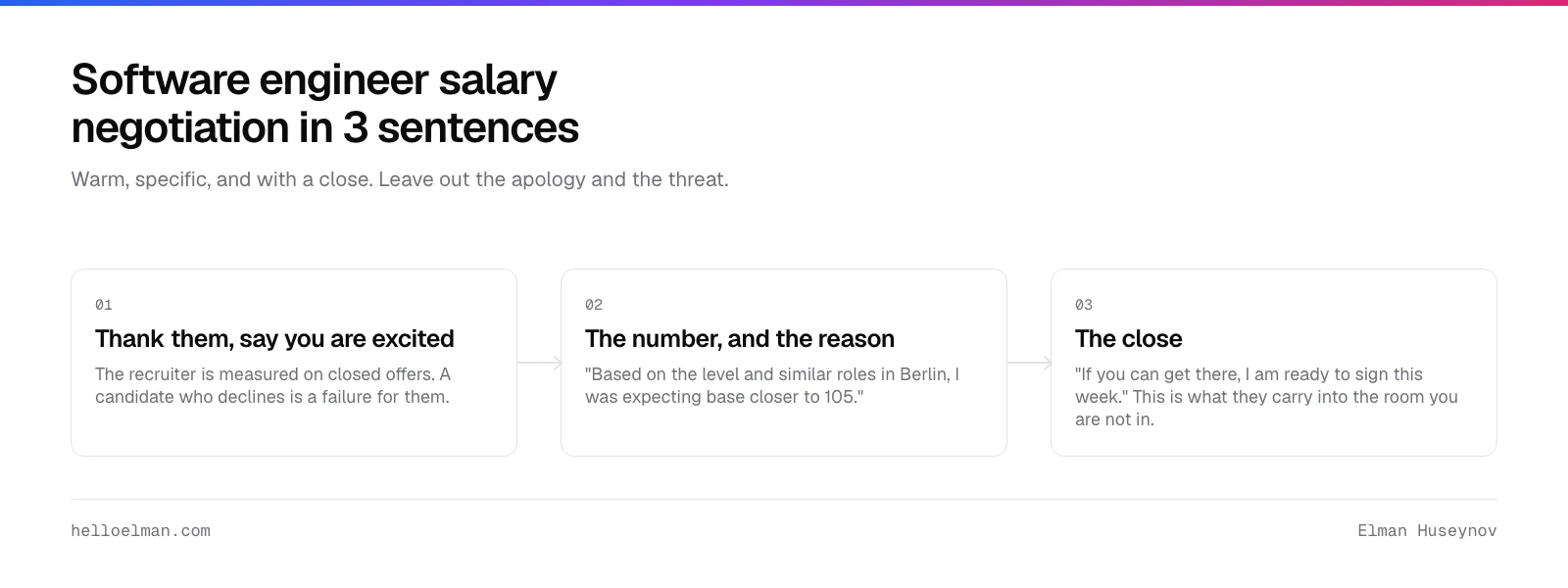
Three sentences: warm, specific, with a close. No apology, no story about your rent, no threat.
Thank you, I am genuinely excited about this team. Based on the level and what I am seeing for similar roles in Berlin, I was expecting base closer to 105. If you can get there, I am ready to sign this week.
Using a competing offer
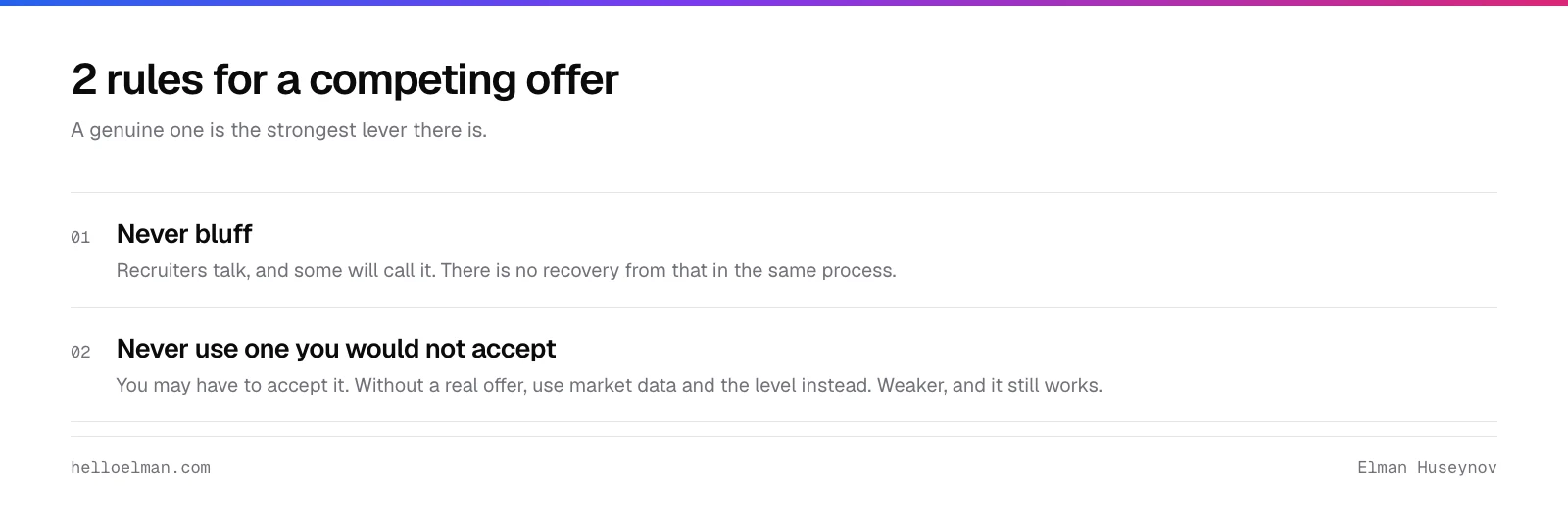
Yes if it is real, never if it is invented. Recruiters talk, and some will call a bluff.
Never use an offer you would not accept. You may have to accept it.
I have another offer at 115 with a similar scope. I would rather be here, and I am asking whether you can close the gap.
Without one, use market data and the level. Weaker, and it works.
How do you handle an exploding offer?
“This expires Friday” is usually pressure rather than policy. Ask: “What happens if I need until Wednesday?”
Most of the time the deadline moves.
If it does not, that is information. An employer who gives you 4 days for a 2-year commitment shows you month 6.
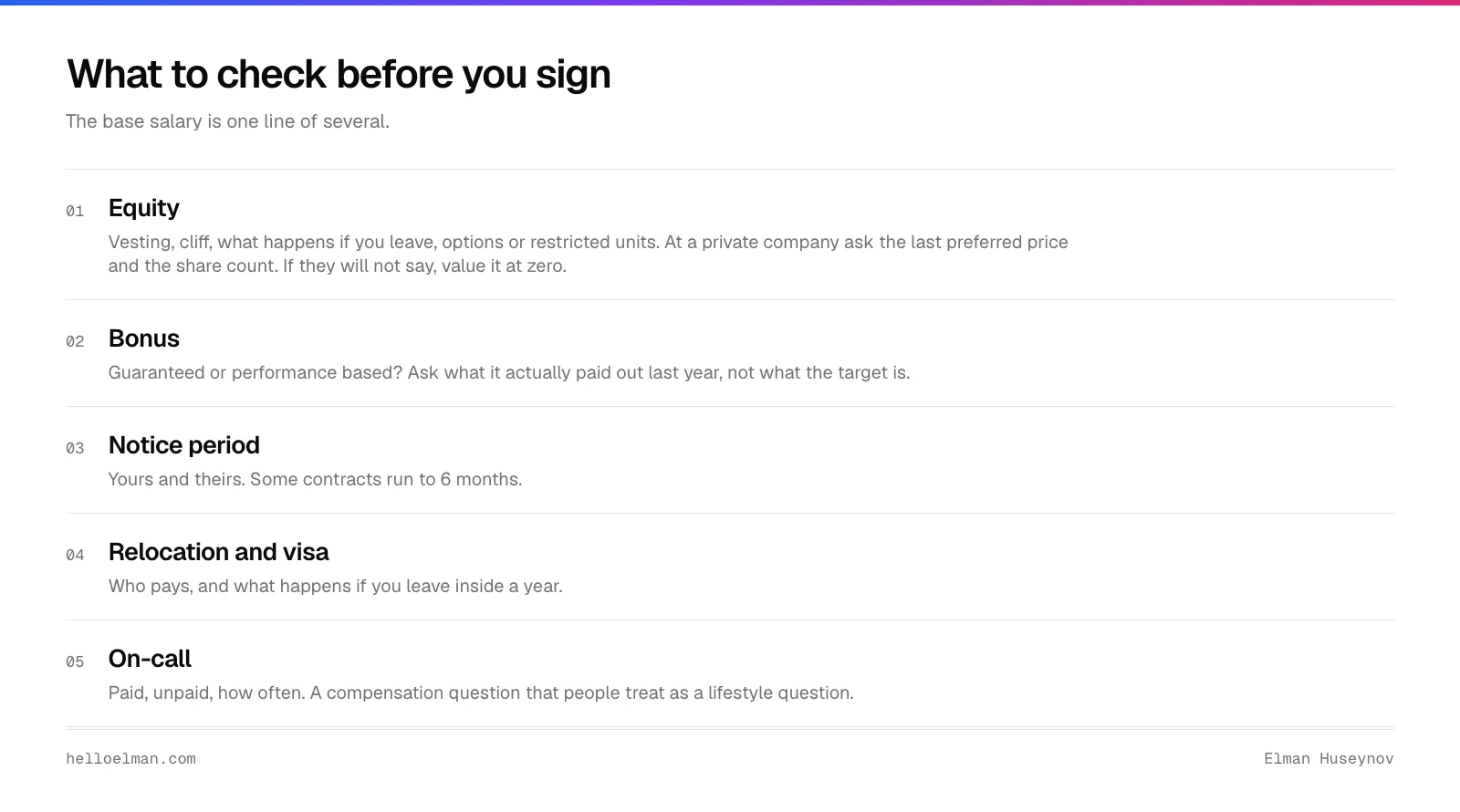
What to check before you sign
- Equity: vesting, cliff, options or restricted units. At a private company ask the last preferred price. If they will not say, value it at zero.
- Bonus: guaranteed or performance based, and what it paid out last year.
- Notice period: yours and theirs.
- Relocation and visa: who pays, and what happens if you leave inside a year.
- On-call: paid or unpaid, how often. A compensation question people treat as a lifestyle question.
- Scope in writing: the systems you own. The promotion criteria for the next level.
Common questions
How much should you counter by?
Ten to 20% above the offer is normal and gets taken seriously. Above 30% you need a competing offer or a level argument behind it. Otherwise the recruiter cannot carry it into the room. Anchor on the band and comparable roles rather than on what you need to earn.
Can an offer be withdrawn because you negotiated?
Rarely, and almost never for asking politely once. The risk comes from 3 things. Going silent for 2 weeks. Renegotiating after a verbal yes. A threat attached to the counter. Ask once, ask warmly, and give them a clear date.
Should you negotiate an internal promotion the same way?
The mechanics differ. Internally your compensation is set in a calibration cycle, months before anyone talks to you. The negotiation happens in your promotion packet and in your manager’s preparation. By the time the number is communicated, the room has already closed. Push earlier in the cycle.
What if they say the offer is final?
Ask what is flexible instead of what is more. Sign-on bonus, start date, remote days, or an early review date. Equity refresh, or a written scope. Final usually means final on base, and the other lines are handled by different approvals. One question costs nothing and often finds 5,000 euro.
Should you negotiate salary?
Yes, and the risk is smaller than people think. An offer is a decision the company already spent weeks making. Asking politely for more does not undo it. The number in the first offer is rarely the top of the band. Not asking is what costs you, every year, compounding.
The short version
Do not name the first number. Ask for the band. Counter in 3 sentences with a reason and a close.
Take the sign-on bonus when base will not move. Never bluff a competing offer. Check the equity and the on-call before you sign.
If the level is wrong, say so before you talk about money. The level is worth more than the number.
To work this through on your actual offer, book an offer negotiation session. Support runs until you sign.