Your First 90 Days as a New Engineering Manager
Related service: Software engineer career coaching
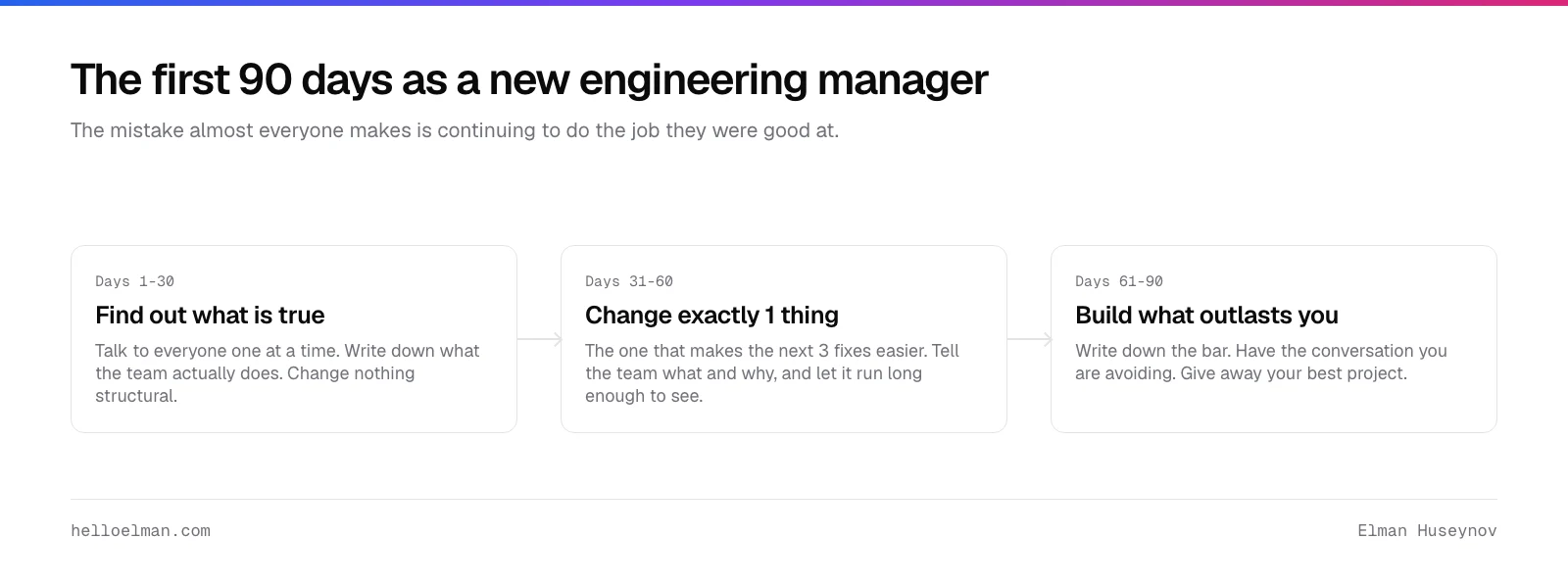
A new engineering manager spends month one finding out what is true.
Month 2 changes exactly one thing. Month 3 builds what outlasts them.
The mistake almost everyone makes is continuing to do the job they were good at.
You got the title and nobody handed you the job description. That is why the first 90 days go badly for so many.
On this page
What mistake does every new engineering manager make?
You keep doing the job you were good at. Reviewing the pull requests, taking the hard ticket, fixing the incident at 9pm.
Doing the old job feels productive, so nothing looks wrong.
Six weeks later an engineer has quietly disengaged and the roadmap has no owner.
Manager work produces nothing visible for weeks. Code produces something in an hour.
First 90 days, month one: find out what is true
What the team does week to week, including on-call. What everyone has stopped mentioning. How you will be measured.
Change nothing structural in month one. You would spend credibility you have not earned.
Talk to everyone, one at a time
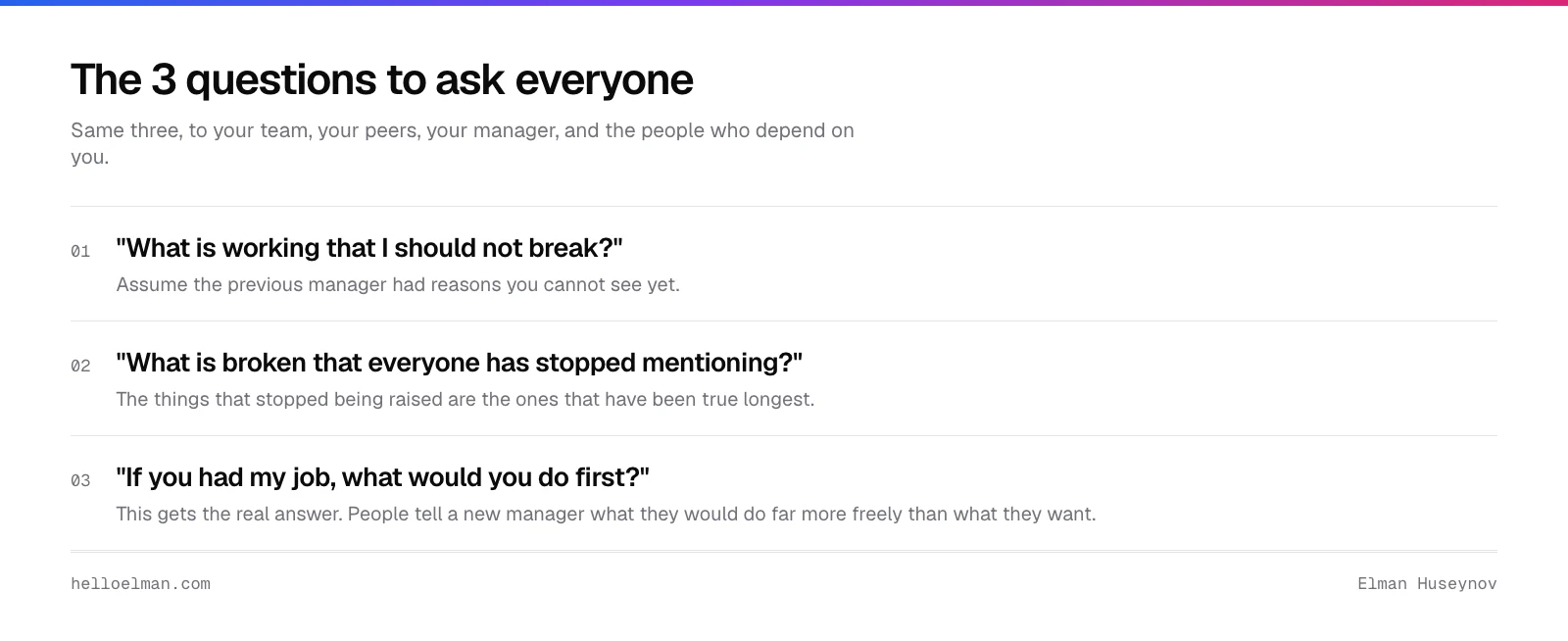
Your team, your peers, your manager, the people outside who depend on you. Same 3 questions:
- What is working that I should not break?
- What is broken that everyone has stopped mentioning?
- If you had my job, what would you do in the first month?
People tell a new manager what they would do more freely than what they want.
Find out how you are measured
Ask your manager: “In 6 months, what will make you say this went well?” If they cannot answer, you learned something.
Start 1:1s in week one
Weekly, 30 minutes, their agenda. When it drifts to status, ask what is on their mind, then stay quiet.
Month two: change exactly one thing
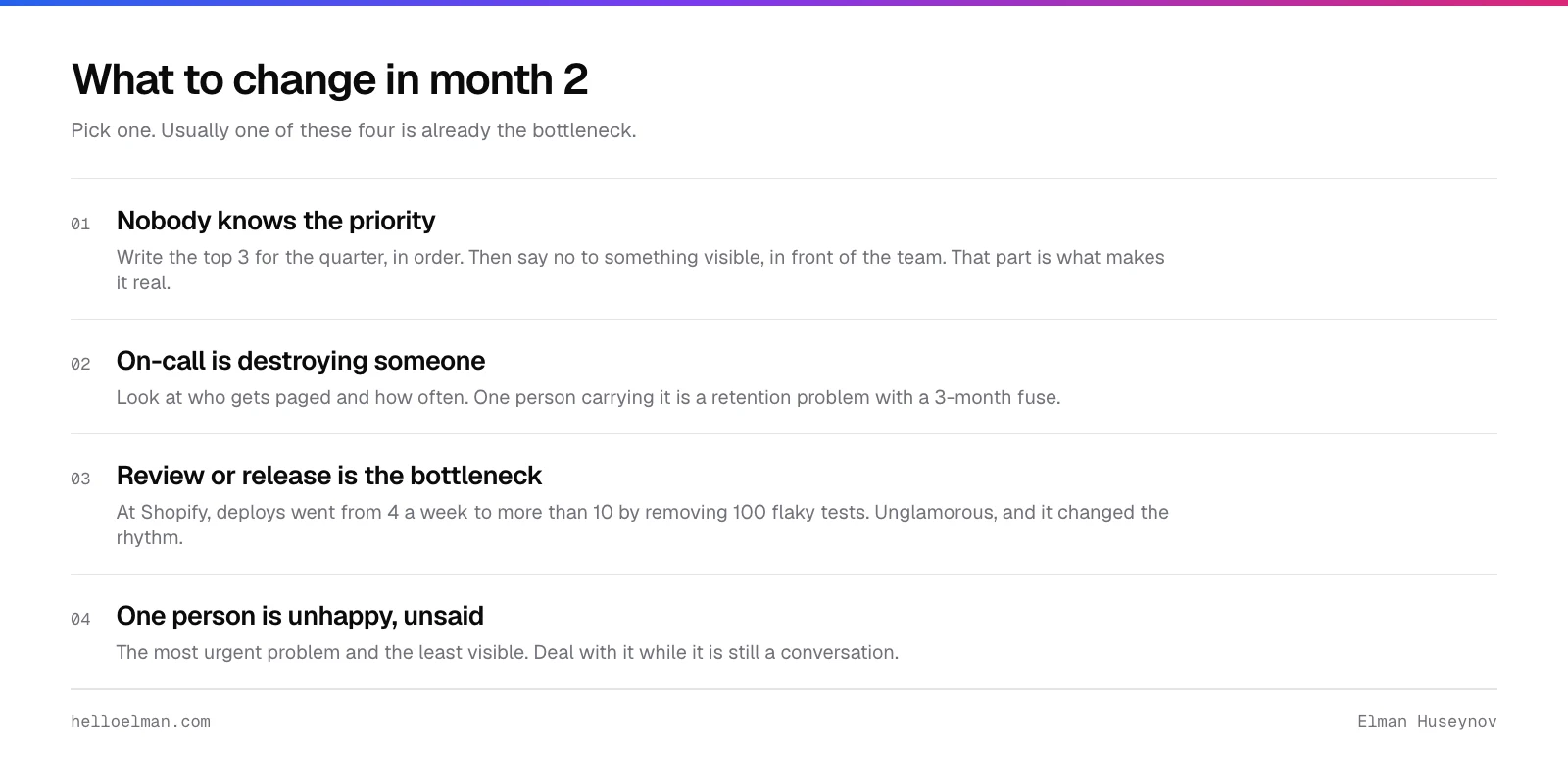
The one that makes the next fixes easier. Usually one of 4.
Nobody knows the priority. Write the top 3 for the quarter, in order. Say no to something visible.
On-call is destroying someone. If 1 person carries it, that is a retention problem with a 3-month fuse.
Review or release is the bottleneck. Removing flaky tests is often the fastest way to more deploys a week.
One person is unhappy and nobody has said so. The most urgent problem and the least visible.
Change one, tell the team why, and let it run long enough to judge.
Month three: build what outlasts you
Write down what good looks like at each level. Most engineers are guessing at the bar. Showing it is the best retention tool.
Have the performance conversation you are avoiding. There is always one, and in 6 weeks it is harder.
“The last quarter was not at the level we need. I want to be specific about why.” Then stop talking.
Hire properly. Write the scorecard before the job ad. The interview scorecard template has the long version.
Give away your best project. Hand it to someone with room to grow. Let them do it worse than you for a while.
What should a new engineering manager stop in week one?
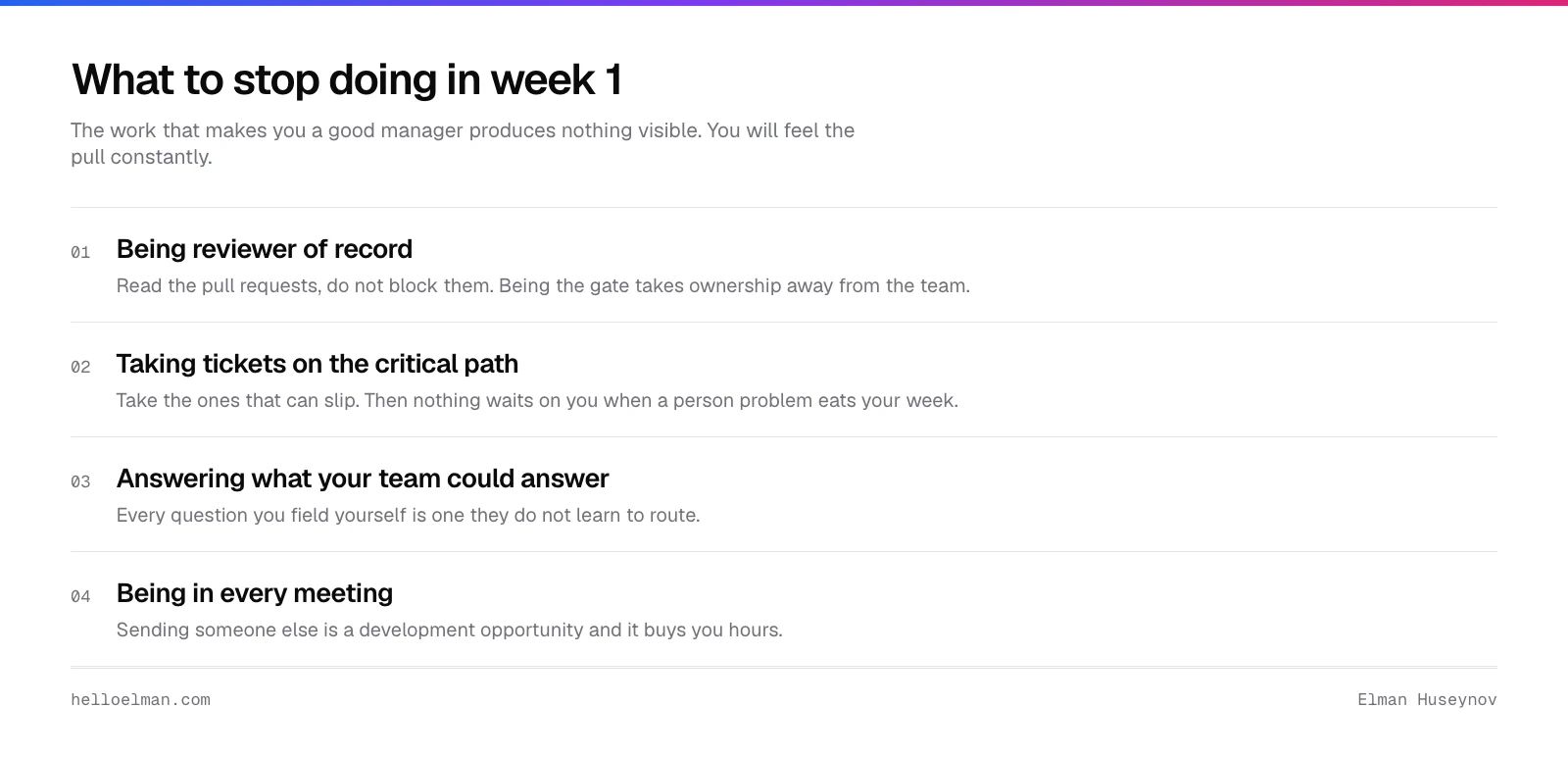
Being the reviewer of record. Read the pull requests, do not block them.
Taking critical-path tickets. Take the ones that can slip.
Answering questions someone on your team could answer.
Being in every meeting. Sending someone else develops them and buys you hours.
Why does the feedback loop break?
As an engineer you knew within a day whether you were doing well. As a manager you find out in 6 months.
Slow feedback is why new managers burn out while their teams are fine. Nothing tells them they are succeeding.
Keep a written list of what you changed and what happened. Get an outside read from someone who has done the job.
How do you know if management is not for you?
Three signals, all inside 90 days. You resent the meetings. You feel relief when you get to write code.
Going back to an IC track after trying management makes you better at it. Staying in a job you dislike does not.
Common questions
Should a new engineering manager still write code?
A little, and never on the critical path. Take the tickets that can slip. Then nothing waits on you when a person problem eats your week. Reviewing to stay current is fine. Being the reviewer of record makes you a bottleneck. It takes ownership away from the team.
What if you inherit a team you did not hire?
Assume the previous manager had reasons you cannot see yet. Spend the first month asking what is working before you touch anything. Every change you make in week 2 costs credibility you have not earned. The person you would move first is often the one holding something invisible together.
How do you run a 1:1 that is not a status update?
Weekly, 30 minutes, their agenda. When it drifts to status, ask what is on their mind. Then stay quiet long enough for an answer. The silence is the technique. Most managers fill it within 4 seconds and never hear the real thing.
When should you have the first hard performance conversation?
Inside the first 90 days, and there is always one. Say the sentence plainly early in the meeting, then stop talking. Six weeks from now it is harder. The person has wasted 6 weeks not knowing. The kindness is in the clarity, not in the softening.
What does an engineering manager do?
Decides who does what, removes the things blocking them, and writes down what happened. The output is the team’s output, which is why it feels invisible at first. The job is not senior engineer with meetings. The biggest change is that your own hands stop being the way work gets done.
The short version
Month one: talk to everyone, write down what is true, change nothing.
Month 2: change exactly 1 thing, the one that makes the next fixes easier.
Month 3: write down the bar, have the hard conversation, give away your best project.
Stop doing the job you were good at. Nobody else on the team can do the one you have now.
To rehearse the job, and the leadership interview that leads to it, book a session.