A manager 1 on 1 earns its place when a board cannot say the same.
On this page
Weekly, 30 minutes, their agenda first, never cancelled.
Ask what is taking longer than it should. Ask what they expected that did not happen.
Ask what they want to be doing in a year. And what you should do differently.
The last question is the whole test. Most 1:1s fail it quietly; both people leave feeling like they had a meeting.
I have had these weekly for 10 years, at Shopify and Zalando. Some managers ran them well. Most did not.
Why the manager 1 on 1 turns into a status update
Status is the safest thing to talk about.
Your report does not want to raise a problem that might reflect badly on them.
You do not want to open a topic you cannot close in 30 minutes.
Both of you reach for the sprint board and the discomfort goes away. The cost arrives later, usually as a resignation.
Manager 1 on 1 template: the structure
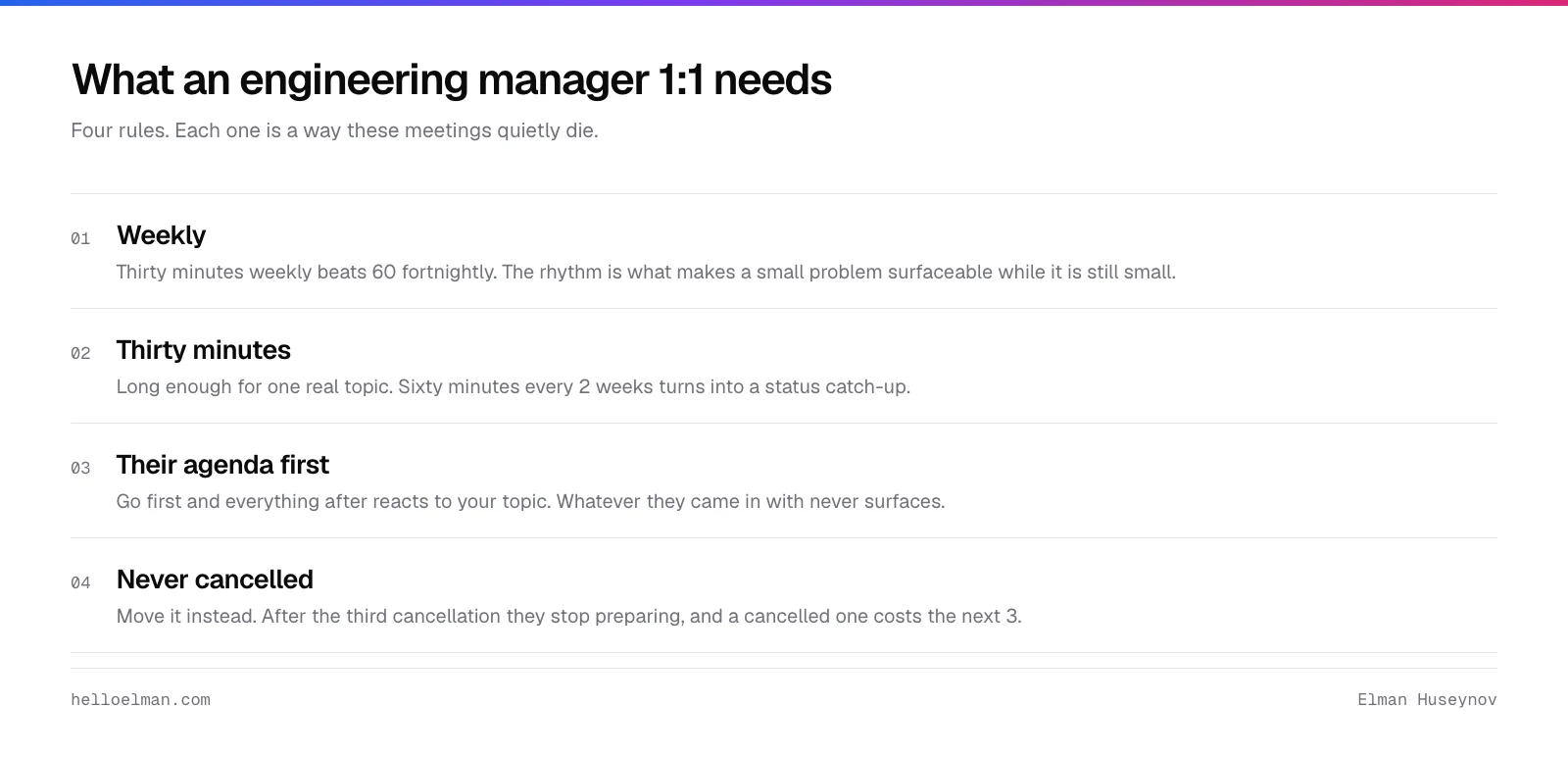
Weekly. 30 minutes. Their agenda first, yours second.
The report’s agenda first is a design decision. If you go first, everything after reacts to your topic.
Open with a real question and then stop talking. Most people need 4 or 5 seconds before they say what they came to say.
Most managers fill that gap.
Never cancel it. Move it, do not cancel it.
Manager 1 on 1 questions: the 4 that do the work
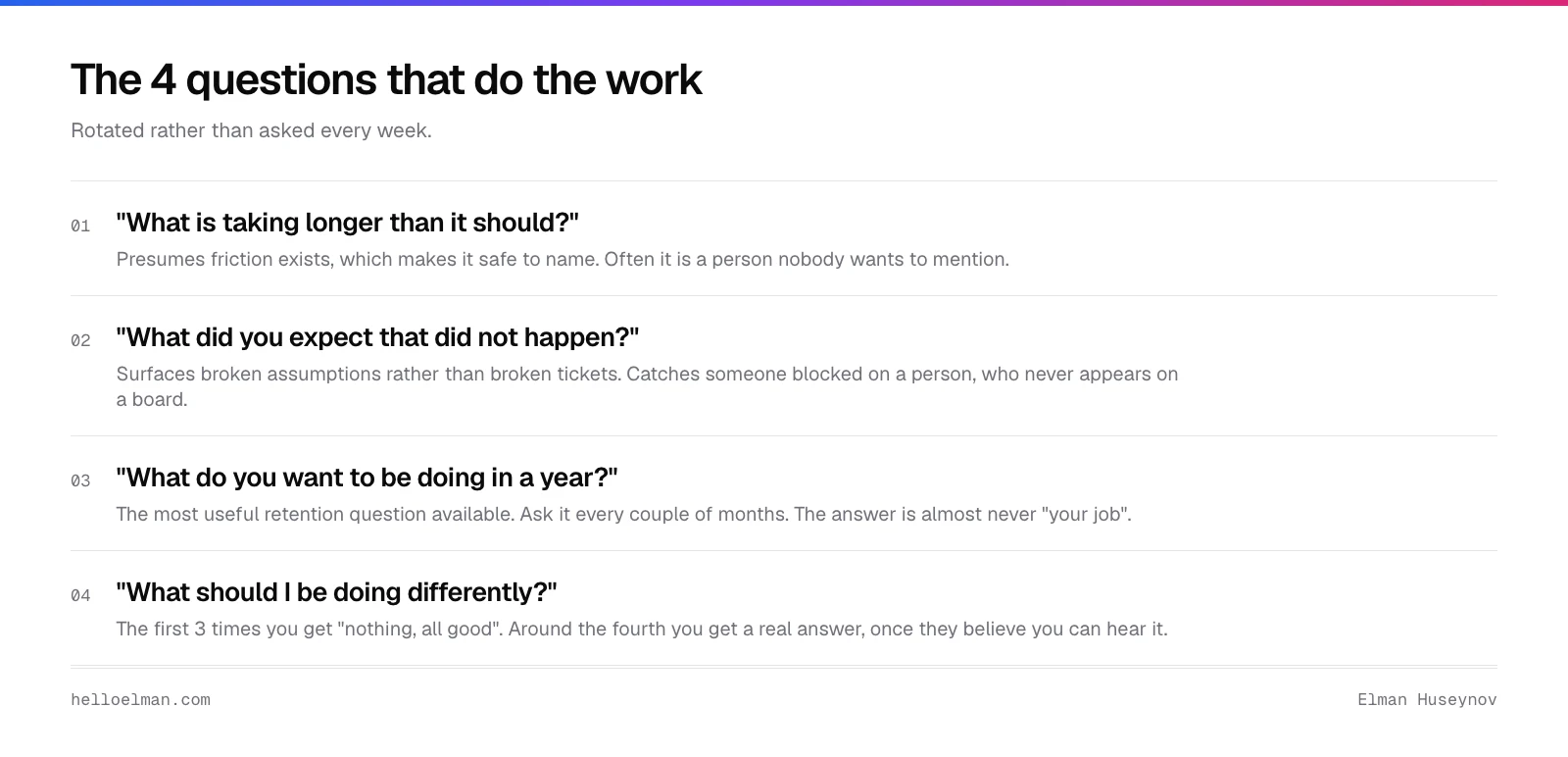
Rotated, rather than asked every week.
“What is taking longer than it should?”
Better than “how is it going”. It presumes friction exists, and makes it safe to name.
The answers tell you about process and tooling. Often about a person nobody wants to mention.
“What did you expect to happen this week that did not?”
This surfaces broken assumptions rather than broken tickets.
It also catches someone blocked on a person. A blocked person never appears on a board.
“What do you want to be doing in a year?”
Every couple of months. The most useful retention question available, and the answer is almost never “your job”.
“What should I be doing differently?”
The first 3 times you get “nothing, all good”. Ask anyway.
Around the fourth time you get a real answer. They now believe you can hear it.
What to do with what you hear
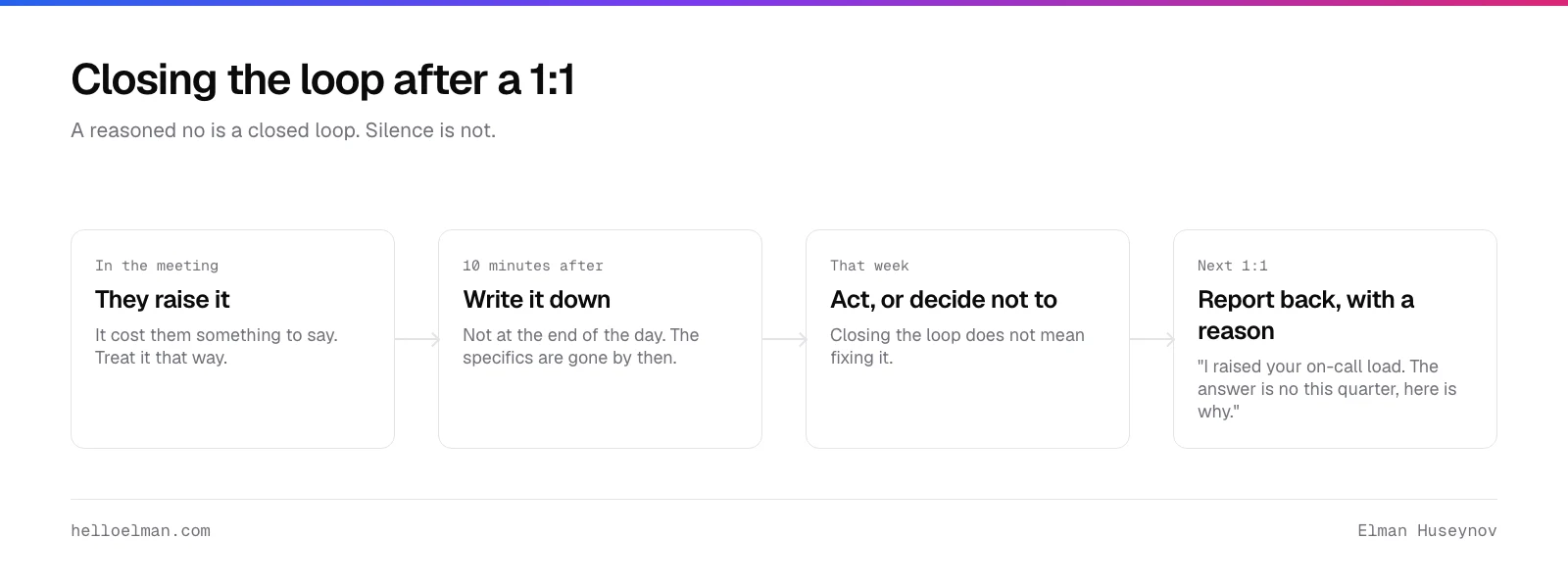
Write it down within 10 minutes after, then close the loop.
Someone raises something in week one and hears nothing by week 3. They have learned that raising things is pointless.
Closing the loop does not mean fixing it. A reasoned no is a closed loop. Silence is not.
“I raised your on-call load with my manager. The answer is no for this quarter, here is why.”
The conversation you are avoiding
Every manager has one. Usually performance. Sometimes a promotion that is not coming.
The 1:1 is where it belongs. Early in the meeting, not in the last 4 minutes.
“I do not think last quarter was at the level we need. I want to be specific about why.” Then quiet.
Softening it feels kind and is not. A person unsure whether they were criticised has the anxiety without the information.
Why your report will not tell you everything
You write their review and decide their raise. There is a limit to how honest anyone can be with the person holding both.
That limit is structural. It is why a mentor outside the company can say the sentence your report cannot.
It works in both directions. There is a sentence you cannot say to your own manager either.
The 4 manager 1 on 1 mistakes I see most
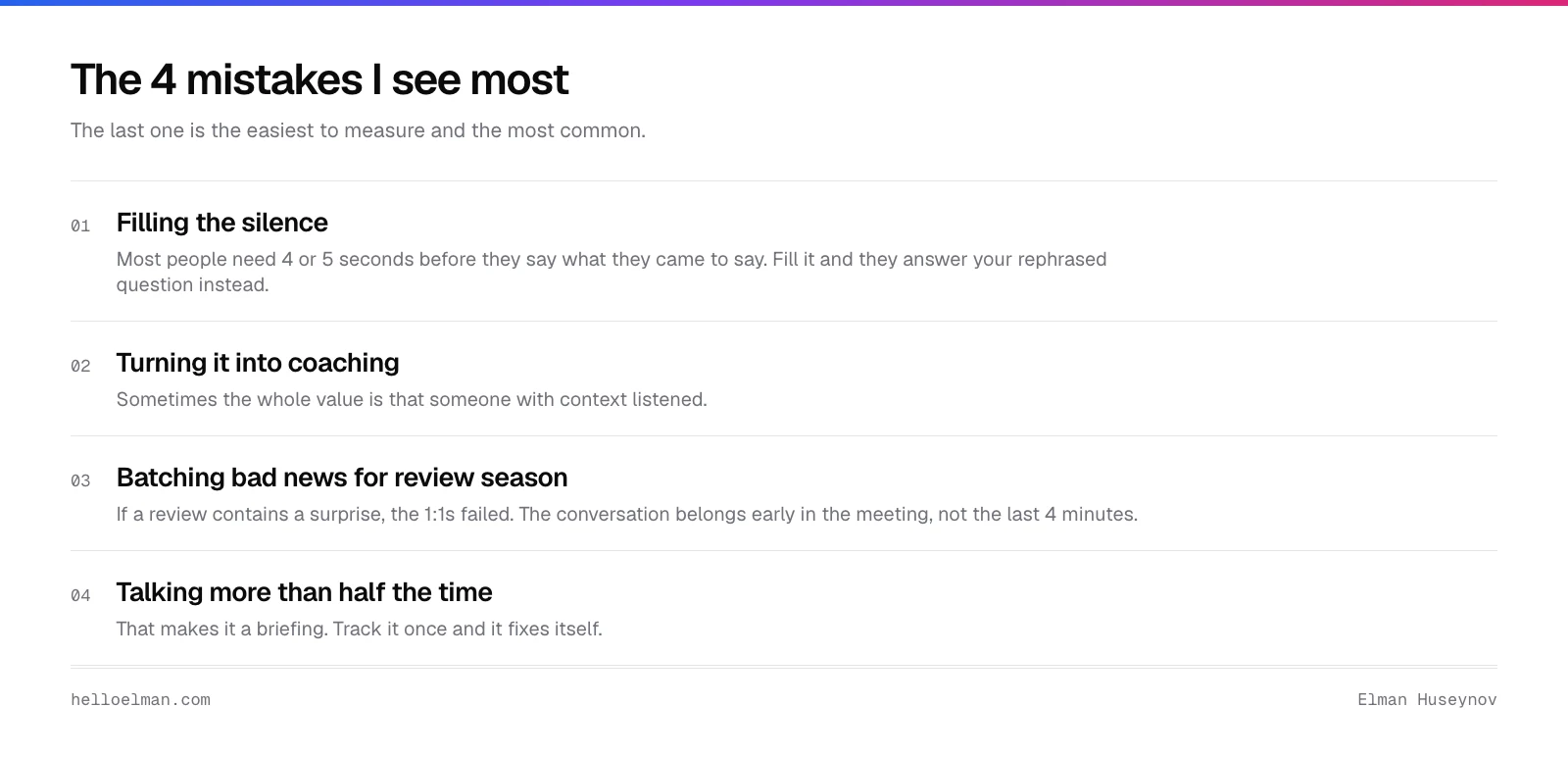
Filling the silence, so they answer your rephrased question instead of the original.
Turning it into coaching, when the value was that someone with context listened.
Batching bad news for review season, which means the 1:1s failed.
Talking for more than half the meeting, which makes it a briefing. Track that one once; it is the most common.
Common questions
How long should a 1:1 be?
Thirty minutes weekly beats 60 fortnightly. The weekly rhythm is what makes small problems surfaceable while they are still small. Sixty minutes every 2 weeks turns into a status catch-up, because too much has happened. The thing worth saying is 3 topics down the list.
Should the report or the manager keep the notes?
A shared document works best, with the report owning the agenda section. It removes the memory problem on both sides. It makes the promotion case easier to build later. Keep anything sensitive out of it. A shared doc is the wrong place for unsaid performance concerns.
What do you do when the report has nothing to say?
Ask one of the 4 questions and wait. Nothing to say usually means nothing safe to say yet. It takes 3 or 4 sessions of you not filling the silence. If it persists past 2 months, ask what would make the meeting useful.
Can you skip a 1:1 when nothing is happening?
Move it, never cancel it. Move it to any slot that week. Cancelling teaches your report that this meeting goes first when you are busy. After the third cancellation they stop preparing. A quiet 15-minute 1:1 costs almost nothing. A cancelled one costs the next 3.
What do you discuss with your manager in a 1:1?
Not status. Status belongs in a document anyone can read. Use the time for what is blocking you. Then what you want next, and what you disagree with. Bring one thing you would not say in a group. Otherwise it becomes a status update by default.
The short version
Weekly, 30 minutes, their agenda, never cancelled.
Ask what is taking longer than it should. Ask what they expected that did not happen. Ask what they want to be doing in a year.
Ask what you should do differently, and keep asking until you get a real answer. Close every loop, even with a no.
1:1s are the first thing an EM panel asks about. Rehearse the answer in a leadership mock interview.
The first 90 days post covers where 1:1s sit in the wider job.