Managing Your First Underperforming Employee
Related service: Software engineer career coaching
Managing an underperforming employee starts by ruling out 4 causes.
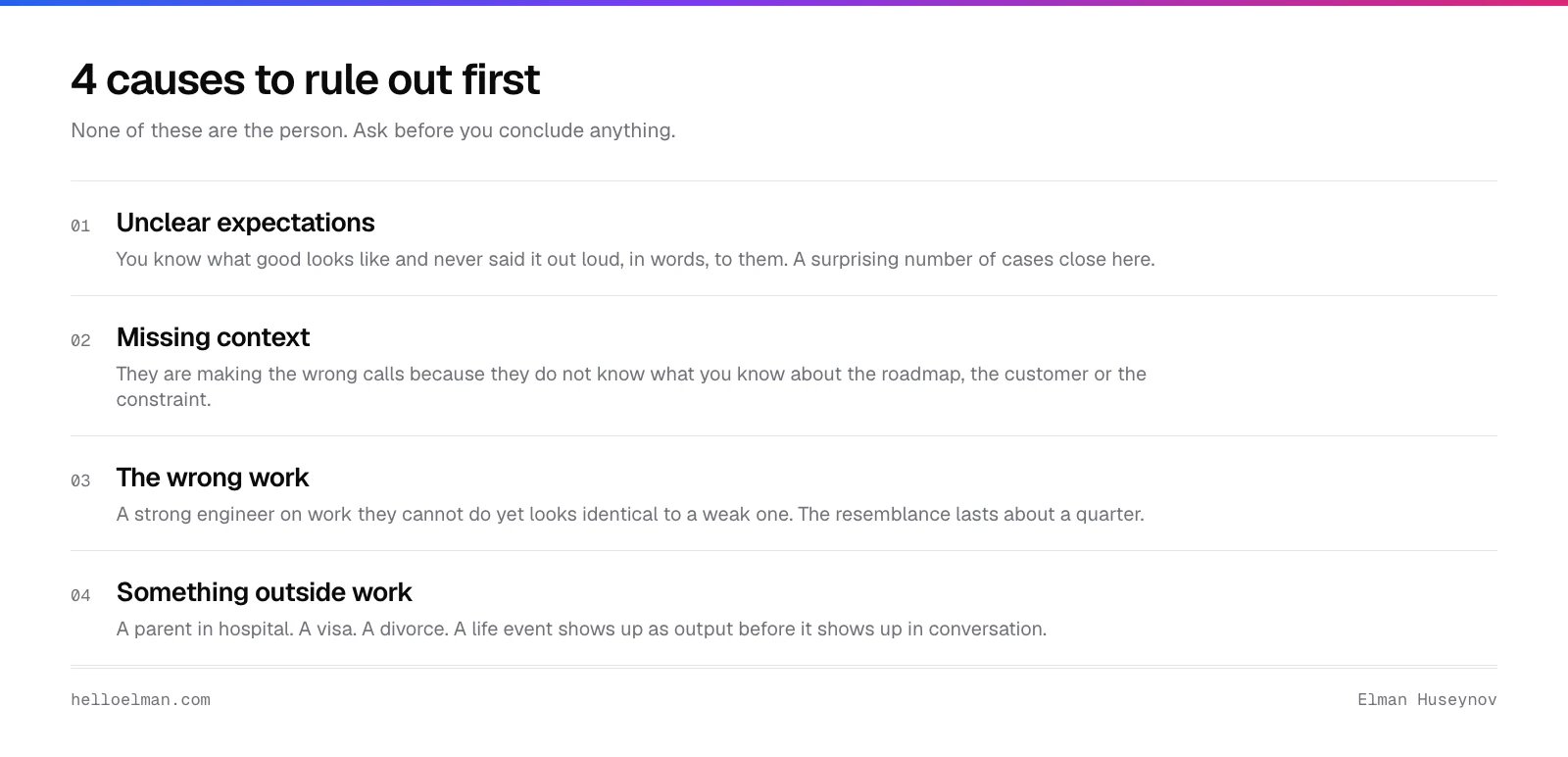
Unclear expectations, missing context, the wrong work, and something outside work. None of those are the person.
If it is genuinely performance, say the specific instance and the standard. Ask. Agree 1 or 2 changes with a date.
On this page
Say what happens if nothing moves.
You have known for about 6 weeks and said nothing clearly. Every week you wait, it gets harder.
Underperformance is where a 1:1 matters most.
First question: is it performance at all?
Unclear expectations.
Have you said what good looks like, out loud, to them? A surprising number of cases close here.
Missing context. They make the wrong calls because they do not know what you know.
The wrong work. A strong engineer on unfamiliar work looks identical to a weak one. For about a quarter.
Something outside work. A parent in hospital, a visa, a divorce. It shows up as output before it shows up in conversation.
Ask before you conclude. “The last 2 tickets took longer than we expected. What is your read on it?”
The answer usually decides which of the 4 you are in.
How do you talk to an underperforming employee?
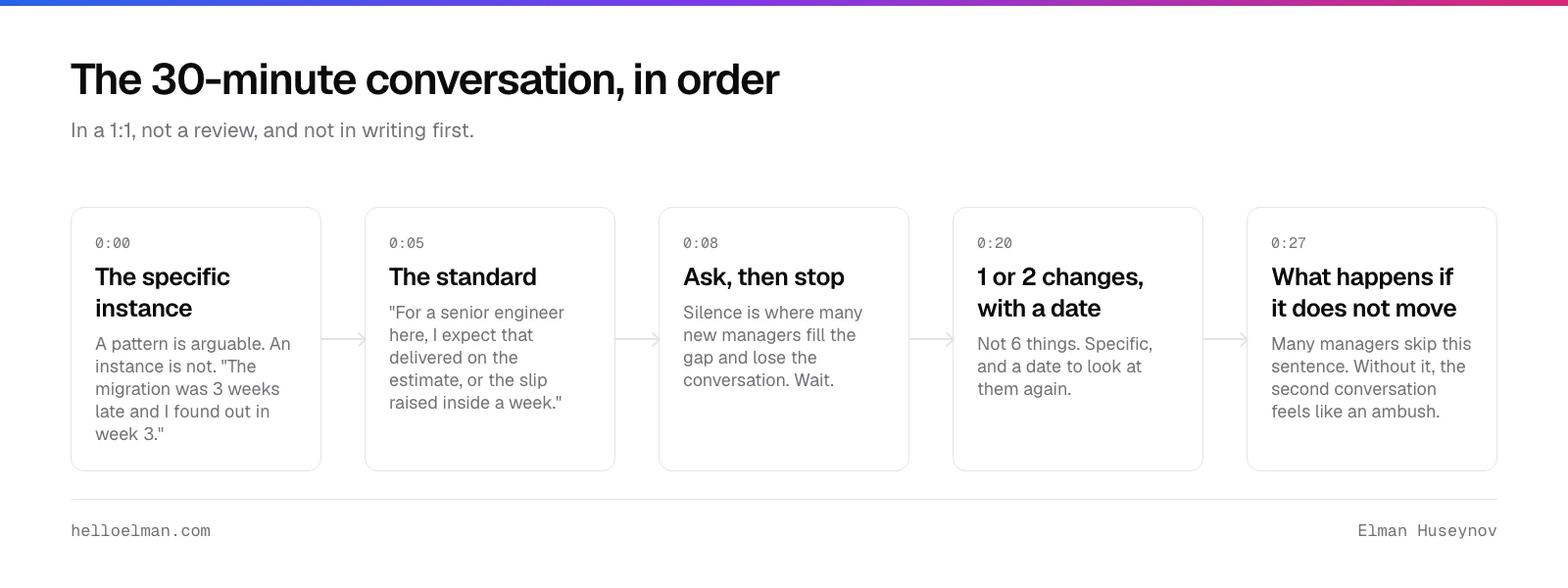
In a 1:1, not a review, and not in writing first. 30 minutes, in this order.
The specific instance.
“The payments migration was 3 weeks late and I found out in week 3.” A pattern is arguable. An instance is not.
The standard.
“For a senior engineer here, I expect that project on the estimate. Or to hear about the slip inside a week.”
Ask, then stop talking. Silence is where many new managers fill the gap and lose the conversation. Wait.
Agree 1 or 2 changes and a date. Not 6 things.
Say what happens if it does not. “If this has not moved by March, we talk about whether this role fits.”
Write down what you both agreed and send it to them the same day.
What should you write down?
Date, what you said, what they said, what you agreed. After every conversation, from the first.
Difficult conversations compress in memory, on both sides.
In 4 months you will not remember your wording. “This needs to change” or “it would be good if”.
If it ever becomes formal, HR asks when you first said it. Dated notes give you options.
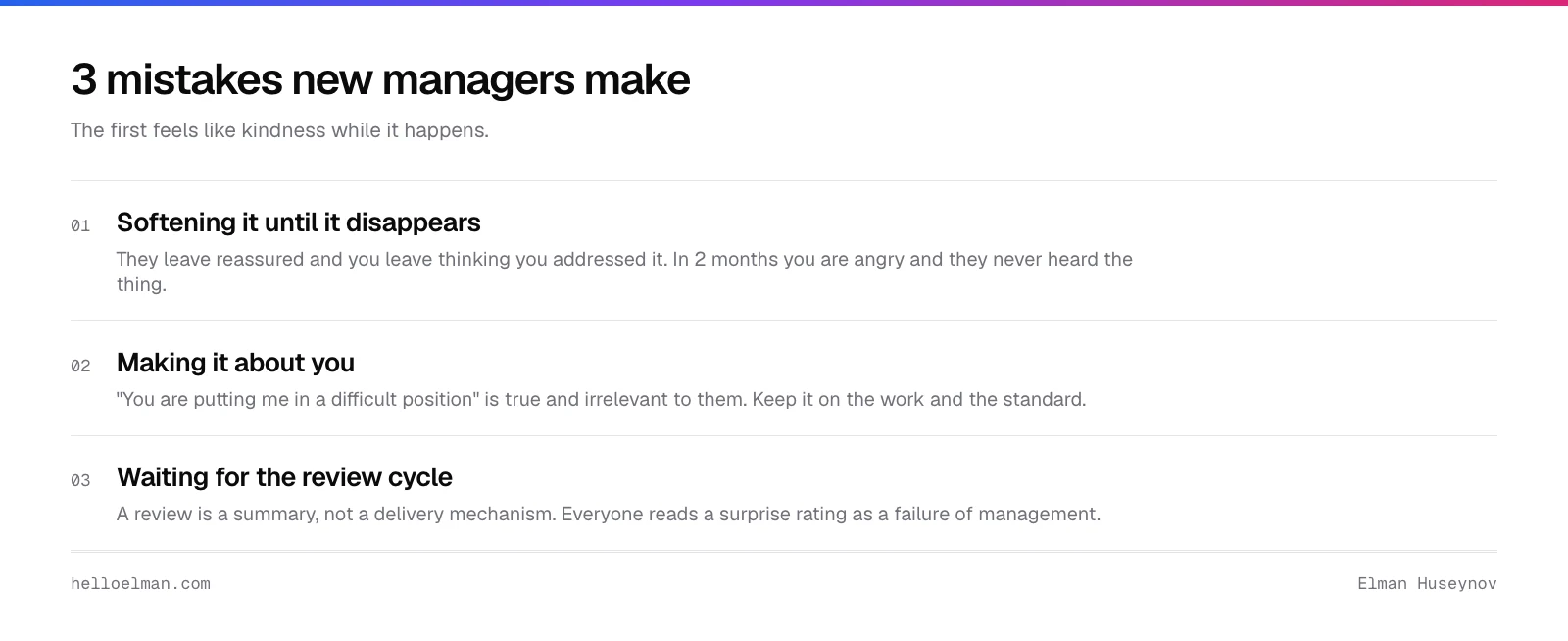
The 3 mistakes new managers make
Softening it until it disappears.
“Just checking in, no big deal.” In 2 months you are angry at someone who never heard the request.
Say the hard sentence in the first 2 minutes. Everything after it can be warm.
Making it about you.
“You are putting me in a difficult position.” True, and irrelevant to them. Stay on the work and the standard.
Waiting for the review cycle. A rating should never be the first time someone hears about a problem.
Your own manager reads a surprise rating as a failure of management.
What if it does not improve?
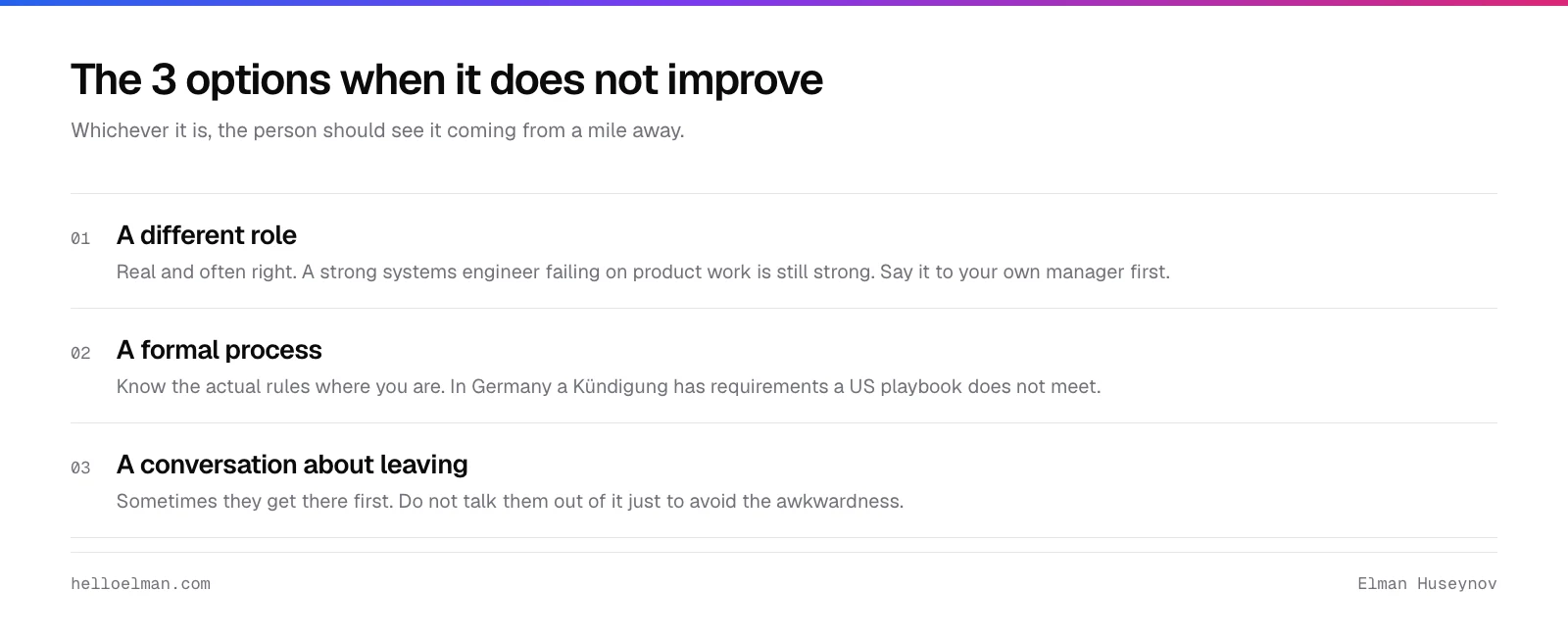
If the plan fails, three options exist.
A different role. A strong systems engineer failing on product work is still strong. Say this to your own manager first.
A formal process. Often the outcome is already decided.
Know the rules where you are. In Germany, after 6 months a dismissal needs a reason the law accepts.
The rule covers firms with more than 10 staff. A works council must be heard first. The notice must be on paper.
Not legal advice. Talk to HR or an employment lawyer before any formal step.
A conversation about leaving. The person sometimes gets there first. Do not talk them out of it.
The part nobody warns you about
The case takes up more of your head than it should. You draft it in the shower and avoid the person in the kitchen.
Put the conversation on the calendar, so the decision is made rather than pending.
Tell your own manager early, so you are not carrying it alone.
After the first one it gets easier. What makes it hard is not having had one before.
Common questions
How long should you wait before saying something?
Two weeks of a clear pattern, not 6. Every week you do not say it, the conversation gets harder. Your credibility with the rest of the team gets thinner. The team already knows. What they are watching is whether you do anything, and how long you take.
Does a performance improvement plan actually work?
Sometimes, and it is also a documentation step. Know the actual rules where you are. In Germany a dismissal after 6 months needs a reason the law accepts. This applies in firms of more than 10 staff. A works council must be heard first. Get your own HR and legal read before you start one.
What do you tell the rest of the team?
Nothing about the individual, and something about the standard. The team has noticed and silence reads as tolerance. You can say the migration was late, and what you are changing. Without naming a person or a conversation. Anything more specific is a trust problem you create yourself.
How do you avoid the person being surprised?
Put the consequence in the first conversation, not the third. If we get to the end of March and this has not moved. Then we are talking about whether this is the right role. Many managers skip that sentence. Without it, the second conversation feels like an ambush.
How do you manage an underperforming employee?
First establish whether it is performance at all. Unclear expectations and a bad fit of task to person look identical from outside. So does a life event. Then say it plainly, in private, with 2 specific examples. Write down what changes and by when.
The short version
Rule out expectations, context, work and life before you call it performance.
Say the specific instance and the standard. Ask. Agree 1 or 2 changes with a date.
Say what happens if nothing moves. Write it down the same day.
Do not soften it into nothing. Do not wait for the review. Never let it be a surprise.
To practise the conversation under pressure, book a leadership mock interview. I play the person you are dreading.
The 90-day version is in your first 90 days as an engineering manager.