11 Resume Mistakes That Get Software Engineers Screened Out
Related service: Resume and CV review
The resume mistakes that get a software engineer screened out share one shape.
A line a mediocre engineer at the same company could write truthfully.
Responsible for the backend services. Passionate about clean code. Improved application performance.
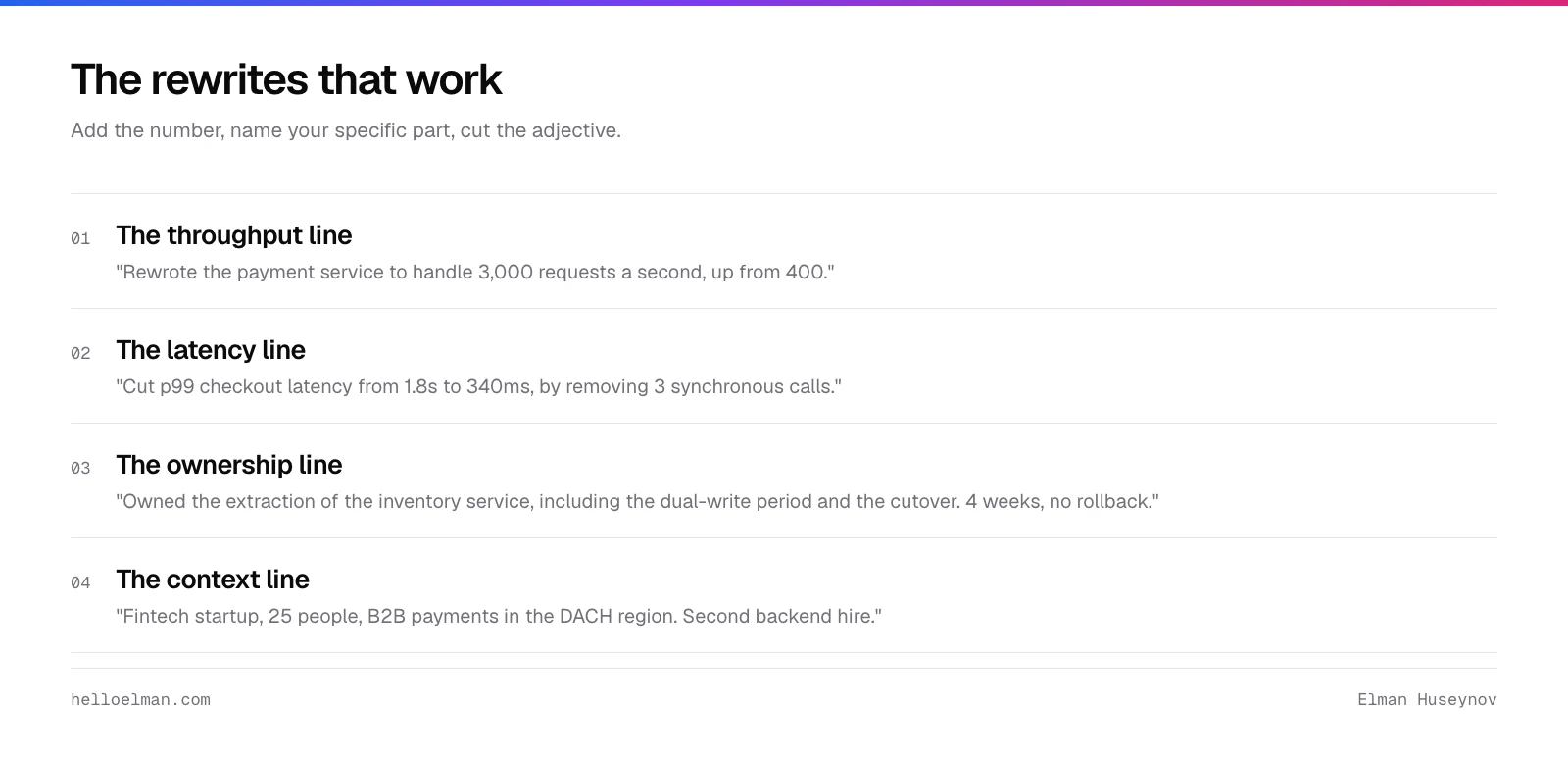
The fix is nearly always the same. Add the number, name your specific part, cut the adjective.
On this page
The 11 lines below are patterns I see in resumes before interviews. Details changed, shape kept.
Which resume mistakes does a screener catch in 20 seconds?
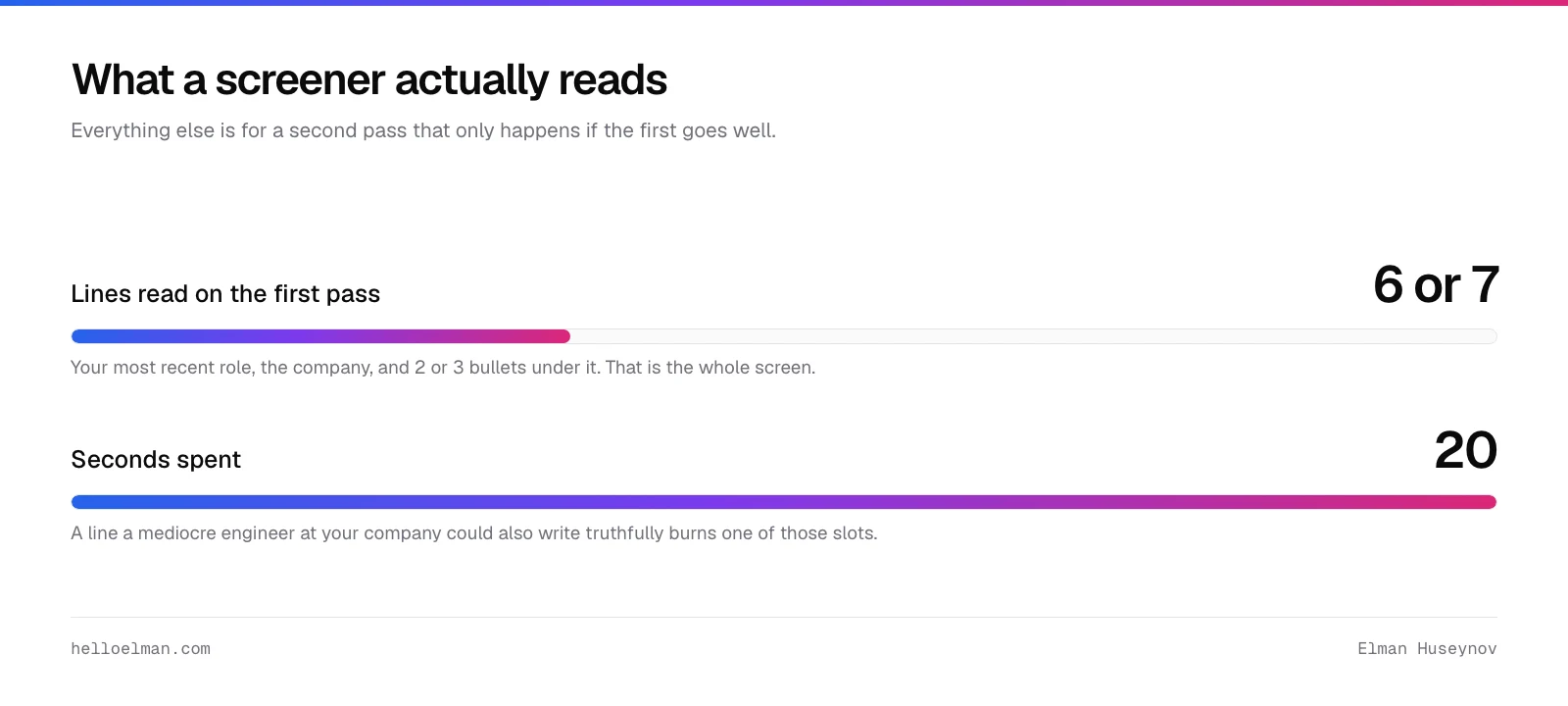
A screener reads 6 or 7 lines. Your most recent role, the company, and 2 or 3 bullets under it.
A line that fits someone else’s resume unchanged burns one of those slots.
The 11 mistakes below all fail that same test.
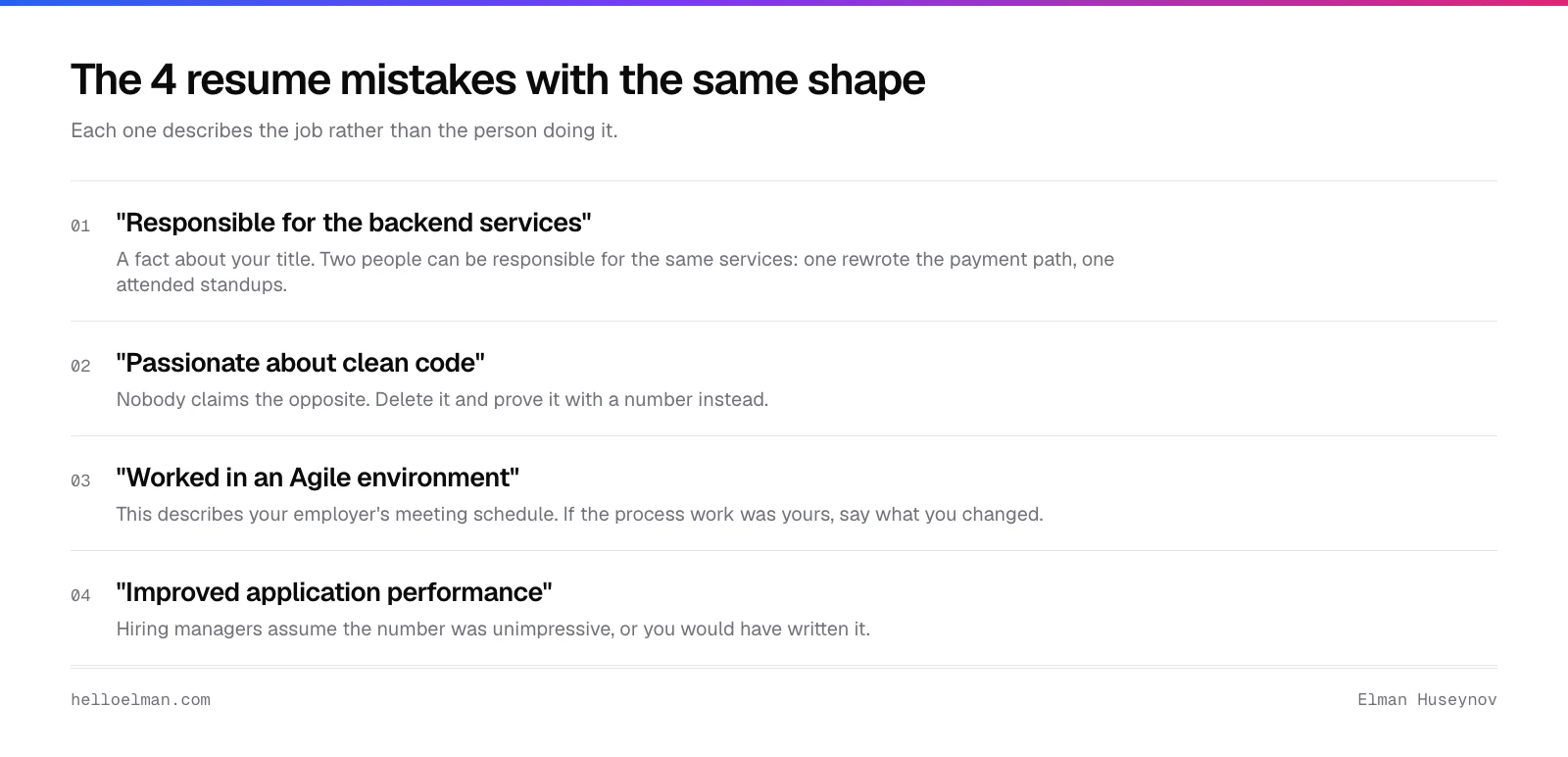
1. What is wrong with “Responsible for the backend services”?
A fact about your title, not about you. Two people can be responsible for the same services.
One rewrote the payment path. The other attended standups.
Rewrite: “Rewrote the payment service to handle 3,000 requests a second, up from 400.”
2. “Passionate about writing clean code”
Everyone claims this. Nobody claims the opposite.
Rewrite: delete it. Care about quality? Show coverage that moved or incidents that dropped.
3. “Worked in an Agile environment using Scrum”
The line describes your employer’s meeting schedule.
Rewrite: delete. Was the process work yours? “Cut the release cycle from 2 weeks to twice a week.”
4. “Improved application performance”
By how much? From what to what? Hiring managers assume the number was unimpressive, or you would have written it.
Rewrite: “Cut p99 checkout latency from 1.8s to 340ms, by removing 3 synchronous calls.”
5. “Familiar with AWS, Azure, GCP, Kubernetes, Docker, Terraform, Ansible, Jenkins, Kafka, Redis…”
A 20-item list means shallow exposure to all, or deep skill in 3, buried. Both readings hurt.
Rewrite: group and cut. 4 categories, 4 or 5 items each, nothing you would not want interviewing on.
6. “Team player with excellent communication skills”
The interview tests this directly. Claiming it in advance costs a line.
Rewrite: “Wrote the design doc that 3 teams built against.”
7. “Startup, Berlin. Software Engineer. 2022 to 2023.”
No scale. I cannot tell 4 people from 400. I will not look it up while screening.
Rewrite: “Fintech startup, 25 people, B2B payments in the DACH region. Second backend hire.”
8. “Contributed to the migration to microservices”
There were probably 15 people on that migration. Vagueness here reads as borrowing credit.
Rewrite: “Owned the extraction of the inventory service, including the dual-write period and the cutover. 4 weeks, no rollback.”
9. A skills section with progress bars
Python at 90%. 90 percent of what?
Meaningless to a human, invisible to a parser, and a third of a page gone.
Rewrite: plain text lists, grouped.
10. “References available upon request”
Everyone knows. Rewrite: delete, and use the line for something that helps you.
11. 6 bullets on the job you left 5 years ago
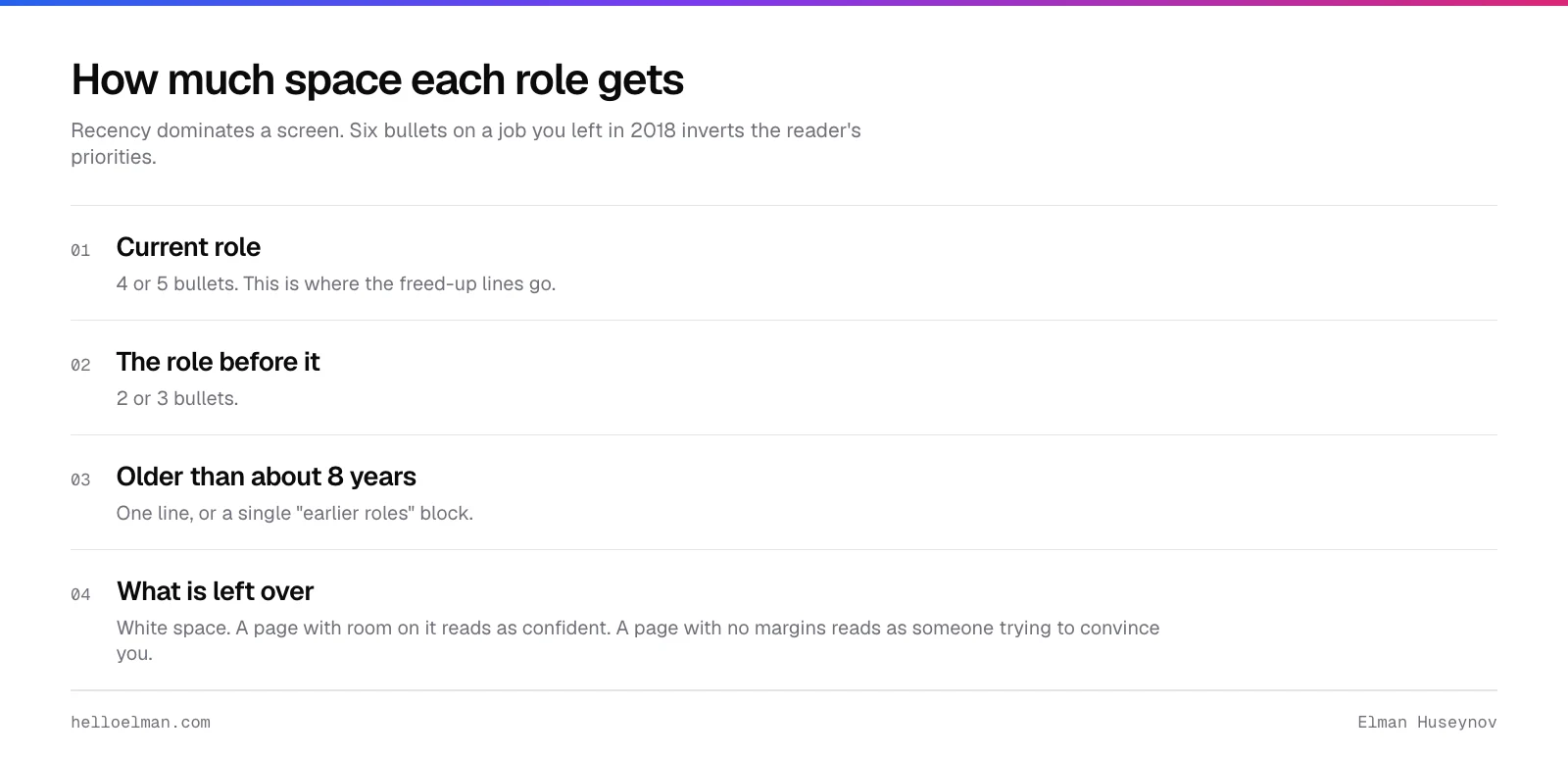
Recency dominates a screen. Your oldest role should not get the same space as your current one.
Rewrite: current role 4 or 5 bullets, the one before 2 or 3. Older than 8 years: 1 line, or an “Earlier roles” block.
What do all 11 resume mistakes have in common?
Every one could appear on someone else’s resume without changing meaning. They describe a job rather than a person.
A resume line works when only you could write it truthfully. The number and your own specific part make that true.
How do you find the mistakes in your own resume?
Read each line. Could a mediocre engineer at your company write it truthfully?
If yes, the line is not working. Expect to fail 6 to 10 of them.
You will free 6 to 10 lines. Spend 2 or 3 on your most recent role. Leave the rest as white space.
A page with room on it reads as confident. A page with no margins reads as someone trying to convince you.
Common questions
Should you ever use the word passionate on a resume?
No, and the same goes for driven, dedicated and enthusiastic. Nobody writes the opposite. The word carries no information and costs a line in a 20-second read. If the feeling is real, it shows up as something you did. Outside the job description, with a number attached.
What if you genuinely do not have numbers?
You almost certainly do, and you have not looked. Time before and after. Requests, users or markets. Incidents, coverage, deploy frequency, people hired or mentored. If the exact figure is confidential, use a ratio. “Cut provider cost by roughly a third” works. “Improved cost efficiency” does not.
How much space should an old job get?
Your current role gets 4 or 5 bullets. The one before it gets 2 or 3. Anything older than about 8 years gets a single line, or an “earlier roles” block. Recency dominates a screen. 6 bullets on a job you left in 2018 inverts the reader’s priorities.
Do skill progress bars actually hurt you?
Yes, in 3 ways. They mean nothing to a human. Python at 90% is 90 percent of an undefined thing. They are invisible to a parser. And they take up a third of a page. The page then reads as a template rather than a considered document.
What are the most common resume mistakes?
Describing the job instead of the work. “Responsible for the backend services” says nothing. The other repeat offenders are adjectives with no evidence. A skills list with 20 tools. Old jobs given as much space as recent ones. All of them waste a 20-second read.
The short version
Delete anything a mediocre engineer could also write. Add a number to every claim. Give each company 1 line of scale.
Spend your space on the last 3 years.
The full structure is in the software engineer resume that passes ATS and humans.
The free resume checker runs 10 checks on yours in a second.
To have this done to yours line by line, book a resume review. A 60-minute call and a written report within 48 hours.